
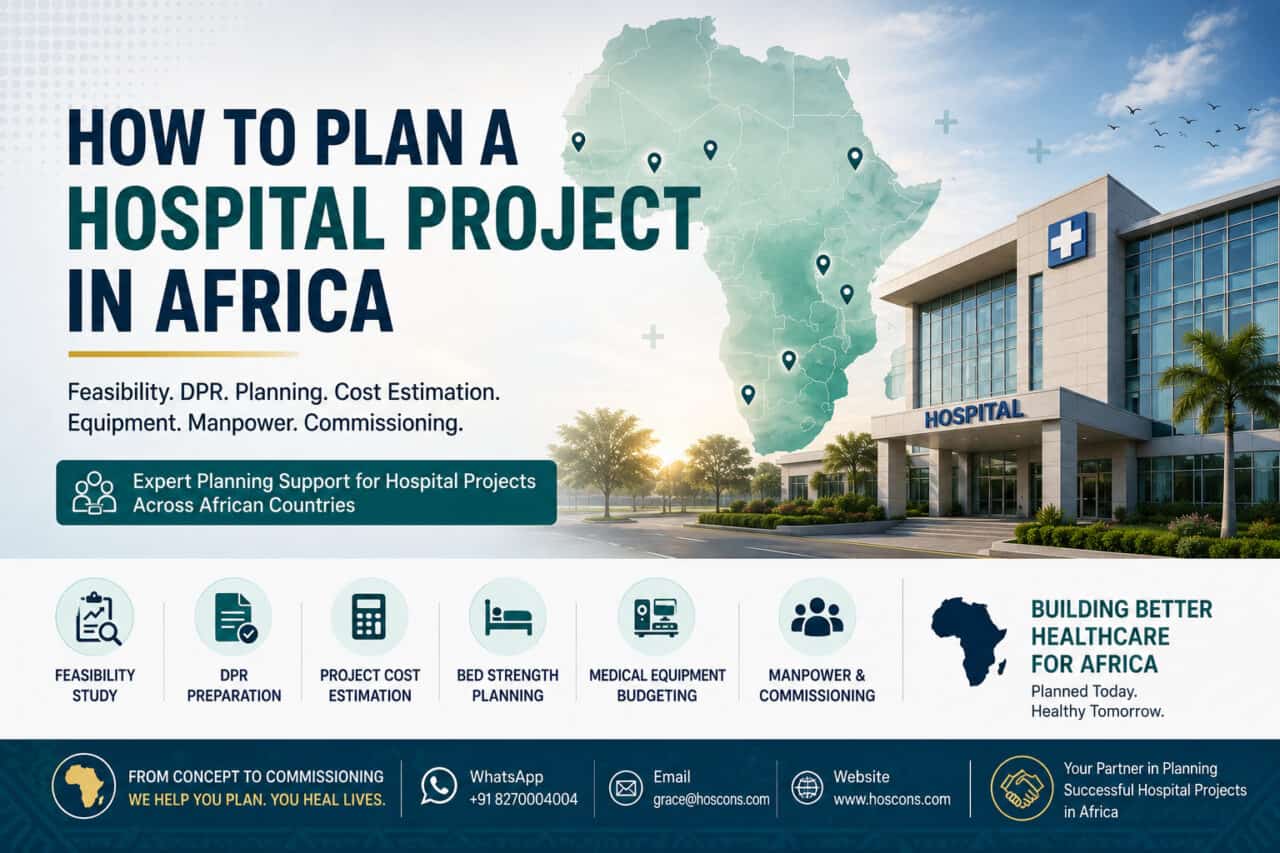
A hospital project in Africa should be planned with a clear feasibility study, DPR, project cost estimate, bed strength plan, service mix, manpower plan and commissioning strategy before major investment is committed.
Hospital Project in Africa: Feasibility, DPR and Planning Support
Planning a hospital project in Africa requires more than land, building and medical equipment. A successful hospital project needs demand validation, bed strength planning, service mix selection, project cost estimation, medical equipment budgeting, manpower planning, licensing guidance and commissioning support.
HOSCONS supports doctors, investors, healthcare entrepreneurs, trusts, NGOs, churches, diaspora promoters and healthcare groups who are planning new hospitals, nursing homes, specialty centres, clinics, diagnostic centres or hospital expansion projects in African countries.
This guide explains how to plan a hospital project in Africa in a structured way — from feasibility study and DPR preparation to project cost, hospital design planning, manpower, equipment and launch readiness.
Planning a Hospital Project in Africa?
HOSCONS can support your hospital project in Africa with feasibility study, DPR preparation, project cost estimation, bed strength planning, department planning, medical equipment budgeting, manpower planning and commissioning advisory.
Hospital Project in Africa: Key Planning Requirements
Every hospital project should be customized to the local market. A model that works in one African country or city may not work in another. The right plan depends on healthcare demand, disease burden, affordability, payer mix, manpower availability, infrastructure readiness and local regulations.
A properly planned hospital project in Africa should answer these important questions:
- Is there enough demand in the proposed location?
- What type of hospital or healthcare facility is suitable?
- What specialties should be planned?
- How many beds are required?
- What is the estimated project cost?
- What medical equipment will be required?
- What manpower is needed?
- What will be the expected revenue and break-even period?
- Should the project be implemented in phases?
HOSCONS Insight
The first question should not be “How many beds can we build?” The better question is “What healthcare model is viable for this location, investment level and patient demand?”
Who Can Benefit from HOSCONS Africa Hospital Project Support?
| Promoter Type | How HOSCONS Can Support |
|---|---|
| Doctors and clinical entrepreneurs | New hospital, clinic, nursing home, specialty centre or diagnostic project planning. |
| Investors and business groups | Feasibility study, DPR, project cost estimate, revenue potential and break-even assessment. |
| Trusts, churches and NGOs | Mission hospital, community hospital, affordable healthcare project or donor-supported project planning. |
| Diaspora promoters | Remote planning support, concept validation, DPR preparation and phased implementation guidance. |
| Existing hospitals | Expansion planning, department addition, equipment planning, operational gap audit and revenue improvement. |
African Countries Where HOSCONS Can Support Hospital Planning
HOSCONS can support early-stage planning for a hospital project in Africa through remote and hybrid consulting models. This may include projects in South Africa, Botswana, Namibia, Zambia, Zimbabwe, Mozambique, Malawi, Kenya, Tanzania, Uganda, Rwanda, Ethiopia, Ghana, Nigeria and other African markets, depending on project scope and engagement model.
Remote + Hybrid Advisory Model
Feasibility study, DPR preparation, bed strength planning, project cost estimation, area statement, equipment budgeting and financial projections can often be supported remotely. Site visits, local validation and implementation advisory can be planned separately based on project requirement.
Step 1: Define the Hospital Project Concept
A hospital project in Africa should begin with a clear concept. The concept should define whether the project is a clinic, nursing home, secondary care hospital, multispecialty hospital, specialty centre, diagnostic centre, day care surgical centre or community hospital.
The concept should answer:
- Who will the hospital serve?
- What healthcare gaps exist in the location?
- What services are most needed?
- What is the expected paying capacity of patients?
- Will the project serve private, insured, corporate, community or donor-supported patients?
- Should the project be developed in phases?
Step 2: Conduct a Hospital Feasibility Study
A feasibility study is the most important starting point before committing major investment. It helps promoters understand whether the proposed hospital project in Africa is viable in the selected location.
A hospital feasibility study should assess:
- Catchment population and healthcare demand
- Existing hospitals and competition
- Disease burden and specialty gaps
- Patient affordability and payer mix
- Doctor and manpower availability
- Expected OP and IP volume
- Bed strength requirement
- Project cost and funding requirement
- Revenue potential and break-even period
- Key risks and mitigation strategy
Common Mistake
Many promoters start with building design or equipment purchase before conducting a feasibility study. This can lead to wrong bed strength, wrong service mix, excess project cost and poor utilization after launch.
Step 3: Prepare a Detailed Project Report
A Detailed Project Report, or DPR, converts the hospital idea into a structured project plan. For a hospital project in Africa, a DPR is useful for investors, banks, boards, trusts, donors and internal decision-making.
A hospital DPR may include:
- Executive summary
- Project concept and vision
- Location and catchment overview
- Demand assessment
- Recommended specialty mix
- Recommended bed strength
- Department planning
- Area statement
- Medical equipment budget
- Furniture and fixture estimate
- Project cost estimate
- Manpower plan
- Revenue assumptions
- Operating cost assumptions
- Break-even estimate
- Implementation timeline
- Risk assessment
Step 4: Decide the Right Bed Strength
Bed strength should be based on demand, service mix, admissions potential, average length of stay, occupancy target, manpower availability and investment capacity.
| Project Size | Suitable For | Planning Focus |
|---|---|---|
| 10–30 beds | Small hospital, nursing home, maternity centre, surgical centre | Control fixed cost and focus on high-demand services. |
| 30–50 beds | Secondary care hospital or small multispecialty hospital | Balance OP, IP, emergency, ICU, OT and diagnostics. |
| 50–100 beds | Growing multispecialty hospital | Needs stronger doctor network, equipment planning and working capital. |
| 100+ beds | Large multispecialty or tertiary care hospital | Requires strong feasibility, funding, leadership and operating systems. |
Step 5: Estimate the Full Hospital Project Cost
Hospital project cost should include much more than civil construction. A realistic estimate helps the promoter understand funding requirement and avoid mid-project financial stress.
| Cost Component | Why It Matters |
|---|---|
| Land and site development | Access, parking, frontage and future expansion depend on site planning. |
| Civil construction | Core building structure and hospital spaces. |
| MEP, fire safety and utilities | Electrical, plumbing, HVAC, fire systems, medical gas and backup systems. |
| Medical equipment | ICU, OT, emergency, diagnostics, laboratory and ward equipment. |
| Furniture, interiors and IT | Patient rooms, reception, nurse stations, HIS, CCTV and communication systems. |
| Pre-opening and working capital | Recruitment, training, launch marketing and early operating support. |
Step 6: Plan Equipment, Manpower and Commissioning
A hospital can be built, but it cannot function without the right equipment, trained manpower and operational systems. Therefore, equipment planning, manpower planning and commissioning should start before the hospital is ready for launch.
Important planning areas include:
- Medical equipment list and budget
- Vendor identification and procurement timeline
- Clinical manpower requirement
- Nursing and technical manpower
- Hospital administrator and department heads
- SOPs and operational policies
- Licensing and approval checklist
- Pre-opening recruitment and training
- Trial runs and commissioning plan
A successful hospital project in Africa should be supported by demand analysis, local market understanding, practical infrastructure planning, realistic project cost estimation and a clear implementation roadmap.
Planning a Hospital Project in Africa? Share Your Requirement
Request Hospital Project Guidance from HOSCONS
If you are planning a hospital project in South Africa, Botswana, Namibia, Zambia, Zimbabwe, Mozambique, Malawi, Kenya, Tanzania, Uganda, Rwanda, Ethiopia, Ghana, Nigeria or any other African country, share your basic project details with us.
HOSCONS can support you with feasibility study, DPR preparation, project cost estimation, bed strength planning, department planning, medical equipment budgeting and commissioning advisory.
Please share your country, city, project type, proposed bed strength, land status and support required. Our team will review your requirement and guide you on the next steps.
Suggested Details to Share with HOSCONS
- Country and city / location
- New project or expansion project
- Land available or yet to be identified
- Proposed bed strength
- Type of hospital or healthcare facility planned
- Estimated investment range
- Stage of project planning
- Support required: feasibility, DPR, cost estimate, planning, equipment or commissioning
- Preferred mode of engagement: remote or hybrid advisory
How HOSCONS Can Support Hospital Projects in Africa
HOSCONS is an India-based healthcare consulting firm supporting hospital promoters with structured project planning, feasibility studies, DPR preparation and hospital advisory services.
Our support may include:
- Hospital feasibility study
- Detailed Project Report preparation
- Hospital project cost estimation
- Bed strength and service mix planning
- Department planning and area statement
- Medical equipment budgeting
- Furniture and fixture budgeting
- Manpower planning
- Revenue and break-even projections
- Licensing guidance and approval checklist
- Pre-opening and commissioning advisory
- Hospital operations planning
Get Expert Guidance for Your Hospital Project in Africa
Whether you are planning a small hospital, specialty centre, diagnostic unit, nursing home, multispecialty hospital or hospital expansion project, structured planning can reduce risk and improve project viability.
HOSCONS can support your project through feasibility study, DPR, cost estimation, hospital planning and commissioning advisory.
WhatsApp: +91 8270004004
Email: grace@hoscons.com
Website: www.hoscons.com
External Reference for Healthcare Infrastructure Planning
Hospital promoters should also consider healthcare access, patient safety and system sustainability while planning infrastructure.
The World Health Organization provides useful global references on health systems, access and healthcare infrastructure priorities.
Frequently Asked Questions
1. How do I start planning a hospital project in Africa?
Start with a feasibility study to assess demand, location, competition, specialty mix, investment requirement, manpower availability, project cost and financial viability.
2. Can HOSCONS support hospital projects in Africa remotely?
Yes. Early-stage planning activities such as feasibility study, DPR preparation, bed strength planning, cost estimation, area statement and equipment budgeting can be supported remotely. Site visits can be planned separately if required.
3. What services can HOSCONS provide for hospital projects in Africa?
HOSCONS can support feasibility study, DPR preparation, project cost estimation, specialty planning, bed strength planning, area statement, medical equipment budgeting, manpower planning and commissioning advisory.
4. Which African countries can HOSCONS support?
HOSCONS can support hospital project planning for promoters in South Africa, Botswana, Namibia, Zambia, Zimbabwe, Mozambique, Malawi, Kenya, Tanzania, Uganda, Rwanda, Ethiopia, Ghana, Nigeria and other African countries, depending on project scope.
5. Is a DPR required for hospital projects in Africa?
A DPR is strongly recommended for hospital projects because it helps estimate project cost, service mix, bed strength, equipment budget, manpower, revenue potential, break-even and implementation timeline.
Related HOSCONS Resources
- Hospital Setup Cost in India
- How to Calculate Hospital Construction Cost Per Sq Ft in India
- Hospital Bed Strength Planning for New Hospital Projects
- Hospital Project Planning: Step-by-Step Guide & Checklist
- Why Feasibility Study is Important Before Building a New Hospital
- Bank Loans for Hospital Projects: What Banks Expect in a DPR