
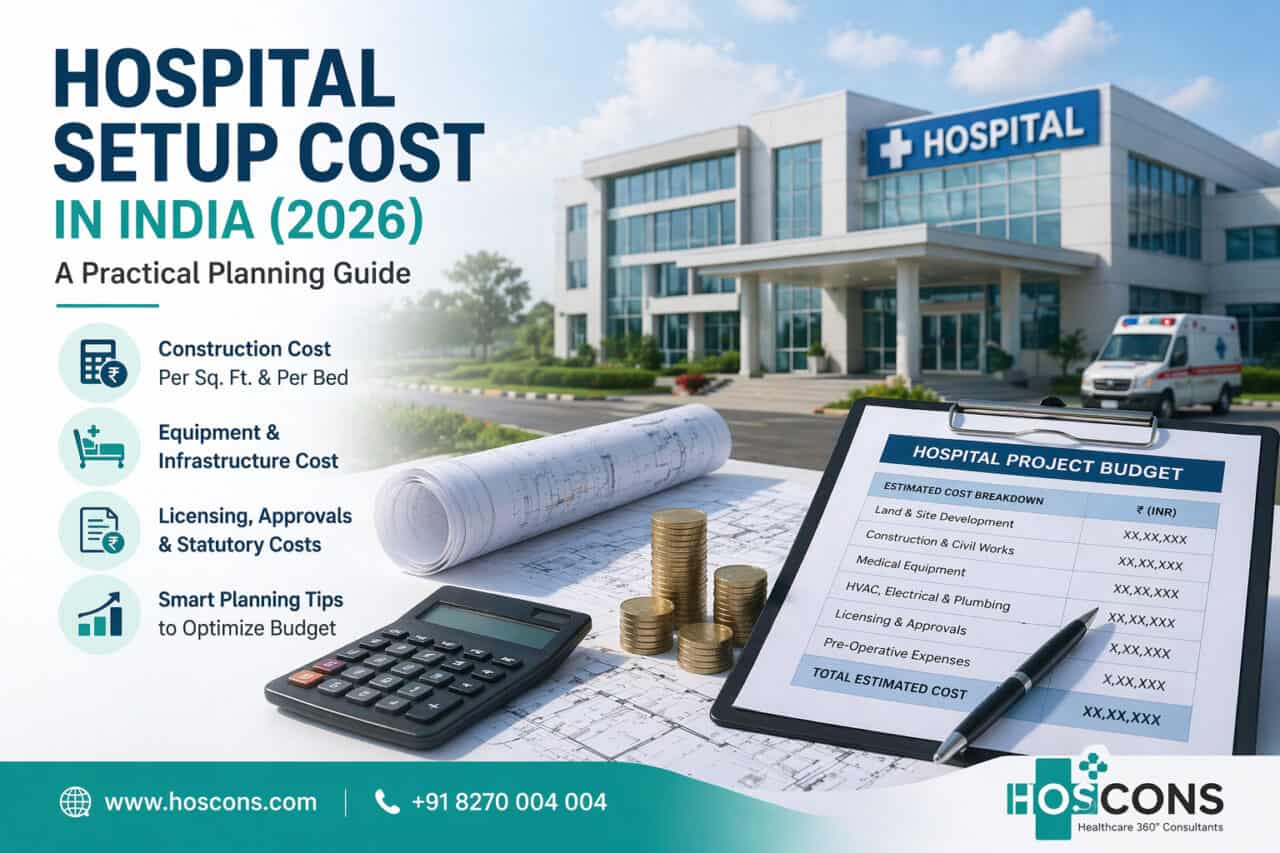
Hospital Setup Cost in India (2026): Real Project Cost Guide
For most doctor-promoters, hospital investors, trusts, institutions and healthcare entrepreneurs, the first question before starting a hospital is simple:
“How much will it really cost to set up a hospital in India?”
In 2026, the hospital setup cost in India is no longer a fixed number. Two hospitals with the same bed strength can differ in project cost by ₹10–20 crore depending on location, land cost, specialty mix, competition, equipment planning, manpower strategy, statutory approvals and execution quality.
This is where many new hospitals go wrong — not because of lack of funds, but because of wrong assumptions made before the project starts.
This guide explains the true cost structure of setting up a hospital in India, bed-wise hospital project cost, land requirement, built-up area, equipment budget, total investment range, major cost components and why market survey and feasibility study are non-negotiable before starting a hospital project.
Quick Cost Snapshot — Hospital Setup Cost in India
20 bed hospital — ₹8–15 crore
30 bed hospital — ₹12–20 crore
50 bed hospital — ₹15–30 crore
100 bed hospital — ₹30–60 crore
150+ bed multispecialty hospital — ₹60–120+ crore
Major Cost Components of a Hospital Project
Hospital Setup Cost in India: Key Factors That Influence Project Budget
1. Land & Location Cost
Land cost varies widely and directly impacts project feasibility.
- Tier-1 city: ₹30–80 crore or more
- Tier-2 city: ₹5–20 crore
- Tier-3 town: ₹1–5 crore
But location is not about price alone. Wrong location = low OPD, weak referrals, long break-even and poor brand acceptance, even if construction is cheap.
This is why catchment analysis and market survey matter more than land rate alone.
2. Construction & Civil Cost
| Hospital Type | Typical Construction Cost / Sq Ft |
|---|---|
| Basic hospital | ₹2,500 – ₹3,200 |
| Standard multispecialty hospital | ₹3,200 – ₹4,500 |
| Premium / corporate hospital | ₹4,500 – ₹6,500+ |
Hospitals are not residential buildings. Medical gas pipelines, infection control zoning, OT planning, HVAC, fire compliance, biomedical waste flow, patient movement, service movement and MEP coordination all add cost.
👉 Bad design decisions made early are very expensive to correct later.
3. Medical Equipment Cost
This is where many hospital promoters overspend.
- OT equipment
- ICU equipment
- CT / MRI / imaging
- Endoscopy / cath lab / dialysis
- Lab automation
- CSSD equipment
- Biomedical equipment for wards and emergency
Without a market-linked service mix, hospitals either:
- Buy expensive equipment that stays under-utilised
- Miss high-demand services their market actually needs
- Lock capital into departments that do not generate enough revenue
👉 Equipment planning must come after market demand study, not before.
4. Interiors, IT & Non-Medical Infrastructure
Often ignored in early budgeting:
- Nurse stations and patient rooms
- Reception, billing, counselling and waiting areas
- HIS, PACS, LIS and billing systems
- Nurse call systems
- CCTV and access control
- Furniture and soft furnishing
- Signages and wayfinding
- Branding and patient experience elements
These can easily add 10–15% to project cost, especially if planned late.
5. Statutory Approvals, Licensing & Compliance Cost
Every hospital project must budget for statutory approvals and compliance requirements. These may include:
- Building plan approval
- Fire NOC
- Clinical Establishment Registration / State Health Department licensing
- Pollution Control Board approvals
- Biomedical Waste Management authorization
- Lift license
- Pharmacy license
- AERB approval for X-ray / CT / radiology equipment
- NABH readiness support, where applicable
Ignoring approvals at the planning stage can delay hospital opening and increase project cost.
6. Pre-Opening Expenses & Working Capital
This is one of the most underestimated parts of hospital budgeting.
Includes:
- Staff recruitment and training
- Salaries before break-even
- Pharmacy stocking
- Consumables
- Marketing and launch expenses
- Doctor engagement and referral development
- Initial operating losses
👉 Many hospitals fail not during construction, but within the first 12–18 months of operations due to poor working capital planning.
Why “Cost per Bed” Is a Dangerous Way to Plan a Hospital
You will often hear figures like:
- ₹60–70 lakh per bed
- ₹1 crore per bed
- ₹1.5 crore per bed for premium hospitals
These numbers are misleading.
In reality, hospital cost is driven by:
- City vs town vs semi-urban location
- Land availability and land cost
- Competition density within 10–15 km
- Specialty mix and case mix
- OPD vs IPD dependency
- Medical college or referral ecosystem
- Local affordability and payer mix
- ICU, OT, diagnostics and equipment strategy
- Manpower availability and salary structure
Hospital Setup Cost by Bed Strength in India (2026)
One of the most common questions asked by hospital promoters is: “How much does a 20, 30, 50 or 100 bed hospital cost in India?”
While the final project cost depends on location, land ownership, building design, specialty mix, diagnostics, ICU beds, operation theatres, equipment planning and working capital, the following table gives a practical starting point for hospital budgeting.
| Hospital Size | Suggested Land Requirement | Approx. Built-up Area | Equipment Budget | Total Investment Range |
|---|---|---|---|---|
| 20 Bed Hospital | 0.25–0.50 acre | 10,000–15,000 sq ft | ₹2–4 crore | ₹8–15 crore |
| 30 Bed Hospital | 0.40–0.75 acre | 15,000–20,000 sq ft | ₹3–5 crore | ₹12–20 crore |
| 50 Bed Hospital | 0.50–1.00 acre | 20,000–30,000 sq ft | ₹4–8 crore | ₹15–30 crore |
| 100 Bed Hospital | 1.00–2.00 acres | 40,000–60,000 sq ft | ₹10–20 crore | ₹30–60 crore |
| 200 Bed Hospital | 2.00–4.00 acres | 80,000–120,000 sq ft | ₹25–45 crore | ₹60–120 crore+ |
20 Bed Hospital Project Cost in India
A 20 bed hospital project in India typically requires an investment of approximately ₹8–15 crore, depending on location, land ownership, specialty mix, diagnostic facilities and construction specifications.
| Parameter | Typical Requirement |
|---|---|
| Land Requirement | 0.25–0.50 Acre |
| Built-up Area | 10,000–15,000 Sq Ft |
| Equipment Budget | ₹2–4 Crore |
| Total Investment | ₹8–15 Crore |
A 20 bed hospital is usually suitable for small towns and emerging healthcare markets. Typical departments include emergency care, OPD consultations, pharmacy, laboratory, labour room, minor OT, basic imaging and inpatient wards.
Many promoters start with a 20 bed facility and later expand based on demand. Proper market assessment is essential to determine whether the catchment can support future growth.
30 Bed Hospital Project Cost in India
A 30 bed hospital in India generally requires an investment of around ₹12–20 crore, depending on project location, service offerings and infrastructure standards.
| Parameter | Typical Requirement |
|---|---|
| Land Requirement | 0.40–0.75 Acre |
| Built-up Area | 15,000–20,000 Sq Ft |
| Equipment Budget | ₹3–5 Crore |
| Total Investment | ₹12–20 Crore |
A 30 bed hospital is often developed as a secondary care facility with emergency services, diagnostics, operation theatre, labour room, ICU support and inpatient services.
This model works well in district headquarters, growing municipalities and suburban healthcare markets where demand exists for comprehensive but affordable healthcare services.
Before finalising bed strength, promoters should evaluate population, referral patterns, disease burden, competition and expected occupancy.
50 Bed Hospital Project Cost in India
A 50 bed hospital project is one of the most popular healthcare investment models in India. Typical investment ranges between ₹15–30 crore depending on location, specialty mix and equipment planning.
| Parameter | Typical Requirement |
|---|---|
| Land Requirement | 0.50–1.00 Acre |
| Built-up Area | 20,000–30,000 Sq Ft |
| Equipment Budget | ₹4–8 Crore |
| Total Investment | ₹15–30 Crore |
A 50 bed hospital typically includes:
- Emergency & Casualty
- Operation Theatres
- ICU & Critical Care
- Lab & Imaging
- Pharmacy
- General & Private Wards
- Labour Room & Maternity Services
- Core Clinical Specialties
For many promoters, a 50 bed hospital offers the right balance between investment, scalability and operational viability. It is also easier to expand later into a 75–100 bed facility if the market demonstrates sufficient demand.
However, one of the biggest mistakes seen in 50 bed projects is over-investment in medical equipment before validating market demand. Equipment planning should always follow feasibility and service-mix planning.
100 Bed Hospital Project Cost in India
A 100 bed multispecialty hospital in India generally requires an investment of around ₹30–60 crore or more, depending on land cost, specialty mix, infrastructure standards, medical equipment, manpower strategy and commissioning model.
| Parameter | Typical Requirement |
|---|---|
| Land Requirement | 1.00–2.00 Acres |
| Built-up Area | 40,000–60,000 Sq Ft |
| Equipment Budget | ₹10–20 Crore |
| Total Investment | ₹30–60 Crore |
A 100 bed hospital requires a much more structured planning approach than a smaller nursing home or secondary care facility. At this scale, promoters must plan carefully for:
- Department-wise space planning
- Multiple operation theatres
- ICU and critical care beds
- Emergency and trauma services
- Diagnostics and imaging
- Medical gas systems
- Fire safety and statutory approvals
- Hospital IT systems
- Manpower planning
- Marketing and referral development
- Working capital for the first 12–18 months
A 100 bed hospital should never be planned only on a simple cost-per-bed estimate. A detailed feasibility study, service mix plan, manpower model and phase-wise commissioning strategy are essential.
200 Bed Hospital Project Cost in India
A 200 bed hospital project is generally considered a large secondary or tertiary care healthcare project. The investment can exceed ₹60–120 crore, especially if the hospital includes advanced diagnostics, multiple ICUs, modular OTs, cath lab, oncology, nephrology, dialysis, cardiac sciences or high-end surgical specialties.
| Parameter | Typical Requirement |
|---|---|
| Land Requirement | 2.00–4.00 Acres |
| Built-up Area | 80,000–120,000 Sq Ft |
| Equipment Budget | ₹25–45 Crore |
| Total Investment | ₹60–120 Crore+ |
For 200 bed hospitals, the risk of overbuilding is high if the project is not backed by a proper market survey, demand-supply gap analysis, financial feasibility and phasing plan.
Large hospitals should be developed with clear answers to:
- Which specialties will generate early revenue?
- Which departments can be added in Phase 2?
- How many ICU beds are actually viable?
- What diagnostic services are justified in the catchment?
- What is the realistic occupancy ramp-up?
- How much working capital is needed after launch?
Why Many New Hospitals Underperform Financially
Common mistakes we see at HOSCONS include:
- Copy-paste DPRs
- Unrealistic occupancy assumptions
- Overestimation of OPD volumes
- Ignoring nearby competition
- Wrong specialty mix
- Over-investment in medical equipment
- Under-investment in market positioning
- Poor manpower planning
- No phased commissioning strategy
- Insufficient working capital planning
👉 These errors usually originate before construction starts.
Why Market Survey & Feasibility Decide Hospital Cost
A proper hospital market survey and feasibility study answers questions that directly affect project cost:
- What services are actually in demand?
- Which specialties are already saturated?
- What price points work in this catchment?
- How many beds are truly needed in Phase 1?
- Should the hospital be phased instead of built full-scale?
- What equipment should be purchased immediately?
- What services can be added later?
- What revenue is realistic in the first 12–24 months?
Without these answers, hospital cost planning becomes guesswork.
Planning a Hospital Project?
Before investing crores in land, construction or medical equipment, it is critical to evaluate:
- Market demand and catchment potential
- Optimal bed strength and service mix
- Competition analysis
- Financial feasibility and ROI
- Phase-wise expansion planning
HOSCONS provides end-to-end support for hospital feasibility studies, project planning, commissioning, licensing, equipment planning and operational readiness across India.
Hospital Feasibility Study Services →
Turnkey Hospital Project Consulting →
Hospital Consulting Services →
Smart Hospital Promoters Are Doing This in 2026
Instead of asking only “How much will it cost?”, smart promoters ask:
- “What size hospital does this market need?”
- “Which services will generate cash flow early?”
- “Should I start with 50 beds and expand?”
- “Is this location actually viable?”
- “How much working capital do I need after launch?”
- “Which departments should be opened in Phase 1?”
This mindset saves crores and reduces project risk.
Know the Investment Before You Commit
Hospital project cost is influenced by much more than bed strength or construction area. Specialty mix, space planning, equipment, manpower, statutory requirements and working capital can significantly change the final investment.
The HOSCONS® Doctor Entrepreneur Initiative helps aspiring doctor entrepreneurs develop a structured project blueprint before committing substantial capital.
Planning packages available for Clinics / OPDs, Hospitals up to 25 Beds and Hospitals up to 50 Beds.
Frequently Asked Questions on Hospital Setup Cost in India
How much does it cost to start a hospital in India?
The cost to start a hospital in India can range from ₹8–15 crore for a small 20 bed hospital to ₹30–60 crore for a 100 bed multispecialty hospital. Large tertiary hospitals can cost ₹100 crore or more depending on location, land, equipment and services.
How much does a 20 bed hospital cost in India?
A 20 bed hospital in India generally costs around ₹8–15 crore. The cost depends on land, building size, diagnostics, OT planning, manpower, medical equipment and statutory approvals.
How much does a 30 bed hospital cost in India?
A 30 bed hospital generally requires around ₹12–20 crore. This usually includes basic emergency services, OPD, pharmacy, laboratory, imaging, operation theatre, labour room, wards and limited critical care support.
How much does a 50 bed hospital cost in India?
A 50 bed hospital in India typically costs around ₹15–30 crore, depending on land cost, building area, ICU beds, operation theatres, diagnostics, interiors, manpower and equipment planning.
How much does a 100 bed hospital cost in India?
A 100 bed hospital generally requires ₹30–60 crore or more. The cost can increase if the hospital includes advanced diagnostics, multiple ICUs, modular operation theatres, cath lab, oncology, nephrology or high-end specialty services.
How much land is required for a hospital in India?
Land requirement depends on hospital size, local building rules, FSI, parking norms, fire access, setbacks and future expansion plans. Broadly, a 20–30 bed hospital may require 0.25–0.75 acre, a 50 bed hospital may require 0.50–1 acre, and a 100 bed hospital may require 1–2 acres or more.
Is cost per bed a reliable method for hospital budgeting?
No. Cost per bed is only a rough indicator. Hospital budgeting should be based on market demand, specialty mix, infrastructure requirement, equipment planning, manpower cost, compliance cost and working capital requirement.
What is the most underestimated cost in a hospital project?
The most underestimated costs are usually medical equipment, interiors, statutory approvals, pre-opening expenses and working capital for the first 12–18 months of operations.
Should I build a full hospital at once or phase the project?
In many cases, phased development is safer. Starting with the right bed strength and service mix based on market demand can reduce investment risk and improve early cash flow.
Conclusion
The real cost of setting up a hospital in India in 2026 is not just about money — it is about decisions made before the first brick is laid.
Hospitals that invest early in:
- Market survey
- Catchment analysis
- Demand–supply gap study
- Feasibility study
- Phased planning
- Equipment strategy
- Manpower and working capital planning
…build sustainable hospitals, not struggling ones.
👉 Contact HOSCONS for a Detailed Market Survey & Feasibility Study
📍 Serving 150+ Hospitals across India
📞 +91 8270004004
🌐 www.hoscons.com
📧 grace@hoscons.com
Related Hospital Consulting Services
- Hospital Feasibility Studies
- Turnkey Hospital Project Consulting
- Hospital Consulting Division
- NABH Accreditation Support
- About HOSCONS