
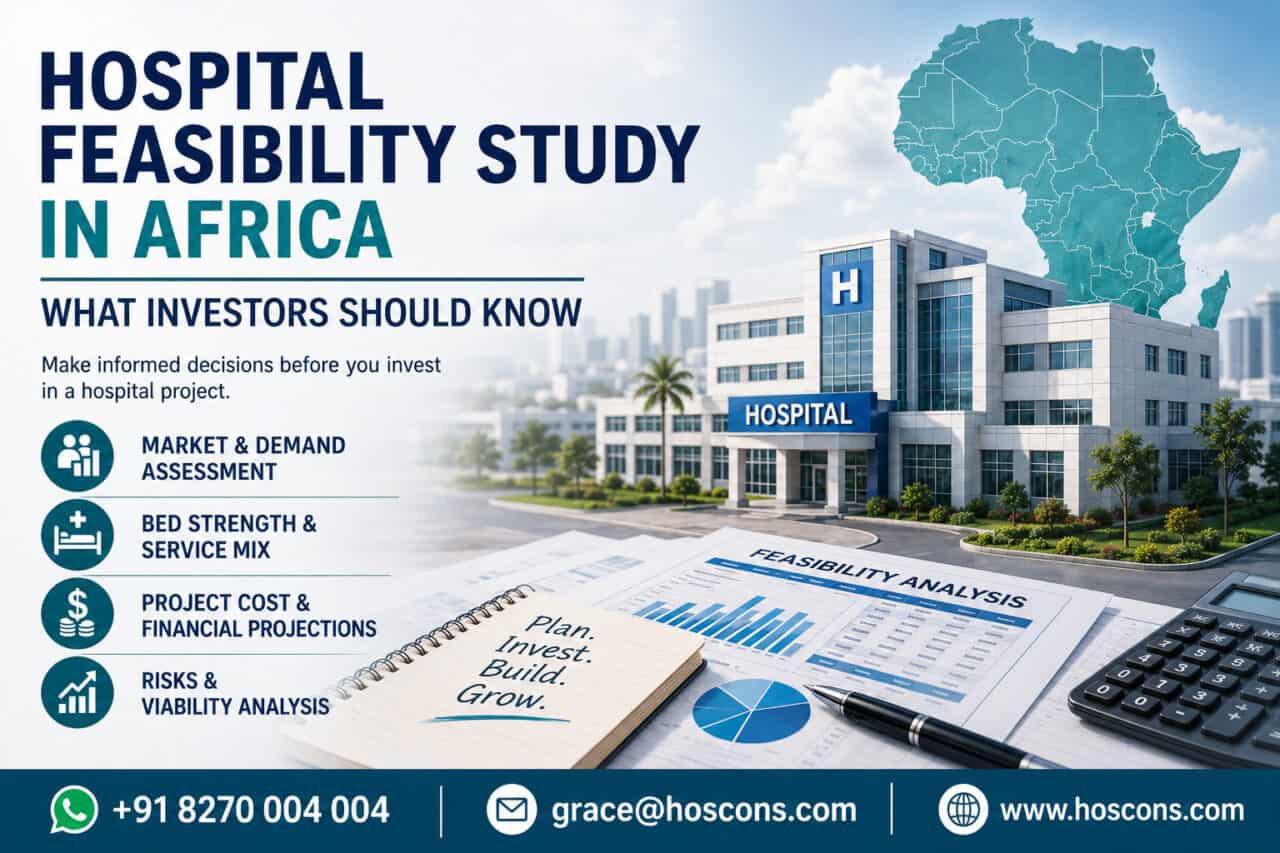
A hospital feasibility study in Africa should ideally be completed before an investor commits substantial funds towards land acquisition, architectural design, construction or medical equipment. It helps determine whether the proposed hospital has sufficient healthcare demand, the right bed strength, an appropriate clinical service mix and a realistic path towards operational and financial sustainability.
Updated: September 2026
Hospital projects require significant capital investment and long-term operating commitments. When major decisions are based mainly on assumptions, promoter preferences or available land, the hospital may be planned with excessive capacity, inappropriate specialties, an unrealistic budget or insufficient working capital.
A structured feasibility assessment can help doctors, investors, healthcare groups, trusts, NGOs, churches and diaspora promoters make better-informed decisions before major expenditure begins.
Evaluating a Hospital Investment in Africa?
Share your proposed country, city, land status, planned bed strength, services and investment expectations. HOSCONS can review the project and recommend an appropriate preliminary assessment, feasibility study or DPR scope.
What Is a Hospital Feasibility Study?
A hospital feasibility study is a structured assessment of whether a proposed healthcare project is likely to be clinically relevant, operationally practical and financially sustainable.
A comprehensive assessment may evaluate:
- Proposed location and catchment area.
- Population and healthcare demand.
- Existing hospitals and competing services.
- Recommended hospital bed strength.
- Clinical specialties and service mix.
- Capital investment requirements.
- Expected patient volumes.
- Projected revenue.
- Operating expenses.
- Manpower requirements.
- Working-capital requirements.
- Financial viability.
- Project risks.
- Potential development phases.
The objective is not simply to confirm the promoter’s original concept. A credible study should also identify where the proposed plan may need to change before major investment decisions are finalised.
Why Should Investors Conduct a Hospital Feasibility Study?
Hospital development differs from many conventional commercial projects because success depends on a complex combination of healthcare demand, clinical manpower, technology, affordability, referral networks, local infrastructure, regulatory requirements and operational efficiency.
A hospital may face difficulties after opening when:
- The location has insufficient demand for the proposed services.
- The bed capacity is larger than the market can support.
- The service mix does not match local healthcare needs.
- Patient-volume projections are unrealistic.
- The project budget excludes important infrastructure costs.
- Working capital is underestimated.
- Specialist doctors are difficult to recruit.
- The proposed prices do not match patient affordability.
- Too many advanced specialties are launched at once.
- The project is developed in a single large phase instead of being scaled gradually.
A properly structured hospital feasibility study in Africa can identify these risks while the project concept, capacity and investment strategy can still be modified.
Who Should Consider a Hospital Feasibility Study?
A feasibility assessment may be particularly useful for:
- Doctors planning their first hospital.
- Investors entering healthcare.
- Existing clinic owners planning inpatient services.
- Healthcare groups entering a new city or country.
- Hospitals planning major expansion.
- Churches and mission organisations developing hospitals.
- Trusts and charitable institutions.
- NGOs and donor-funded healthcare projects.
- Diaspora investors planning healthcare facilities.
- Real-estate developers evaluating hospital projects.
10 Critical Areas a Hospital Feasibility Study Should Evaluate
| Assessment Area | Key Question | Expected Outcome |
|---|---|---|
| Project Concept | What type of hospital is appropriate? | Clear positioning and level of care |
| Location | Can the local market support the project? | Location and catchment assessment |
| Healthcare Demand | Which services are genuinely needed? | Demand-based service recommendations |
| Competition | What healthcare services already exist? | Competitive gaps and positioning opportunities |
| Bed Strength | How many beds should be developed? | Initial and long-term capacity plan |
| Service Mix | Which specialties should be prioritised? | Clinically and financially suitable services |
| Project Cost | What is the likely investment requirement? | Preliminary capital budget |
| Manpower | Can the required clinical team be recruited? | Organisation and staffing strategy |
| Financial Viability | Can the hospital sustain its operating expenses? | Revenue, cost, cash-flow and break-even projections |
| Project Risks | What could weaken or delay the project? | Risk identification and mitigation strategy |
1. Define the Hospital Project Concept
The feasibility process should begin by defining exactly what the promoter intends to establish.
Possible models include:
- General hospital.
- Secondary-care hospital.
- Multispecialty hospital.
- Mother and child hospital.
- Day-care surgery centre.
- Diagnostic and specialist centre.
- Orthopaedic or surgical hospital.
- Cardiac hospital.
- Oncology hospital.
- Renal-care hospital.
- Mission or community hospital.
- Teaching or referral hospital.
The project concept should reflect local healthcare demand, promoter capability, available investment, expected payer mix, clinical manpower and the level of care that can realistically be sustained.
Investors should avoid adding complex specialties merely because they appear prestigious. Advanced services should be developed only when demand, supporting departments, specialist availability, referral networks and capital requirements have been properly assessed.
2. Evaluate the Proposed Location and Catchment
Hospital viability is strongly influenced by location.
A suitable hospital site requires much more than sufficient land.
The assessment should consider:
- Population within the realistic catchment area.
- Population growth and development trends.
- Road accessibility.
- Public transport.
- Ambulance accessibility.
- Referral access from surrounding towns and districts.
- Distance from competing hospitals.
- Availability of power.
- Availability of water.
- Drainage and flood risk.
- Internet and communication infrastructure.
- Potential for future expansion.
A prominent roadside site is not automatically a viable hospital location. The surrounding market must also be capable of generating sufficient patient demand.
3. Assess Population and Healthcare Demand
A hospital feasibility study in Africa should evaluate the actual healthcare requirements of the proposed catchment rather than relying only on national statistics.
Demand assessment may consider:
- Population size.
- Population growth.
- Age distribution.
- Maternal and child healthcare needs.
- Burden of chronic diseases.
- Communicable diseases.
- Trauma and emergency-care requirements.
- Surgical demand.
- Diagnostic demand.
- Patient travel to other cities or countries.
- Corporate and institutional healthcare demand.
- Insurance coverage.
- Self-pay affordability.
Where reliable published information is limited, the study may require physician interviews, employer discussions, local stakeholder inputs, field research or community-level data collection.
Population Alone Does Not Prove Hospital Demand
A large population does not automatically make a hospital project viable. Patient affordability, competition, referral behaviour, payer profile, accessibility, disease burden and availability of qualified doctors must also be considered.
4. Review Existing Hospitals and Competition
Competition analysis should not be limited to counting hospitals in the proposed location.
The study should examine:
- Existing hospital bed capacity.
- Major clinical specialties.
- Emergency and critical-care capability.
- Diagnostic services.
- Doctor availability.
- Pricing.
- Payer acceptance.
- Hospital reputation.
- Patient volumes, where reliable data is available.
- Occupancy, where available.
- Infrastructure and equipment.
- Known expansion plans.
The purpose is to identify genuine service gaps and determine how the proposed hospital can differentiate itself.
5. Determine the Appropriate Bed Strength
Bed strength should not be determined only by available land or investor ambition.
The recommended capacity should consider:
- Expected admissions.
- Projected occupancy.
- Average length of stay.
- Proposed specialties.
- Critical-care requirements.
- Maternity volumes.
- Surgical volumes.
- Clinical manpower availability.
- Capital investment capacity.
- Future expansion potential.
For many projects, phased development can be more sustainable.
The building and master plan may support a larger long-term capacity while only the beds required during the first operating phase are equipped, staffed and commissioned.
The hospital feasibility study in Africa should therefore distinguish between initial operational capacity and long-term development capacity.
6. Select the Right Clinical Service Mix
The service mix affects the hospital’s building design, equipment, staffing, operating expenses and revenue potential.
Possible services may include:
- General medicine.
- General surgery.
- Obstetrics and gynaecology.
- Paediatrics.
- Orthopaedics.
- Emergency care.
- Critical care.
- Laboratory.
- Imaging.
- Dialysis.
- Cardiology.
- Oncology.
- ENT.
- Ophthalmology.
- Rehabilitation.
- Day-care procedures.
The initial service mix should balance market demand with clinical practicality and the availability of trained healthcare professionals.
7. Estimate the Complete Hospital Project Cost
Hospital investment involves much more than land and construction.
A preliminary project budget may include:
- Land and site development.
- Civil construction.
- Electrical systems.
- Plumbing.
- HVAC.
- Fire and life-safety systems.
- Medical-gas systems.
- Medical equipment.
- Furniture and interiors.
- Hospital IT systems.
- Power backup.
- Water infrastructure.
- Professional fees.
- Licensing.
- Recruitment.
- Training.
- Pre-opening expenditure.
- Initial inventory.
- Working capital.
- Contingency.
For a detailed explanation, read: Hospital Setup Cost in Africa: The Complete Budget Guide
.
Before You Invest, Test the Project’s Viability
If you already have a location, land, preliminary concept or proposed bed strength, HOSCONS can review the project stage and recommend the appropriate feasibility, planning or DPR approach before major capital commitments are made.
8. Assess Medical Manpower Availability
A hospital cannot operate successfully without appropriate doctors, nurses, technicians, pharmacists, administrators and support personnel.
The manpower assessment may examine:
- Availability of specialists.
- Availability of medical officers.
- Nursing availability.
- Laboratory technicians.
- Radiology technicians.
- Pharmacists.
- Biomedical support.
- Recruitment lead time.
- Salary expectations.
- Staff accommodation.
- Transport requirements.
- Training requirements.
- Staff-retention challenges.
- Professional licensing requirements.
The proposed clinical services may need to be modified where critical specialist manpower cannot be recruited or retained reliably.
9. Prepare Financial Projections
The financial component of a hospital feasibility study in Africa converts project assumptions into projected revenue, operating expenses, cash flow and break-even.
Financial modelling may include:
- OPD-volume projections.
- Admission projections.
- Bed-occupancy ramp-up.
- Surgical volumes.
- Procedure volumes.
- Diagnostic revenue.
- Pharmacy revenue.
- Specialty-wise revenue assumptions.
- Payer mix.
- Pricing assumptions.
- Manpower costs.
- Consumables.
- Utilities.
- Equipment maintenance.
- Administrative costs.
- Marketing expenditure.
- Operating profit projections.
- Cash-flow requirements.
- Break-even.
Patient-Volume Ramp-Up
A new hospital is unlikely to reach stable occupancy immediately after opening.
The financial model should therefore allow for a gradual increase in:
- OPD visits.
- Admissions.
- Procedures.
- Diagnostics.
- Revenue.
Adequate working capital should support the hospital during this ramp-up period.
Scenario Analysis
Financial projections should ideally test more than one operating scenario.
These may include:
- Conservative scenario.
- Base or realistic scenario.
- Higher-growth scenario.
This helps investors understand how changes in occupancy, pricing or operating expenses may affect the hospital’s financial performance.
10. Identify the Major Project Risks
Every hospital investment carries risk. The purpose of the feasibility process is not to eliminate uncertainty but to identify important risks early and determine how they can be managed.
Common project risks may include:
- Insufficient healthcare demand.
- Overestimated patient volumes.
- Excessive bed capacity.
- Unsuitable specialty mix.
- Construction-cost escalation.
- Foreign-exchange fluctuation.
- Delays in imported equipment.
- Power and water limitations.
- Difficulty recruiting specialists.
- Licensing delays.
- Weak project governance.
- Underestimated working capital.
- Low patient affordability.
- Dependence on one doctor or payer.
- Slow referral and market development.
A robust hospital feasibility study in Africa should clearly distinguish between manageable risks, issues requiring further investigation and risks that could materially affect project viability.
Can a Hospital Feasibility Study in Africa Be Done Remotely?
A preliminary project assessment can often be completed remotely using promoter-provided information, available public data, land details, architectural documents, local stakeholder inputs and virtual discussions.
Remote assessment may support:
- Project-concept clarification.
- Preliminary bed-strength planning.
- Indicative service-mix recommendations.
- Preliminary department planning.
- Area requirements.
- Project-cost estimation.
- Equipment-budget estimation.
- Manpower planning.
- Initial financial modelling.
- Identification of project risks.
However, a complete market feasibility study depends on reliable local information about population, patient demand, competition, pricing, payer patterns and referral behaviour.
Where this information is unavailable or cannot be validated remotely, the study may require:
- Local data collection.
- Physician and stakeholder interviews.
- Patient or community surveys.
- Competitor visits.
- Catchment assessment.
- Collaboration with local research partners.
- A project-specific on-site visit.
This distinction is important because financial projections are only as reliable as the demand and operating assumptions on which they are based.
Preliminary Assessment, Feasibility Study and DPR: What Is the Difference?
| Stage | Purpose | Typical Output |
|---|---|---|
| Preliminary Assessment | Initial project direction | Concept, indicative capacity, budget direction and next steps |
| Feasibility Study | Assess market, operational and financial viability | Demand, competition, bed strength, service mix, project cost, financial projections and risks |
| Detailed Project Report | Detailed project planning | Project concept, departments, cost, equipment, manpower, operations, implementation and financial model |
The appropriate scope depends on the project’s stage, available information, investment requirement and intended use of the report.
How Feasibility Findings Can Change a Hospital Project
A feasibility assessment may confirm the promoter’s original plan, but it may also recommend significant changes.
For example, the study may recommend:
- Reducing the initial bed strength.
- Increasing capacity where justified.
- Developing the hospital in phases.
- Changing the specialty mix.
- Adding emergency or maternity services.
- Strengthening diagnostics.
- Postponing high-cost specialties.
- Changing the location.
- Revising the project budget.
- Increasing working capital.
- Developing clinical partnerships.
- Beginning with a smaller clinic, day-care or diagnostic model.
These recommendations can protect the investor from creating infrastructure that is expensive to maintain but difficult to utilise.
Country-Level Healthcare Data Is Only the Starting Point
Investors may use the World Bank health expenditure database as one source of country-level healthcare information.
However, national-level indicators should not replace project-specific local research. Hospital viability depends on the actual catchment, competing facilities, patient affordability, referral behaviour, available manpower and payer environment surrounding the proposed project.
How HOSCONS Supports Hospital Feasibility Studies in Africa
HOSCONS is an India-based hospital consulting firm supporting doctors, investors, healthcare groups, trusts, NGOs, churches and diaspora promoters planning hospital projects across African markets.
Depending on the project stage and availability of reliable local information, our support may include:
- Preliminary hospital project assessment.
- Hospital concept development.
- Market and demand assessment.
- Competition review.
- Service-gap assessment.
- Bed-strength recommendation.
- Specialty and service-mix planning.
- Department planning.
- Area statements.
- Capital investment estimation.
- Medical-equipment budgeting.
- Manpower planning.
- Revenue projections.
- Operating-cost projections.
- Working-capital assessment.
- Break-even modelling.
- Project risk assessment.
- Detailed Project Report preparation.
- Project implementation advisory.
Support can be structured as a remote, hybrid or project-specific on-site engagement depending on the nature of the study and availability of reliable market information.
Explore our hospital consulting services for Africa for more information.
Continue Your Hospital Investment Planning
These related resources can help you evaluate the project further:
- How to Start a Hospital in Africa: Complete 15-Step Guide
- Hospital Setup Cost in Africa: The Complete Budget Guide
- Hospital Consulting Services for Africa
Frequently Asked Questions
When should a hospital feasibility study be conducted?
Ideally, it should be conducted before finalising the hospital size, preparing detailed architectural drawings, beginning construction or ordering major medical equipment.
What information is required from the promoter?
Initial information may include the proposed country and city, land details, proposed hospital size, intended specialties, investment expectations, promoter background, current project stage and any available market information.
What is included in a private hospital feasibility study?
A private hospital feasibility study may evaluate the proposed location, healthcare demand, competition, recommended bed strength, clinical service mix, project cost, manpower, revenue assumptions, operating expenses, working capital, break-even and major investment risks.
Does a large population automatically make a hospital viable?
No. Population should be assessed together with healthcare demand, patient affordability, competition, payer mix, referral patterns, accessibility and clinical manpower availability.
Can a feasibility study recommend a smaller hospital?
Yes. The study may recommend a smaller first phase, phased expansion or a different healthcare model if this creates a more sustainable investment.
Does a feasibility study include architectural drawings?
A feasibility study may define preliminary bed strength, departments and area requirements. Detailed architectural, structural and engineering drawings usually form a separate design scope.
Can a feasibility study guarantee profitability?
No. A feasibility study improves decision-making by evaluating demand, investment, operating assumptions and risks. Actual hospital performance also depends on implementation, clinical quality, management efficiency and market development.
Can HOSCONS conduct a feasibility study remotely?
Several planning and financial components can be prepared remotely. Where reliable local market information is unavailable, local research, stakeholder interviews, collaboration with local professionals or an on-site assessment may be required.
Can HOSCONS prepare the DPR after the feasibility study?
Yes. Depending on the agreed scope, HOSCONS can support preparation of a Detailed Project Report covering project concept, departments, bed strength, area requirements, investment, equipment, manpower, operating assumptions, financial projections and implementation planning.
Planning to Invest in a Hospital Project in Africa?
Share your country, proposed location, land status, planned bed strength, intended specialties, investment expectations and current project stage. HOSCONS can review your requirement and recommend an appropriate preliminary assessment, feasibility study or DPR scope.
WhatsApp:
+91 8270 004 004
Email:
grace@hoscons.com
www.hoscons.com