
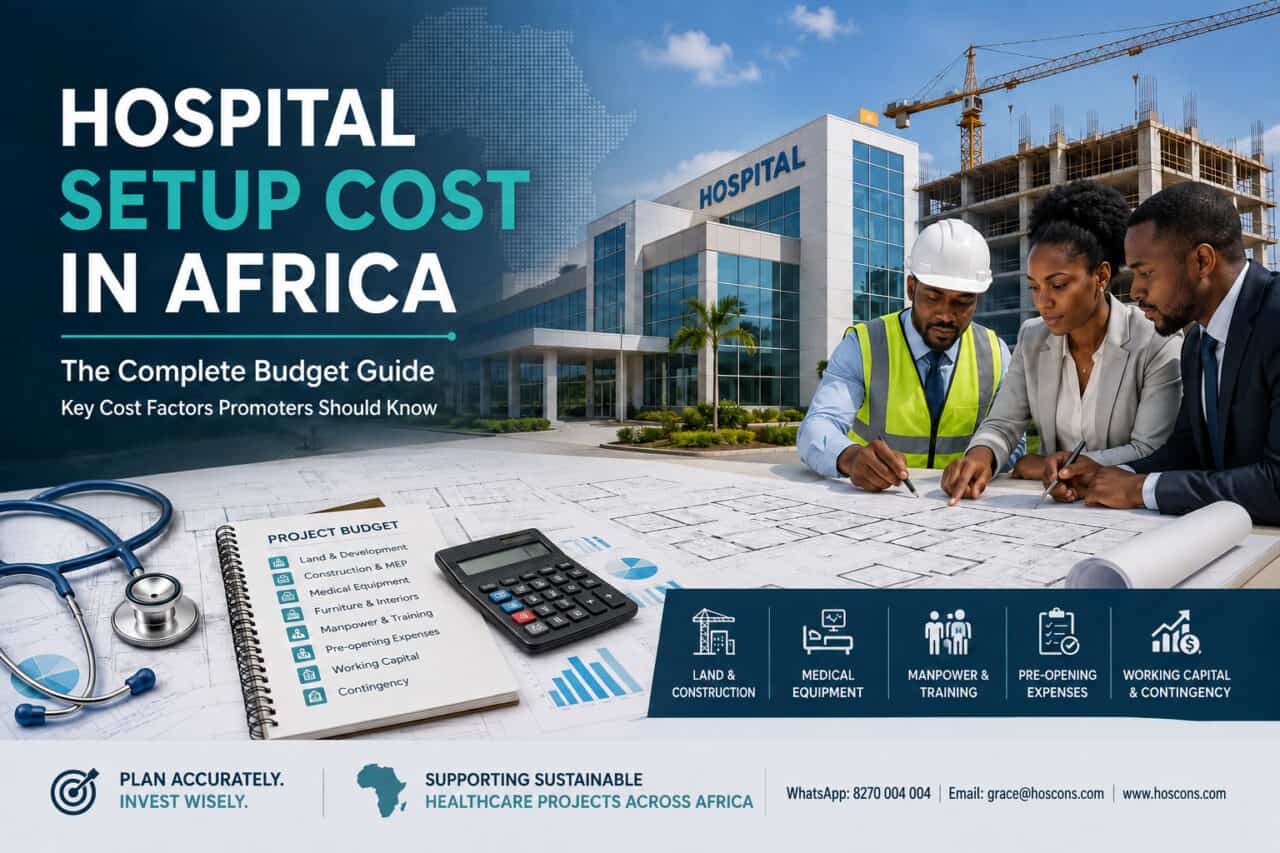
The hospital setup cost in Africa is one of the most important considerations for doctors, investors, healthcare groups, trusts, NGOs and mission organisations planning a new hospital project. The total investment involves much more than purchasing land and constructing a building.
A realistic hospital budget should consider civil construction, engineering systems, medical equipment, furniture, utilities, technology, manpower mobilisation, statutory requirements, pre-opening expenses, working capital and contingency.
Costs can vary significantly between countries and even between cities within the same country. The appropriate investment therefore depends on the proposed location, hospital size, clinical services, level of care, infrastructure availability, equipment specifications and development strategy.
Planning a Hospital Project in Africa?
HOSCONS supports hospital promoters with project concept planning, bed-strength assessment, area planning, preliminary project costing, medical-equipment budgeting, manpower planning, feasibility studies and Detailed Project Reports.
How Much Does It Cost to Build a Hospital in Africa?
There is no single reliable answer to the question, “How much does it cost to build a hospital in Africa?” A 20-bed secondary-care hospital, a 100-bed multispecialty hospital and a tertiary-care hospital with advanced imaging and critical-care facilities will have very different investment requirements.
The cost also depends on factors such as:
- Country and city.
- Land cost and site conditions.
- Hospital bed strength.
- Built-up area.
- Number and type of clinical departments.
- Level of critical care.
- Operating-theatre requirements.
- Diagnostic and imaging facilities.
- Imported versus locally available equipment.
- Power, water and medical-gas infrastructure.
- Construction specifications.
- Availability and cost of clinical manpower.
- Pre-opening and working-capital requirements.
A realistic hospital setup cost in Africa should therefore be prepared specifically for the proposed country, city, hospital concept and level of care rather than applying a generic cost-per-bed figure.
What Should Be Included in the Hospital Project Budget?
One of the most common budgeting mistakes is to consider only land, building and medical equipment. A complete hospital project budget should capture the expenditure required from project conception until the hospital achieves a stable operating stage.
The major cost heads normally include:
- Land and site development
- Hospital building and civil construction
- MEP and healthcare engineering systems
- Medical equipment
- Furniture and interiors
- Power, water and other infrastructure
- Hospital IT and communication systems
- Manpower recruitment and training
- Licensing and professional services
- Pre-opening expenses
- Initial inventory
- Working capital
- Contingency
1. Land and Site Development
Land cost can vary substantially depending on the country, city, neighbourhood, road frontage and surrounding development.
However, land purchase is only one component of site-related expenditure. The promoter should also consider:
- Legal due diligence.
- Land registration and professional charges.
- Topographical and soil investigations.
- Site clearing and grading.
- Boundary development.
- Internal roads.
- Parking.
- Storm-water drainage.
- Water storage.
- External utilities.
- Landscaping.
- Future expansion requirements.
Before purchasing land, the promoter should also confirm that the site is suitable for hospital development from planning, access, utility and regulatory perspectives.
2. Hospital Construction and Engineering Systems
Construction and engineering systems generally represent a major portion of the overall hospital setup cost in Africa.
A hospital building is significantly different from a conventional commercial or residential building. It requires careful integration of clinical workflows and specialised engineering systems.
The construction budget may include:
- Civil and structural works.
- Flooring, ceilings and wall finishes.
- Electrical systems.
- Plumbing and drainage.
- Fire detection and fire-fighting systems.
- HVAC and ventilation.
- Medical-gas pipelines.
- Operating-theatre systems.
- ICU engineering requirements.
- Nurse-call systems.
- Lifts.
- Access-control systems.
- Emergency power distribution.
- Waste-management infrastructure.
Hospitals should ideally be designed around the approved clinical programme and departmental requirements rather than designing a generic building first and attempting to fit the hospital into it later.
3. Medical Equipment
Medical equipment can substantially influence the total hospital setup cost in Africa, particularly when the project includes advanced imaging, surgery, critical care, dialysis or specialised services.
Equipment requirements may include:
- Operating-theatre equipment.
- ICU and HDU equipment.
- Emergency equipment.
- Laboratory equipment.
- X-ray and imaging systems.
- Ultrasound.
- CT or MRI, where justified.
- Dialysis equipment.
- Endoscopy equipment.
- CSSD equipment.
- Maternity and neonatal equipment.
- Ward and OPD equipment.
The appropriate equipment specification should be based on expected patient volumes, proposed specialties, clinical protocols, after-sales support, maintenance capability and the hospital’s investment capacity.
Buying high-end equipment merely because it is technologically attractive can increase capital costs without necessarily improving the project’s viability.
4. Furniture, Fixtures and Interiors
Hospital furniture and interiors should be planned according to function, durability, infection-control requirements and patient experience.
Budget heads may include:
- Hospital beds and bedside furniture.
- OPD furniture.
- Nursing stations.
- Doctor consultation furniture.
- Administrative furniture.
- Waiting-area seating.
- Storage systems.
- Pharmacy shelving.
- Laboratory furniture.
- Kitchen and dietary equipment.
- Signage and wayfinding.
- Patient-room furnishings.
5. Power, Water, Oxygen and Utility Infrastructure
Utility planning is particularly important for hospital projects where reliable municipal infrastructure cannot be assumed.
Power, water, oxygen and waste-management requirements can materially increase the hospital setup cost in Africa where additional infrastructure must be developed specifically for the hospital.
Depending on the location, the project may require:
- Generator backup.
- Solar-power systems.
- UPS systems.
- Voltage stabilisation.
- Water borewells or alternative sources.
- Water-treatment systems.
- Large water-storage capacity.
- Sewage-treatment facilities.
- Medical-oxygen generation or storage.
- Biomedical-waste systems.
- Additional cold-storage or refrigeration systems.
These requirements should be assessed early because they influence both capital expenditure and future operating expenses.
Need a Project-Specific Hospital Cost Estimate?
Hospital investment varies significantly by country, location, bed strength, specialty mix, equipment level and infrastructure requirements. Share your proposed project details with HOSCONS for a structured review of the likely investment requirement and planning approach.
6. Hospital IT and Digital Systems
Hospital technology requirements should be incorporated into the initial project budget rather than added after construction.
These may include:
- Hospital Information System.
- Electronic medical records.
- Laboratory Information System.
- Radiology and PACS.
- Pharmacy and inventory systems.
- Billing and revenue-cycle systems.
- Network infrastructure.
- Servers or cloud services.
- Computers and printers.
- Telecommunication systems.
- CCTV and access control.
- Patient communication systems.
7. Manpower Recruitment and Pre-Opening Training
Hospital manpower expenses begin before the first patient enters the facility.
Key clinical, administrative and technical personnel may need to be recruited several weeks or months before opening for:
- Department setup.
- Equipment familiarisation.
- SOP development.
- Mock drills.
- IT training.
- Emergency-response preparation.
- Licensing inspections.
- Vendor coordination.
- Trial operations.
Pre-opening salary costs therefore need to be included in the project budget.
8. Licensing, Professional and Consultancy Costs
Hospital projects normally require support from several professional disciplines.
Depending on the project and jurisdiction, costs may include:
- Architectural design.
- Structural design.
- MEP design.
- Hospital planning consultancy.
- Fire and safety consultancy.
- Environmental approvals.
- Legal services.
- Surveyors and quantity consultants.
- Statutory application fees.
- Hospital licensing.
- Project-management services.
The exact statutory requirements should always be verified for the proposed country and location before implementation.
9. Pre-Opening Expenses
A hospital incurs substantial expenditure before revenue generation begins.
Typical pre-opening costs can include:
- Recruitment.
- Employee salaries during mobilisation.
- Training.
- Trial runs.
- Licensing and inspections.
- Initial marketing.
- Website and communication materials.
- Opening inventory.
- Consumables.
- Uniforms.
- Office supplies.
- Vendor mobilisation.
- Commissioning activities.
10. Working Capital: The Cost Promoters Often Underestimate
Working capital is one of the most important components of a hospital investment plan.
A newly opened hospital normally requires time to establish doctor referrals, community awareness, patient confidence, insurer relationships and stable occupancy.
During this period, the hospital continues to incur expenses such as:
- Doctor and employee salaries.
- Medical consumables.
- Medicines.
- Utilities.
- Equipment maintenance.
- Housekeeping.
- Security.
- Marketing.
- Insurance.
- Administrative expenses.
- Loan servicing, where applicable.
Working capital should therefore be planned alongside construction and equipment budgets, not after the hospital is ready to open.
11. Contingency
Hospital development involves several moving components, and the final cost may change because of:
- Construction-price escalation.
- Foreign-exchange fluctuations.
- Shipping and import costs.
- Changes in equipment specifications.
- Site-related surprises.
- Regulatory modifications.
- Design changes.
- Project delays.
A suitable contingency provision should therefore form part of the capital plan rather than relying entirely on the original base estimate.
Hospital Cost Should Be Linked to the Right Bed Strength
A larger hospital is not automatically a better hospital investment.
Developing excess capacity can increase:
- Construction cost.
- Medical-equipment investment.
- Manpower costs.
- Utility expenditure.
- Maintenance.
- Working-capital requirements.
Bed strength should instead be determined using expected patient demand, specialty requirements, likely occupancy, clinical manpower availability and future growth potential.
For many projects, it may be more prudent to create a master plan for the long-term hospital capacity while commissioning only the number of beds required for the initial operating phase.
Should the Hospital Be Developed in Phases?
Phased development can help promoters control capital exposure and align expansion with actual patient demand.
For example, a project may be planned structurally for a larger long-term capacity while initially opening:
- A smaller number of operational beds.
- Core specialties with established demand.
- Essential diagnostics.
- Emergency services.
- One or two operating theatres.
- Appropriate critical-care capacity.
Additional wards, specialties, equipment and facilities can then be commissioned as patient volumes grow.
However, phasing should be considered during master planning so that future expansion does not disrupt existing hospital operations.
Hospital Cost Should Not Be Finalised Before Feasibility
Before committing substantial investment, the promoter should determine whether the proposed hospital size and services are supported by the market.
A feasibility assessment may consider:
- Catchment population.
- Healthcare demand.
- Existing hospitals.
- Available beds.
- Service gaps.
- Patient referral patterns.
- Payer profile.
- Affordability.
- Clinical manpower availability.
- Expected patient volumes.
- Revenue potential.
- Operating costs.
Learn more in our guide:
Hospital Feasibility Study in Africa: What Investors Should Know
.
Important: Reliable Local Data Matters
Hospital financial projections should not be based solely on national statistics or assumptions. Where reliable local data on population, competition, pricing, referral patterns or patient demand is unavailable, additional local research, stakeholder discussions or an on-site market assessment may be required.
How Should Investors Prepare a Reliable Hospital Budget?
The project budget should be developed after coordinating the clinical plan, capacity, area requirements, engineering infrastructure and equipment requirements.
A practical sequence is:
- Define the hospital concept.
- Assess the proposed market.
- Determine the appropriate bed strength.
- Finalise the initial specialty mix.
- Prepare departmental requirements.
- Prepare the preliminary area statement.
- Estimate construction and engineering costs.
- Prepare the equipment budget.
- Estimate manpower requirements.
- Include pre-opening costs.
- Calculate working capital.
- Add contingency.
- Prepare revenue, expense and cash-flow projections.
The final hospital setup cost in Africa should therefore be the outcome of coordinated project planning rather than a simple multiplication of cost per bed.
Can HOSCONS Support an African Hospital Project Remotely?
Yes. Several components of hospital project planning can be supported remotely.
These may include:
- Hospital project concept development.
- Preliminary bed-strength planning.
- Department planning.
- Area statements.
- Preliminary project-cost estimation.
- Medical-equipment budgeting.
- Manpower planning.
- Financial modelling.
- DPR preparation.
- Design review and project advisory.
Where the engagement requires detailed market feasibility, competitor assessment, local pricing, patient-demand validation or other information that cannot be reliably established remotely, HOSCONS may recommend local data collection, stakeholder interviews, collaboration with local professionals or a project-specific on-site assessment.
Depending on the requirement, the assignment can therefore be structured as a remote, hybrid or project-specific on-site consulting engagement.
How HOSCONS Supports Hospital Projects in Africa
HOSCONS is an India-based hospital consulting firm supporting doctors, investors, healthcare groups, trusts, NGOs, churches and other healthcare promoters planning hospitals across African markets.
Depending on the project stage, our hospital project consulting support may include:
- Hospital feasibility studies.
- Market and demand assessment.
- Hospital concept development.
- Bed-strength planning.
- Specialty and service-mix planning.
- Department and area planning.
- Detailed Project Reports.
- Project-cost estimation.
- Medical-equipment planning and budgeting.
- Manpower planning.
- Financial modelling.
- Design coordination and review.
- Project implementation advisory.
- Pre-opening and hospital commissioning support.
Explore our
hospital consulting services for Africa
for more information about our international healthcare consulting support.
Planning Your Hospital Investment? Continue With These Guides
These related resources may help you move from initial investment planning to a more structured hospital project:
How to Start a Hospital in Africa: Complete 15-Step Guide
Hospital Feasibility Study in Africa: What Investors Should Know
Hospital Consulting Services for Africa
Frequently Asked Questions
How much does it cost to set up a hospital in Africa?
There is no universal figure. The investment depends on the country, location, bed strength, clinical services, construction specifications, medical equipment, infrastructure, manpower and working-capital requirement.
Is hospital construction cost the same across African countries?
No. Construction materials, labour, imported equipment, taxation, logistics, power infrastructure and local regulations differ considerably between countries and cities.
What is usually excluded when promoters estimate hospital cost?
Working capital, pre-opening manpower, licensing, professional fees, utility infrastructure, initial inventory, staff training and contingency are among the items that can be underestimated or omitted from early budgets.
Should I decide the number of beds before preparing the budget?
The proposed bed strength should ideally be validated against market demand, specialty requirements, projected occupancy, manpower availability and investment capacity before the final project budget is prepared.
Can I start with fewer beds and expand later?
Yes. A phased development strategy can be considered where the master plan, engineering infrastructure and building configuration allow future expansion without major disruption to the operating hospital.
How much working capital should a new hospital maintain?
The requirement depends on the hospital’s monthly operating expenditure, expected patient-volume ramp-up, payer mix and collection cycle. It should be calculated as part of the financial model rather than using a generic rule.
Can HOSCONS estimate the cost before architectural drawings are completed?
A preliminary investment estimate can be prepared using the proposed hospital concept, bed strength, specialties, indicative area requirements, equipment needs and infrastructure assumptions. The estimate can subsequently be refined as the design develops.
Can HOSCONS support hospital projects outside India?
Yes. HOSCONS can provide remote and hybrid hospital project consulting support for international projects. Where reliable local market information or physical assessment is required, the scope may include local research, stakeholder collaboration or a project-specific on-site visit.
Where can hospital investors review country-level healthcare data?
Investors may use the
World Bank health expenditure database
as one source of country-level healthcare information. Such national data should be supplemented with project-specific local market information before investment decisions are made.
Planning a New Hospital in Africa?
Share your country, proposed location, land status, planned bed strength, intended specialties and current project stage. HOSCONS can review your requirement and recommend an appropriate project assessment, feasibility study, DPR or hospital planning scope.
WhatsApp:
+91 8270 004 004
Email:
grace@hoscons.com
www.hoscons.com