How to Select Land for Hospital Projects: Site Selection Checklist for New Hospitals
Understanding how to select land for hospital projects is one of the most important early decisions in hospital development. The right site can support strong patient access, smooth statutory approvals, efficient infrastructure planning, and long-term financial sustainability, while the wrong site can create delays, cost overruns, and operational challenges.
This practical guide explains the key factors hospital promoters should evaluate before choosing land for a new hospital in India, based on real-world project planning and feasibility experience.
Why Learning How to Select Land for Hospital Development Is Critical
Land selection is not just a real estate decision. In healthcare, it directly influences project viability, patient volumes, accessibility, licensing timelines, parking adequacy, service expansion, and even future profitability.
Once land is purchased and construction begins, correcting a poor site decision becomes expensive and difficult. That is why promoters must evaluate land scientifically before committing capital.
- Improves patient access and convenience
- Supports ambulance movement and emergency response
- Helps secure approvals more smoothly
- Reduces infrastructure and utility risks
- Supports future bed and specialty expansion
- Improves long-term project viability
Minimum Land Benchmarks for New Hospital Projects
The amount of land required depends on the number of beds, specialties planned, setbacks, parking requirements, circulation space, utility blocks, and future expansion. As a planning benchmark, the following ranges are commonly considered.
| Hospital Size | Typical Land Requirement |
|---|---|
| 30–50 Beds | 15,000 – 25,000 sq ft |
| 50–100 Beds | 25,000 – 50,000 sq ft |
| 100–200 Beds | 50,000 sq ft – 1 acre |
| 200+ Beds | 1 – 3 acres |
These are only indicative planning ranges. Final land needs must be validated through a proper feasibility study and concept plan.
Key Factors to Consider Before Choosing Land for a Hospital
- Catchment Area and Demand Potential
Evaluate the surrounding population, disease burden, competing hospitals, referral ecosystem, and likely service demand.
- Catchment Area and Demand Potential
- Accessibility and Road Connectivity
The land should have easy approach roads for patients, staff, ambulances, and emergency vehicles.
- Accessibility and Road Connectivity
- Zoning and Land Use Compliance
Verify whether the site is legally suitable for hospital or institutional use before proceeding.
- Zoning and Land Use Compliance
- Availability of Utilities
Reliable water, electricity, sewage, drainage, and telecom connectivity are essential for hospital functioning.
- Availability of Utilities
- Parking and Traffic Movement
Space for patient vehicles, staff parking, ambulance bay movement, and smooth entry/exit planning is critical.
- Parking and Traffic Movement
- Future Expansion Potential
Choose land that allows future bed expansion, additional specialty blocks, diagnostics, or staff facilities.
- Future Expansion Potential
- Soil, Topography, and Construction Suitability
Uneven terrain, weak soil, or poor site conditions can significantly increase construction cost and complexity.
- Soil, Topography, and Construction Suitability
- Legal Title and Documentation
Ensure the land title is clear, dispute-free, and supported by proper legal and statutory documents.
- Legal Title and Documentation
Common Mistakes in Hospital Land Selection
- Choosing land only because it is cheaper
- Ignoring demand and catchment analysis
- Overlooking zoning and approval risks
- Underestimating parking and circulation needs
- Selecting land with poor ambulance access
- Buying land without feasibility validation
- Ignoring future expansion requirements
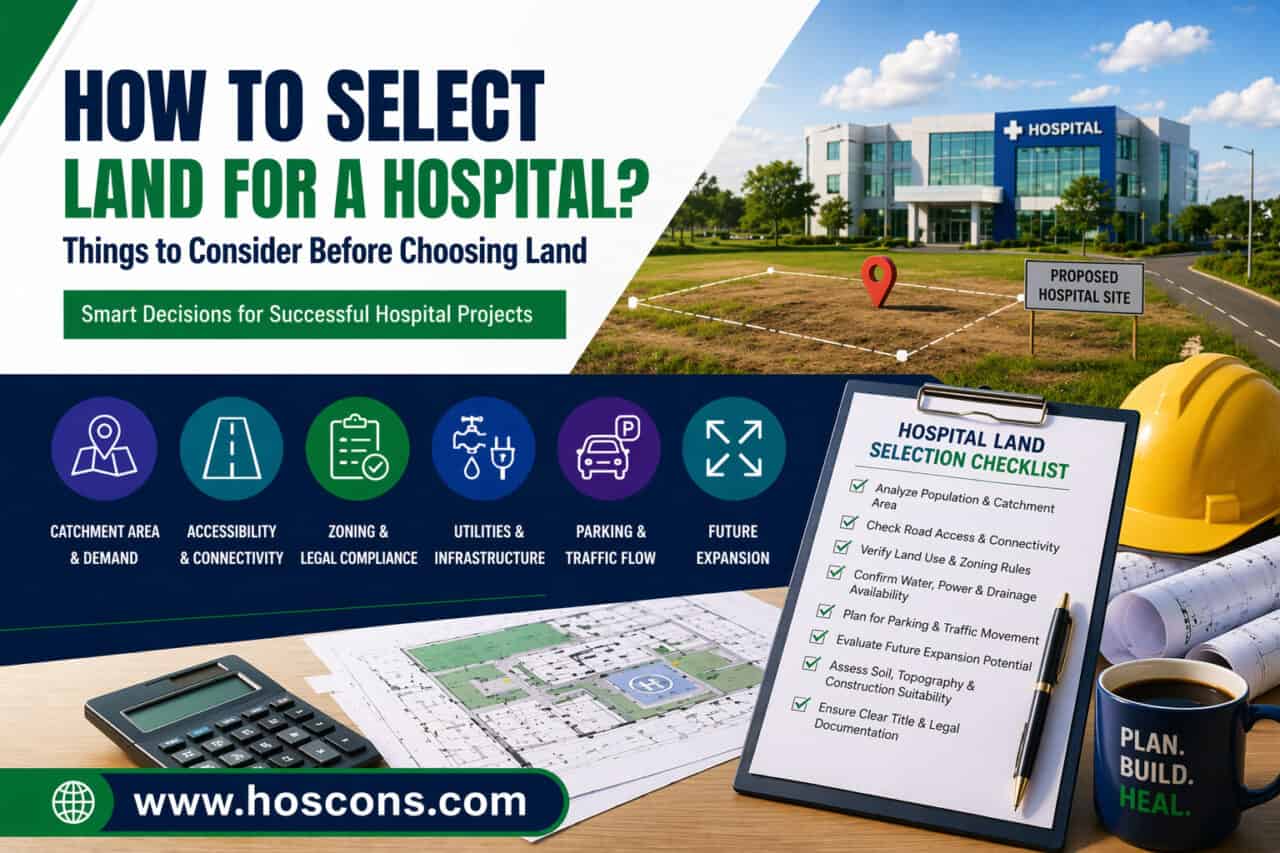
Hospital Land Selection Checklist
- Analyze catchment demand and nearby competition
- Verify road access and ambulance movement
- Confirm zoning and legal land use eligibility
- Check water, power, sewage, and drainage availability
- Assess parking and internal traffic circulation
- Evaluate soil condition and constructability
- Ensure clear title and legal documentation
- Plan for future hospital expansion
When Should You Conduct a Feasibility Study?
A hospital feasibility study should ideally be done before finalizing land purchase. This helps determine whether the proposed location can support the intended hospital size, specialty mix, investment level, and long-term sustainability.
A structured feasibility study typically evaluates:
- Catchment population and demand potential
- Competitor mapping and service gaps
- Occupancy and revenue projections
- Investment requirements and ROI
- Ideal bed strength and specialty mix
If you are in the early planning stage, our hospital feasibility study services can help validate the location before major investment decisions are made.
How HOSCONS Supports Hospital Site Selection
At HOSCONS, we support hospital promoters with location evaluation, market survey, demand assessment, project feasibility, bed planning, and end-to-end project strategy. This helps avoid expensive land selection mistakes and improves the chances of long-term project success.
You may also explore our related services:
👉 Contact HOSCONS for Hospital Site Selection & Feasibility Support
If you need expert guidance on how to select land for hospital development, our team can support you with site evaluation, catchment assessment, regulatory review, and project feasibility planning before you commit to land purchase.
📍 Serving 150+ Hospitals across India
📞 +91 8270004004
🌐 www.hoscons.com
📧 grace@hoscons.com