
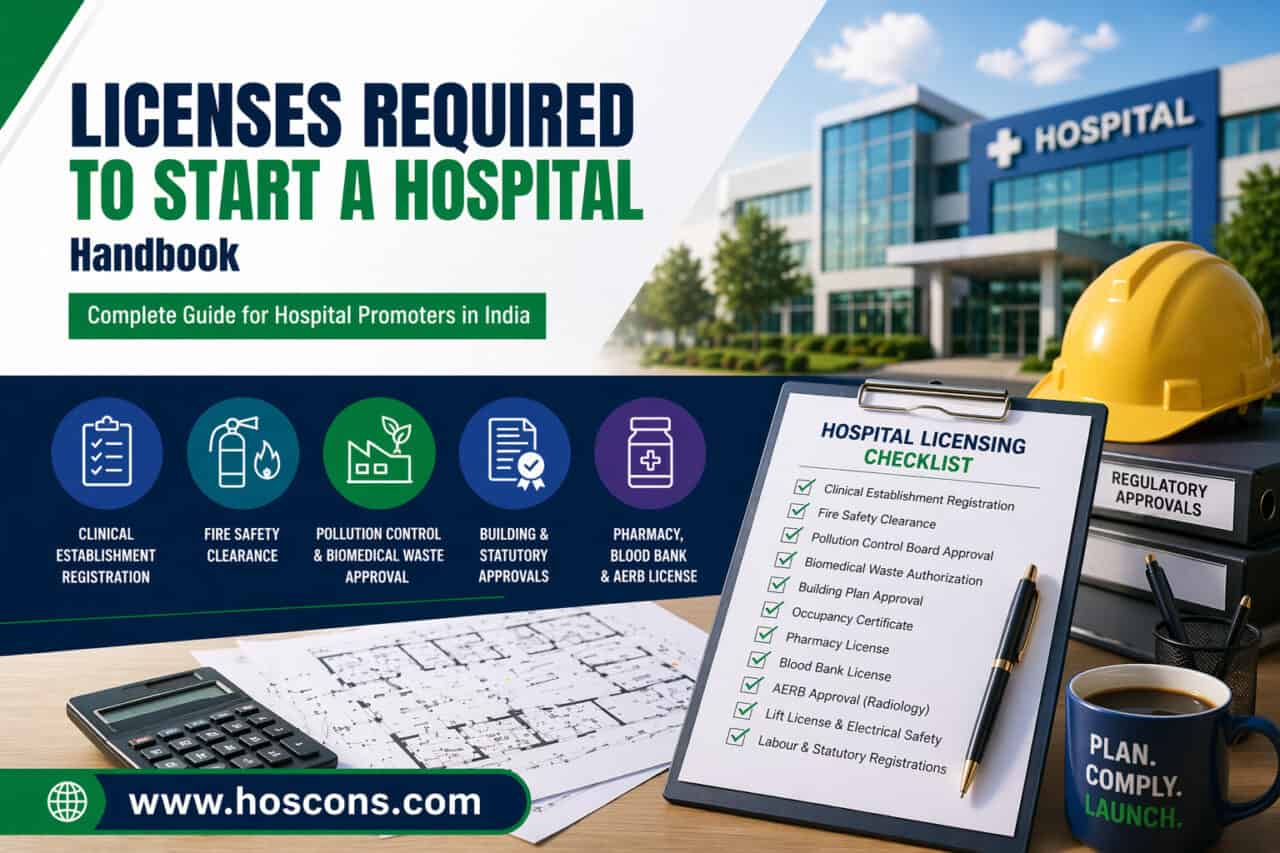
Licenses Required to Start a Hospital in India
Starting a hospital in India involves much more than construction, equipment procurement, and staffing. One of the most critical parts of the process is obtaining the statutory licenses and approvals required to legally establish and operate the facility.
Many hospital projects face delays not because the infrastructure is incomplete, but because licensing and compliance planning starts too late. Understanding the approvals required at the project planning stage helps avoid last-minute setbacks, costly delays, and operational disruptions.
This handbook explains the major licenses required to start a hospital in India and why early compliance planning is essential for smooth commissioning.
Why Licensing Planning Is Important for New Hospital Projects
Hospital licensing is not a single approval. It is a structured compliance process involving multiple government departments and statutory authorities. Each approval plays a role in ensuring patient safety, legal compliance, environmental responsibility, and operational readiness.
If licensing is delayed, the hospital opening is delayed. Therefore, promoters should integrate compliance planning into the overall hospital project roadmap from the very beginning.
- Prevents project delays
- Reduces compliance risks
- Supports smoother commissioning
- Improves operational readiness
- Avoids costly redesign and corrections
Licenses Required to Start a Hospital in India
Below are the key licenses and approvals generally required to start a hospital in India. The exact list may vary depending on the state, bed strength, specialty mix, and services planned.
1. Clinical Establishment Registration
This is one of the primary registrations required to legally operate a hospital. It establishes the hospital as a recognized clinical facility under applicable state or central regulations.
- Issued by: State Health Department / Relevant Authority
- Purpose: Legal authorization to operate the hospital
- Applies to: Hospitals, nursing homes, clinics, diagnostic centers
2. Fire Safety Clearance
Hospitals must comply with fire safety norms to protect patients, staff, attendants, and critical infrastructure. Fire approval is especially important for multi-storey buildings and facilities with inpatient services.
- Issued by: Fire Department
- Purpose: Confirm fire safety systems and emergency preparedness
- Typical requirements: Fire extinguishers, alarms, hydrants, exits, evacuation plans
3. Pollution Control Board Approval
Hospitals generate waste, emissions, and sewage that fall under environmental regulation. Approval from the Pollution Control Board is essential to ensure compliance with environmental norms.
- Issued by: State Pollution Control Board
- Purpose: Control environmental impact and regulate waste handling
- Applies to: Hospitals, labs, healthcare facilities generating biomedical waste
4. Biomedical Waste Management Authorization
Hospitals must segregate, store, transport, and dispose of biomedical waste as per applicable rules. This authorization is mandatory for safe and compliant waste management.
- Issued by: Pollution Control Board / Competent Authority
- Purpose: Ensure proper biomedical waste handling and disposal
5. Building Plan Approval
Before construction begins, the hospital building plan must be approved by the competent municipal or local authority. This ensures compliance with zoning, land use, setbacks, structural norms, and building rules.
- Issued by: Municipal / Local Authority
- Purpose: Approve the building design and land use compliance
6. Occupancy Certificate / Completion Approval
After construction is completed, the hospital building may require occupancy or completion certification before being used for operations.
- Issued by: Local Authority
- Purpose: Confirm that the completed building complies with approved plans and safety norms
7. Pharmacy License
If the hospital plans to operate an in-house pharmacy, a pharmacy license is required for storage and dispensing of medicines.
- Issued by: Drug Control Department
- Purpose: Regulate medicine storage and sale within the hospital premises
8. Blood Bank License (If Applicable)
Hospitals planning to operate a blood bank need a separate license and must comply with specialized standards for blood collection, storage, testing, and transfusion services.
- Issued by: Relevant Drug / Central Regulatory Authority
- Purpose: Regulate blood bank operations and patient safety
9. AERB Approval for Radiology Equipment
Hospitals using radiology and imaging equipment such as X-ray, CT, or other radiation-based systems require approval from the Atomic Energy Regulatory Board.
- Issued by: Atomic Energy Regulatory Board (AERB)
- Purpose: Ensure radiation safety and compliant equipment usage
10. Lift License (If Applicable)
Multi-floor hospital buildings with lifts are typically required to obtain lift approval or certification to ensure operational safety.
- Issued by: Electrical Inspectorate / Competent Authority
- Purpose: Verify lift safety and compliance
11. Electrical Safety Approval
Hospitals have critical electrical requirements for clinical areas, diagnostics, life-support equipment, HVAC, and utilities. Electrical safety approvals may be required depending on project scope and state norms.
- Issued by: Electrical Inspectorate / Relevant Authority
- Purpose: Ensure electrical systems are safely installed and compliant
12. Labour and Employment Registrations
Hospitals must comply with labour, employment, and workplace regulations for their manpower structure.
- ESI registration
- PF registration
- Shops and Establishment registration
- Other labour compliance requirements as applicable
When Should Hospital Licensing Planning Begin?
Licensing planning should begin during the feasibility and project planning stage itself. This helps ensure that the hospital design, department layout, utility provisions, safety systems, and documentation are aligned with approval requirements.
Starting compliance work only after construction is completed can result in:
- Design changes
- Project delays
- Additional cost
- Commissioning setbacks
- Operational risk
Common Mistakes in Hospital Licensing and Compliance
Many hospital promoters underestimate the complexity of the licensing process. As a result, approvals get delayed and project timelines get affected.
- Starting documentation too late
- Designing without compliance inputs
- Missing key statutory registrations
- Underestimating approval timelines
- Poor coordination between consultants, architects, and authorities
- Not planning service-specific licenses in advance
How Professional Hospital Project Planning Simplifies Licensing
Professional hospital planning helps promoters identify the required licenses early, align the design with statutory norms, prepare documents in time, and reduce approval-related delays.
Structured compliance support helps with:
- Identifying all applicable licenses
- Planning documentation requirements
- Aligning project design with regulations
- Tracking approvals systematically
- Supporting smoother commissioning
If you are still in the initial stage of hospital development, it is advisable to begin with a detailed hospital feasibility study so that licensing, demand, project viability, and infrastructure decisions are aligned from the start.
Planning a New Hospital? Explore End-to-End Project Support
Starting a hospital involves more than just obtaining licenses. It requires integrated planning across feasibility, infrastructure, medical equipment, manpower, statutory approvals, and commissioning.
👉 Contact HOSCONS for a Detailed Market Survey & Feasibility Study
📍 Serving 150+ Hospitals across India
📞 +91 8270004004
🌐 www.hoscons.com
📧 grace@hoscons.com
- Related Hospital Consulting Services:
- Hospital Feasibility Studies
- Hospital Consulting Division
- Turnkey Hospital Project Consulting
- Hospital Gap Analysis
- Hospital Revenue Leakage Audit
- About HOSCONS
- NABH Accreditation Support
External Resources:
Frequently Asked Questions
How many licenses are required to start a hospital in India?
The number of licenses depends on the hospital’s size, specialties, services, and state-specific regulations. However, most hospitals require clinical establishment registration, fire clearance, pollution approval, biomedical waste authorization, building approval, and other statutory registrations.
When should hospital licensing planning begin?
Hospital licensing planning should begin during the feasibility and project planning stage. Starting early helps avoid redesign, delays, and approval bottlenecks later.
Is a pharmacy license mandatory for hospitals?
Yes, if the hospital intends to operate an in-house pharmacy, a pharmacy license is generally required.
Do all hospitals need Pollution Control Board approval?
Hospitals generating biomedical waste and healthcare-related environmental impact usually require approval or authorization from the Pollution Control Board or competent authority.
Do radiology services require separate approval?
Yes, hospitals using radiation-based imaging equipment such as X-ray or CT systems generally require AERB approval.