
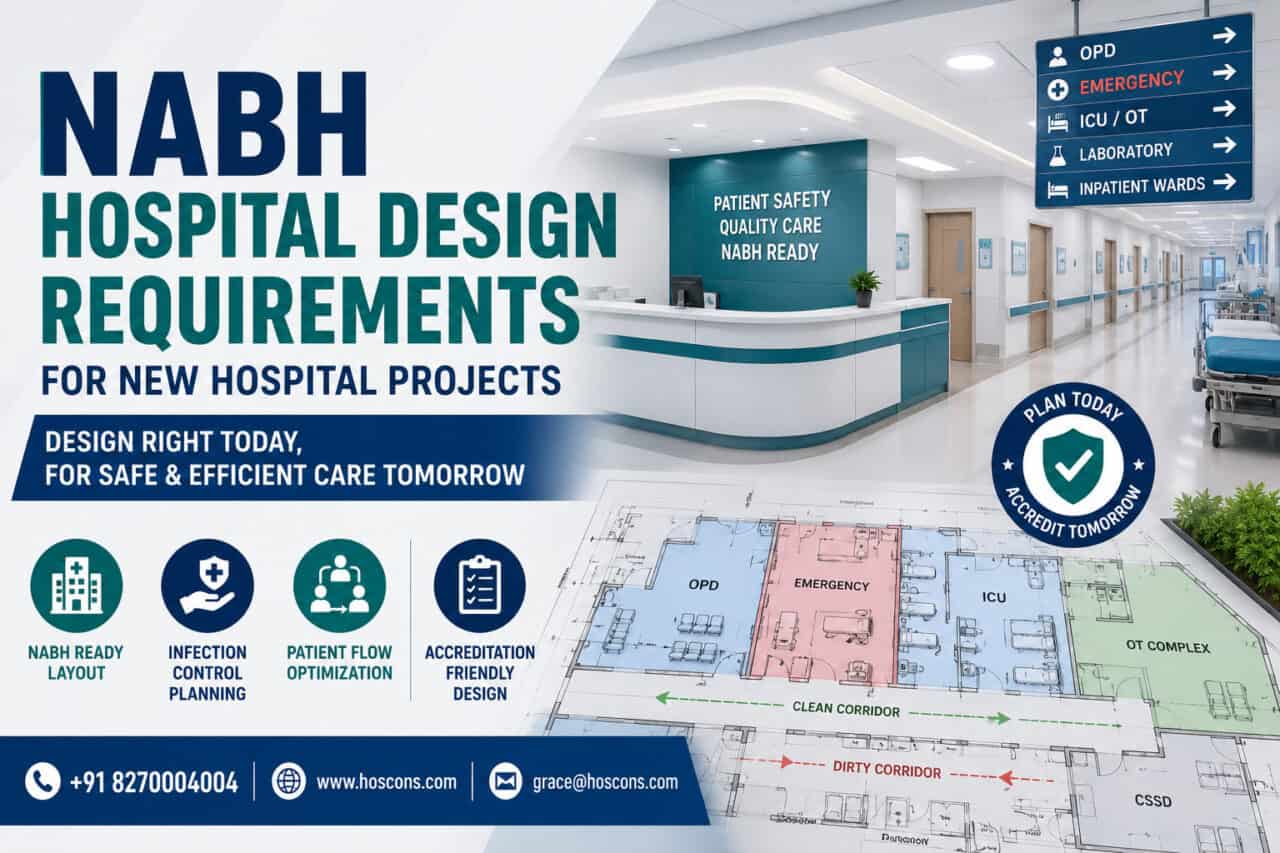
NABH Hospital Design Requirements for New Hospital Projects
Understanding NABH Hospital Design Requirements is one of the most important steps when planning a new hospital project. Many hospital promoters focus on land acquisition, building approvals, and construction timelines but fail to consider how early design decisions can impact future operations, patient safety, accreditation readiness, and long-term profitability.
One of the biggest misconceptions among hospital promoters is that NABH accreditation can be addressed after the hospital is constructed. In reality, many NABH-related challenges originate during the design and planning stage itself.
A hospital building may stand for several decades, but design mistakes made during the planning stage can affect patient care, workflow efficiency, infection control, safety standards, and operational performance throughout the life of the facility.
Why NABH Planning Must Start Before Construction
Many hospital projects begin with architectural drawings and civil planning before healthcare operational requirements are fully evaluated. While architects are experts in building design, hospitals require additional consideration for patient flow, clinical workflows, infection prevention, emergency preparedness, safety systems, and operational efficiency.
Early consideration of NABH Hospital Design Requirements helps:
- Reduce future redesign costs
- Improve operational efficiency
- Support infection control measures
- Improve patient safety
- Enhance staff productivity
- Prepare for future accreditation
- Support long-term expansion plans
- Improve patient experience
NABH Is More Than Room Sizes and Corridor Widths
When promoters hear about NABH standards, they often think only about room dimensions, handwashing stations, or infrastructure specifications.
However, NABH focuses on a much broader objective: creating a healthcare environment that promotes safety, quality, efficiency, and patient-centered care.
Hospital design should support:
- Patient safety
- Infection prevention and control
- Efficient clinical workflows
- Emergency preparedness
- Medication safety
- Staff efficiency
- Patient privacy and dignity
- Future scalability
This is why NABH readiness should be viewed as an operational planning exercise rather than merely an architectural requirement.
Key Areas That Require NABH-Oriented Planning
1. Outpatient Department (OPD)
The OPD is often the first point of contact for patients and significantly influences patient experience.
Hospital planners should consider:
- Patient movement flow
- Waiting area adequacy
- Accessibility for elderly and disabled patients
- Registration and billing workflow
- Consultation privacy
- Future specialty expansion
2. Emergency Department
Emergency services require special planning because they handle time-sensitive and critical patients.
Design considerations include:
- Ambulance access
- Triage workflow
- Resuscitation access
- Patient observation areas
- Isolation capability
- Rapid access to diagnostics
Poor emergency design can affect both patient outcomes and operational efficiency.
3. Operation Theatre Complex
Operation theatres are among the most sensitive clinical areas within a hospital.
Planning considerations include:
- Clean and sterile workflow
- Material movement pathways
- Patient transfer routes
- Equipment movement
- Infection control measures
- Future technology upgrades
Effective OT planning helps improve safety, efficiency, and long-term usability.
4. Intensive Care Units (ICU)
ICUs require careful planning to support continuous monitoring, emergency interventions, staff movement, and patient safety.
Important considerations include:
- Patient visibility
- Emergency access
- Equipment positioning
- Staff workflow
- Utility planning
- Medical gas provisions
- Infection prevention measures
5. Inpatient Wards and Rooms
Patient rooms must support comfort, safety, privacy, and nursing efficiency.
Planning considerations include:
- Patient accessibility
- Staff observation capability
- Infection control measures
- Toilet accessibility
- Patient safety provisions
- Family convenience
Infection Control Considerations
Infection prevention and control is a major component of NABH-focused planning.
Hospital design should facilitate:
- Hand hygiene practices
- Isolation capability
- Clean and dirty workflow separation
- Biomedical waste movement
- Linen movement planning
- Environmental cleaning
- Air quality management
Poor infection control planning may create operational challenges and increase healthcare-associated infection risks.
Utility and Infrastructure Planning
Many operational challenges arise because hospitals focus on civil construction while underestimating utility planning requirements.
Hospital design should consider:
- Electrical systems
- Backup power systems
- Medical gas pipelines
- Water supply
- HVAC requirements
- Biomedical equipment support
- IT infrastructure
- Future expansion requirements
Common Hospital Design Mistakes
| Common Mistake | Potential Impact |
|---|---|
| Designing without operational inputs | Workflow inefficiencies |
| Poor patient flow planning | Congestion and delays |
| Weak infection control design | Safety and accreditation concerns |
| Inadequate utility planning | Future modifications and downtime |
| No provision for expansion | Higher future capital expenditure |
| Architect-only planning approach | Operational inefficiencies |
Why Architects Alone May Not Be Enough
Architects are highly skilled in designing buildings, but hospitals are operationally complex environments that require healthcare-specific planning expertise.
Successful hospital projects often involve collaboration between:
- Architects
- Hospital consultants
- Clinical experts
- Biomedical engineers
- MEP consultants
- Operations specialists
Hospital consultants help bridge the gap between infrastructure design and operational realities by incorporating clinical workflows, patient journeys, staffing requirements, equipment planning, and future growth considerations.
How HOSCONS Supports NABH-Oriented Hospital Planning
HOSCONS assists hospital promoters, doctors, trusts, and healthcare investors in planning hospitals that align with operational requirements, future accreditation goals, and long-term growth objectives.
Our services include:
- Hospital feasibility studies
- Detailed Project Reports (DPR)
- Space programming and functional planning
- Department planning
- Workflow planning
- Medical equipment planning
- NABH readiness reviews
- Hospital commissioning support
- Turnkey hospital project consulting
Planning a New Hospital Project?
Ensure your hospital is designed for operational efficiency, patient safety, future growth, and accreditation readiness from day one. HOSCONS can help you plan smarter and avoid costly design mistakes.
👉 Contact HOSCONS for Hospital Planning Support
📍 Serving Hospitals across India & International Markets
📞 +91 8270004004
🌐 www.hoscons.com
📩 grace@hoscons.com
Related Services:
- Hospital Feasibility Study Consultants
- Hospital DPR Consultants
- Turnkey Hospital Project Consultants
- Hospital Project Management Consultants
- Hospital Consulting Division
According to the National Accreditation Board for Hospitals & Healthcare Providers (NABH), healthcare facilities should be designed to support patient safety, quality care, infection prevention, and operational effectiveness.
Frequently Asked Questions
When should NABH planning start in a hospital project?
NABH-oriented planning should begin during the hospital design stage before construction starts.
Can NABH requirements be incorporated after construction?
Some requirements can be addressed later, but many design-related issues become expensive and difficult to modify once construction is completed.
Does NABH focus only on infrastructure?
No. NABH focuses on patient safety, quality systems, infection control, workflows, emergency preparedness, and operational effectiveness in addition to infrastructure.
Why should hospital consultants be involved during planning?
Hospital consultants help align infrastructure with clinical workflows, operational requirements, equipment planning, future expansion, and accreditation readiness.