
“`html
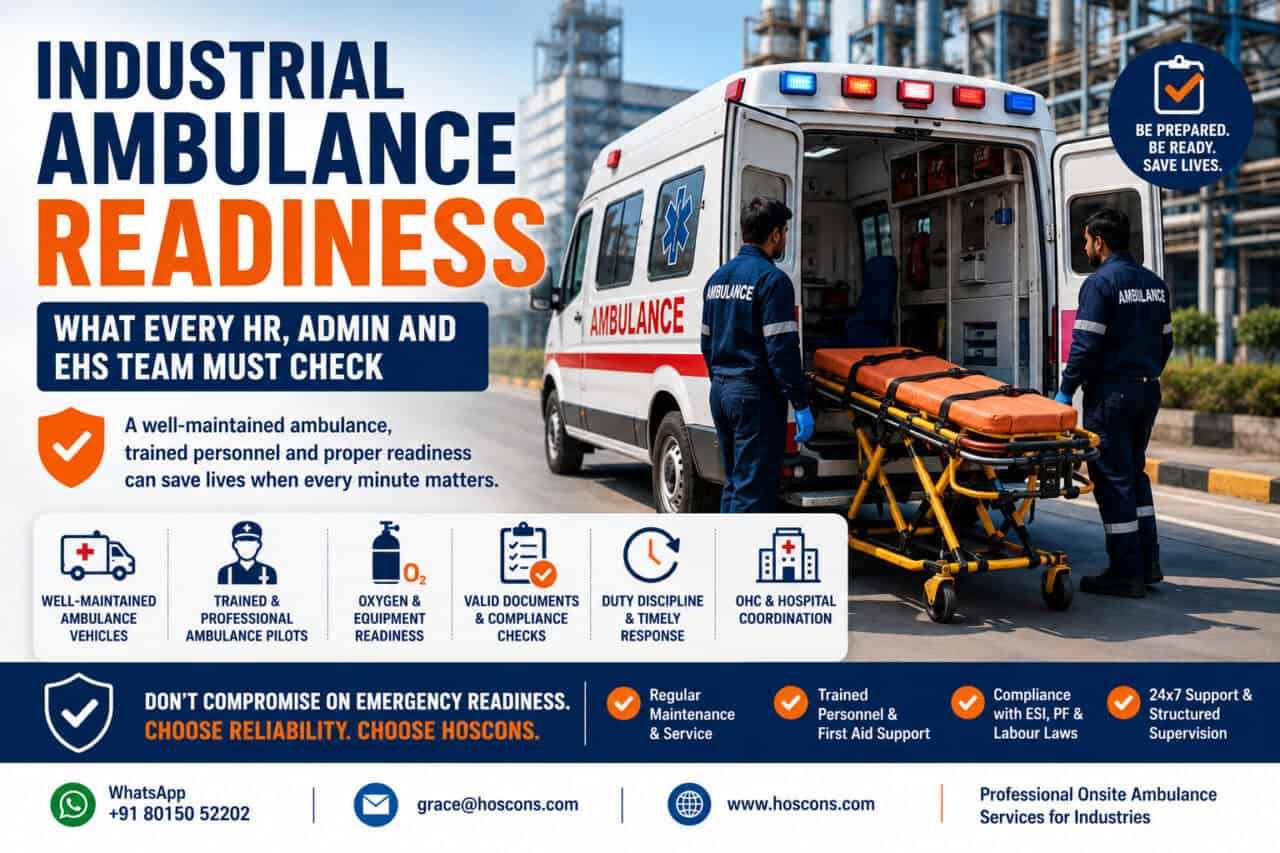
Industrial Ambulance Readiness: What Every HR, Admin and EHS Team Must Check
Industrial ambulance readiness is not just about keeping an ambulance parked inside the factory premises. During a real medical emergency, the ambulance must be roadworthy, well-maintained, equipped, oxygen-ready, properly documented and operated by a trained ambulance pilot who can respond quickly and safely.
For factories and industries, ambulance service is closely linked to employee safety, emergency response, OHC coordination, referral hospital movement and management accountability. A vehicle may be available on paper, but if it is poorly maintained, inadequately equipped or handled by an untrained driver, the organisation may face serious risk during emergencies.
HOSCONS helps industries move from simple ambulance vehicle supply to professionally managed emergency-response readiness with well-maintained vehicles, trained ambulance pilots, duty discipline, compliance support and Occupational Health Centre coordination.
An industrial ambulance should not be just a parked compliance vehicle. It should be a reliable emergency-response system ready to move when every minute matters.
Key Areas to Check in Industrial Ambulance Readiness
Vehicle Condition
The ambulance should be roadworthy, regularly serviced, hygienic, mechanically reliable and suitable for emergency movement.
Valid Documents
FC, insurance, registration, pollution certificate, service records and other vehicle documents should be valid and updated.
Trained Ambulance Pilot
The person handling the ambulance should be trained, disciplined, alert and familiar with emergency response protocols.
Equipment Readiness
Oxygen, stretcher, first aid materials, emergency equipment and consumables must be checked regularly.
Duty Discipline
Ambulance duty must include proper roster planning, rest, backup arrangement and attendance discipline.
OHC Coordination
The ambulance team must coordinate with the OHC doctor, nurse, EHS team and referral hospitals during emergencies.
An Ambulance Is Not Just a Vehicle Parked at the Factory Gate
Many organisations check whether an ambulance is physically present inside the factory premises and assume that emergency readiness is covered. But vehicle availability alone does not mean emergency readiness.
During an actual emergency, the ambulance must be able to move immediately, reach the right location inside the campus, safely shift the employee, coordinate with the OHC team and transport the patient to the appropriate hospital without confusion or delay.
- Is the ambulance roadworthy and mechanically reliable?
- Is the oxygen cylinder filled and functional?
- Is the stretcher usable and clean?
- Are first aid materials and emergency consumables available?
- Is the ambulance pilot trained and alert?
- Does the ambulance team know the emergency route?
- Is there coordination with the OHC team and referral hospitals?
If these points are not checked, the ambulance may satisfy a basic compliance expectation but may fail during a real emergency.
Vehicle Condition: Service, Fitness Certificate, Insurance and Hygiene Matter
Factories should not treat ambulance selection like normal vehicle hiring. An industrial ambulance must be reliable enough to respond during critical situations. Poor vehicle condition, weak maintenance or expired documentation can create serious risk.
HR, Admin and EHS teams should regularly verify whether the ambulance is properly serviced, clean, mechanically fit and supported with valid documents.
- Valid vehicle registration
- Valid Fitness Certificate where applicable
- Valid insurance
- Updated pollution certificate
- Regular service records
- Clean and hygienic patient area
- Functional lights, siren and electrical systems
- Reliable tyres, brakes and battery condition
- Proper air conditioning and ventilation where applicable
A poorly maintained ambulance can become a risk during the very moment it is expected to save time and support life.
Why Low-Cost Ambulance Vendors Can Create Emergency Response Risk
Low-cost ambulance arrangements may appear attractive from a monthly billing perspective, but hidden risks can become visible only during emergencies. Some arrangements fail because the vehicle is old, poorly maintained, inadequately equipped or not suitable for reliable emergency movement.
In some cases, ambulance service is treated as a simple driver-and-vehicle arrangement without proper emergency orientation, duty planning, statutory coverage, supervision or equipment checks.
- Old or poorly maintained vehicles
- Weak air conditioning or poor patient comfort
- Expired or missing documents
- Untrained drivers without first aid orientation
- Frequent driver changes
- No proper backup arrangement
- Continuous duty without adequate rest
- Weak equipment and oxygen readiness
- No structured coordination with OHC or referral hospitals
In emergency response, the cheapest monthly ambulance quote may become expensive if the vehicle fails, the driver is untrained or the response is delayed.
Driver vs Professional Ambulance Pilot
Industrial ambulance service should not depend only on a driver who knows how to operate the vehicle. The person handling the ambulance must understand the seriousness of emergency movement, patient transfer, route discipline, OHC communication and first response coordination.
At HOSCONS, we position ambulance drivers as professional ambulance pilots — trained, disciplined and oriented to emergency response, patient handling support, basic first aid coordination, route planning and communication with the OHC team.
Ordinary Driver Approach
- Vehicle driving focus only
- Limited emergency orientation
- Poor site familiarity if frequently changed
- Weak communication during emergencies
- No structured duty discipline
Professional Ambulance Pilot Approach
- Emergency response orientation
- Basic first aid awareness
- Patient transfer support
- OHC and EHS coordination
- Route discipline and hospital movement readiness
Duty Rotation: Why Tired Drivers Are a Safety Risk
A tired ambulance driver is a safety risk. Ambulance duty must be planned with proper rest, backup arrangement and duty rotation. Continuous duty for long periods without rest can compromise alertness, response quality and road safety.
HR, Admin and EHS teams should check whether the ambulance manpower is deployed with proper duty discipline and statutory employment practices.
- Proper duty roster
- Backup ambulance pilot availability where required
- No unsafe continuous duty patterns
- Attendance discipline
- Rest and replacement planning
- Basic first aid and emergency orientation
- Statutory coverage such as ESI/PF wherever applicable
Ambulance readiness depends not only on the vehicle, but also on the alertness, training and discipline of the person operating it.
Frequent Driver Changes Can Affect Emergency Confidence
Frequent ambulance driver replacement can create operational risk. A new driver may not know the factory layout, internal emergency points, gate movement process, nearest hospital routes, OHC coordination protocol or key emergency contacts.
In emergencies, site familiarity is important. The ambulance pilot must know where to reach, whom to call, how to move inside the premises and which hospital route to take.
- Factory layout familiarity
- Emergency assembly and pick-up points
- Internal route and gate movement process
- Nearby hospital route knowledge
- OHC doctor and nurse coordination
- EHS and security coordination
- Emergency contact escalation process
A stable, trained and supervised ambulance pilot improves emergency confidence inside the workplace.
Ambulance Equipment and Oxygen Readiness Checklist
HR, Admin and EHS teams should periodically verify whether the ambulance is equipped and ready. Equipment should not be checked only during vendor onboarding. It should be part of a regular readiness review.
- Oxygen cylinder availability and pressure check
- Oxygen mask and tubing
- Functional stretcher
- Wheelchair where applicable
- First aid kit
- Basic emergency consumables
- Gloves and infection control materials
- BP apparatus and basic monitoring tools where applicable
- Clean linen and patient transfer support materials
- Fire extinguisher and safety items
- Emergency contact list
- Referral hospital contact details
An ambulance without ready oxygen, basic equipment and trained support is only a vehicle — not an emergency-response asset.
OHC, Ambulance and Referral Hospital Coordination
Industrial ambulance readiness becomes stronger when it is integrated with the Occupational Health Centre, EHS team, security team and referral hospital network. The ambulance team should not function in isolation.
During emergencies, the OHC team may need to stabilise the employee, communicate the clinical condition, decide the referral priority, coordinate ambulance movement and inform the receiving hospital.
- OHC doctor and nurse coordination
- EHS and safety team communication
- Security and gate clearance process
- Referral hospital selection and route planning
- Emergency contact escalation
- Patient handover documentation
- Post-incident review and reporting
This coordination helps reduce confusion, delay and panic during workplace medical emergencies.
What HR, Admin and EHS Teams Must Check Before Choosing an Ambulance Vendor
Before finalising an ambulance vendor, industries should evaluate more than the monthly cost. The vendor should be assessed for vehicle quality, manpower discipline, documentation, readiness checks and emergency coordination capability.
- Is the ambulance vehicle well-maintained and suitable for emergency use?
- Are FC, insurance and other documents valid?
- Is the vehicle clean, hygienic and air-conditioned where required?
- Are oxygen and basic emergency equipment available?
- Is the ambulance pilot trained and first-aid oriented?
- Is there proper duty roster and backup support?
- Are ambulance pilots covered under proper employment compliance where applicable?
- Is the driver frequently changed or site-stable?
- Is there coordination with the OHC team?
- Are nearby referral hospital routes and contacts ready?
- Are ambulance readiness checks documented?
- Does the vendor provide supervision and accountability?
How HOSCONS Provides Professionally Managed Industrial Ambulance Support
HOSCONS does not treat ambulance service as simple vehicle supply. We provide professionally managed industrial ambulance support with maintained vehicles, trained ambulance pilots, compliance discipline and emergency-response coordination.
Our approach is designed for factories and industries that need dependable ambulance readiness, not just vehicle availability.
- Company-serviced and well-maintained ambulance vehicles
- Regular vehicle fitness and document checks
- Professional ambulance pilots
- First aid and emergency response orientation
- Duty roster discipline and backup planning
- Statutory manpower coverage support where applicable
- OHC doctor, nurse and ambulance coordination
- Oxygen and equipment readiness checks
- Referral hospital coordination support
- Structured vendor supervision and reporting
HOSCONS helps industries convert ambulance service from a parked compliance vehicle into a coordinated emergency-response system.
Explore Related HOSCONS Occupational Health Services
Industries looking to strengthen emergency readiness can also explore our related occupational health services:
Final Thought
Industrial ambulance readiness should never be reduced to monthly vehicle availability.
The ambulance must be well-maintained, equipped, documented, oxygen-ready and operated by a trained ambulance pilot who can respond with discipline during emergencies.
When an emergency happens, readiness matters more than monthly savings.
Review Your Factory Ambulance Readiness
If your organisation wants to strengthen ambulance readiness, HOSCONS can help you with professionally managed onsite ambulance services, trained ambulance pilots, maintained vehicles, oxygen and equipment checks, OHC coordination and emergency response readiness support.
Contact HOSCONS to discuss onsite ambulance services for factories and industries.
WhatsApp: Chat with HOSCONS I Email: grace@hoscons.com I Website: www.hoscons.com
Send Your Ambulance Service Requirement
Share your location, shift requirement, ambulance type, workforce size and OHC requirement. Our team will get in touch with you.
Frequently Asked Questions
What is industrial ambulance readiness?
Industrial ambulance readiness means ensuring that the ambulance is roadworthy, equipped, oxygen-ready, properly documented, operated by a trained ambulance pilot and integrated with the factory emergency response system.
Is ambulance availability alone enough for factories?
No. Vehicle availability alone is not enough. The ambulance must be maintained, equipped, staffed properly, documented and ready to respond during real emergencies.
Why is ambulance vehicle maintenance important?
Poorly maintained vehicles may fail during emergencies. Regular service, valid documents, working air conditioning, functional lights, tyres, brakes and hygiene are important for reliable emergency movement.
What is a professional ambulance pilot?
A professional ambulance pilot is more than a driver. The ambulance pilot is trained and oriented in emergency movement, first aid coordination, patient transfer support, route planning and OHC communication.
Why is duty rotation important for ambulance pilots?
Continuous duty without adequate rest can affect alertness and road safety. Proper duty rotation, backup planning and attendance discipline are essential for safe ambulance response.
How does HOSCONS support industrial ambulance services?
HOSCONS provides professionally managed onsite ambulance services with well-maintained vehicles, trained ambulance pilots, equipment readiness checks, OHC coordination, duty discipline and emergency response support.
“`