
“`html
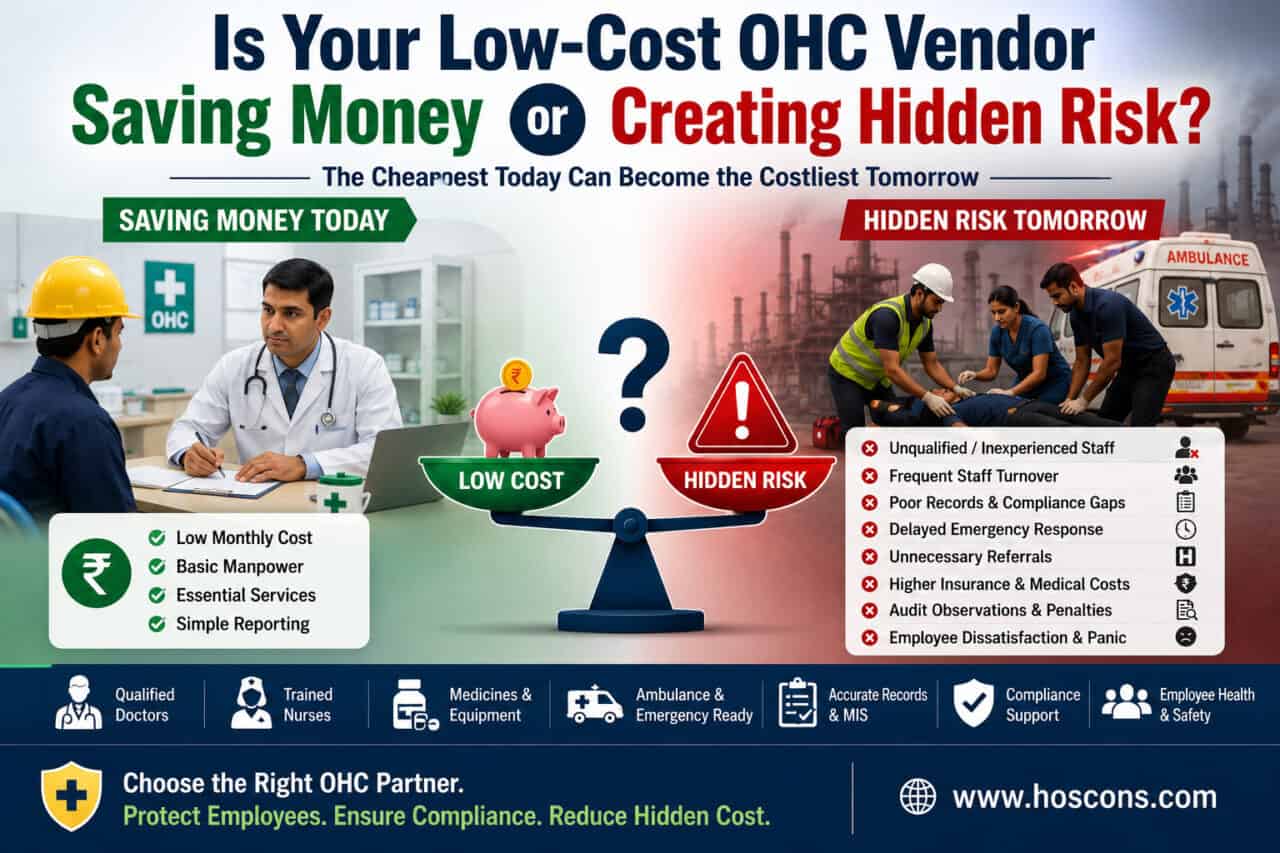
Is Your Low-Cost OHC Vendor Saving Money or Creating Hidden Risk?
For many factories and industries, the Occupational Health Centre is often seen as a routine monthly expense. During vendor selection, the focus may quickly shift to one question:
Who is giving the lowest quote?
But in Occupational Health Centre management, the lowest monthly quote is not always the lowest cost. A low-cost OHC vendor may reduce the visible monthly bill, but can create hidden risks through poor staffing, weak documentation, inadequate emergency readiness, unnecessary referrals, medicine gaps and compliance failures.
For factories, the real cost of a poorly managed OHC may be seen only during an emergency, audit, employee complaint, statutory inspection or serious workplace health incident.
The Cheapest OHC Vendor May Not Be the Safest OHC Partner
An Occupational Health Centre is not just a place where a doctor or nurse sits during duty hours. It is the organisation’s first line of defence for employee health, first aid, emergency response, statutory medical records, referral control and workplace health risk management.
When an OHC is managed only as a low-cost manpower supply arrangement, the organisation may save a small amount every month but lose much more through operational gaps, compliance exposure and poor health outcomes.
A good OHC vendor should not only provide manpower. It should protect employees, support compliance and reduce hidden organisational risk.
Visible Cost vs Hidden Cost in OHC Management
When companies compare OHC vendors, they usually compare visible costs such as doctor charges, nurse salary, ambulance cost, medicines and vendor service charges.
However, hidden costs are often ignored during vendor finalisation.
Visible Cost
- Doctor and nurse deployment cost
- Ambulance service charges
- Medicine and consumable cost
- Vendor management fee
- Health checkup camp cost
Hidden Cost
- Compliance gaps and audit observations
- Delayed emergency response
- Poor medical documentation
- Unnecessary hospital referrals
- Higher insurance claim usage
- Employee dissatisfaction and panic
- Management time spent on corrections
Where Low-Cost OHC Vendors Usually Cut Corners
Many low-cost OHC vendors are able to quote aggressively because they reduce supervision, staffing quality, backup planning, reporting systems or compliance support. These gaps may not be visible on day one, but they slowly weaken the entire workplace health system.
- Poorly selected or inadequately trained medical staff
- Frequent doctor, nurse or paramedic replacement
- No structured backup during leave or absence
- Weak supervision from the vendor side
- No monthly review of OHC records and registers
- Poor medicine stock and expiry control
- No proper emergency medicine and equipment checklist
- Weak ambulance coordination and emergency protocol
- No meaningful MIS or health trend reporting
- No follow-up on annual health checkup abnormalities
In such cases, the factory may technically have an OHC, but the OHC may not be functioning as a strong occupational health system.
Poor Documentation Can Become Expensive During Audits
In factories, OHC documentation is not a formality. It becomes important during internal audits, statutory reviews, client audits, EHS inspections, accident investigations and management reviews.
A low-cost vendor may maintain basic registers, but the quality of documentation is often weak. Missing entries, incomplete case records, poor referral documentation, expired medicine records, unclear fitness tracking and absent follow-up reports can create avoidable risk for the employer.
During an audit or incident review, the question will not be whether the vendor was cheap. The question will be whether the factory had a properly managed occupational health system.
Emergency Response Failure Is the Biggest Hidden Risk
A weak OHC may look affordable until there is a real medical emergency inside the factory.
Workplace emergencies may include injuries, chest pain, fainting, burns, chemical exposure, breathing difficulty, seizures, trauma, heat-related illness or sudden collapse. In such situations, every minute matters.
If the OHC team is not trained, if emergency medicines are missing, if equipment is not functional, if ambulance coordination is weak or if referral protocols are unclear, the organisation may face serious consequences.
- Delayed first response
- Poor stabilisation before referral
- Panic among employees and supervisors
- Confusion in ambulance movement
- Unclear documentation after the incident
- Higher management and legal exposure
This is why OHC vendor selection should never be based on price alone.
Low-Cost Vendors May Increase Unnecessary Referrals
A professionally managed OHC should know what can be safely managed inside the factory and what genuinely requires hospital referral.
But when the OHC team is not confident, not supervised or not properly trained, even minor cuts, simple dressing cases, mild symptoms or manageable first aid cases may be referred outside unnecessarily.
Frequent unnecessary referrals can create multiple problems for the employer.
- Increased hospital visits
- Employee panic and anxiety
- Higher consultation and investigation usage
- Higher insurance claim utilisation
- More HR and admin follow-up work
- Loss of productive working hours
An OHC should not become a referral counter. It should function as a workplace health, first-response, documentation and risk-control system.
Poor OHC Management Can Affect Employer Health Costs
When employees are frequently referred outside for manageable conditions, it may increase consultation visits, diagnostic tests, medication usage and insurance claims.
Over time, this may affect the employer’s medical expenditure, claim utilisation pattern and future insurance premium discussions.
A strong OHC partner helps reduce avoidable escalation by ensuring proper first aid, clinical judgement, documentation, referral review and employee counselling.
The goal is not to avoid necessary hospital referral. The goal is to avoid unnecessary medical escalation while ensuring that genuine emergencies and serious cases receive timely care.
Cheap Manpower Supply Is Not OHC Management
One of the biggest mistakes factories make is treating OHC services as a simple manpower contract.
A real OHC partner should provide structured occupational health management, not just deploy a doctor and nurse.
Manpower Supplier Approach
- Provides staff
- Limited supervision
- Basic attendance focus
- Weak reporting
- Reactive response
OHC Management Approach
- Provides staff with systems
- Supervises clinical and operational quality
- Maintains records and MIS
- Reviews referrals and emergencies
- Supports compliance and audits
What Factories Should Check Before Choosing an OHC Vendor
Before selecting an OHC vendor, companies should look beyond the monthly quotation and evaluate whether the vendor can actually manage workplace health risks.
- Is the doctor qualified and suitable for factory OHC work?
- Is there a proper nurse, paramedic and support staffing plan?
- Is backup coverage available during leave or absence?
- Are OHC records reviewed periodically?
- Are emergency medicines and equipment checked regularly?
- Is ambulance readiness monitored?
- Are referral cases reviewed?
- Are annual medical checkup abnormalities followed up?
- Is monthly MIS submitted to HR, Admin or EHS?
- Does the vendor understand factory compliance requirements?
- Is the vendor only supplying manpower or managing the OHC?
How HOSCONS Helps Industries Reduce Hidden OHC Risk
HOSCONS supports factories and industries with structured Occupational Health Centre services designed to improve compliance, emergency readiness, employee health support and operational control.
Our approach goes beyond low-cost manpower supply. We focus on practical OHC management that supports both employee welfare and employer risk reduction.
- Occupational Health Centre setup and management
- Doctor, nurse and paramedic deployment
- AFIH and MBBS doctor support based on requirement
- Annual and periodic medical checkups
- Ambulance coordination and emergency readiness
- OHC medicines, consumables and equipment support
- Medical records, registers and monthly MIS
- Referral review and escalation control
- OHC audit and corrective action support
- Employee health counselling and follow-up
HOSCONS helps industries convert the OHC from a routine cost centre into a structured workplace health and compliance support system.
Explore HOSCONS Occupational Health Services
Industries looking to strengthen their OHC system can also explore our related occupational health services:
Final Thought
In OHC management, the cheapest vendor may become the costliest risk.
The right vendor is not the one who quotes the lowest price, but the one who protects employees, supports compliance, manages emergencies, maintains records and reduces hidden organisational cost.
Before choosing a low-cost OHC vendor, factories should ask one important question: Are we saving money today, or creating hidden risk for tomorrow?
Request an OHC Cost & Compliance Review
If you are unsure whether your current OHC vendor is protecting your organisation or creating hidden risk, HOSCONS can help you review your OHC system, staffing, emergency readiness, documentation, referrals, medicines and compliance gaps.
Contact HOSCONS for structured Occupational Health Centre management and review support.
WhatsApp: Chat with HOSCONS I Email: grace@hoscons.com I Website: www.hoscons.com
Send Your OHC Requirement
Share your current OHC requirement or vendor concern. Our team will get in touch with you.
Frequently Asked Questions
Why should factories avoid choosing OHC vendors based only on price?
Choosing an OHC vendor only based on price can create hidden risks such as poor staffing, weak documentation, emergency response gaps, unnecessary referrals and compliance issues.
What is the hidden cost of a low-cost OHC vendor?
Hidden costs may include audit observations, delayed emergency response, poor medical records, higher hospital referrals, increased insurance usage, employee dissatisfaction and management time spent on corrections.
Is OHC only a manpower supply service?
No. A professionally managed OHC should include staffing, supervision, emergency protocols, medicine management, record maintenance, referral review, MIS reporting, health checkup follow-up and compliance support.
How can HOSCONS help factories with OHC management?
HOSCONS supports factories with Occupational Health Centre setup, doctor and nurse deployment, annual medical checkups, ambulance coordination, medicines and equipment, records, MIS, referral review, OHC audit and compliance support.
“`