
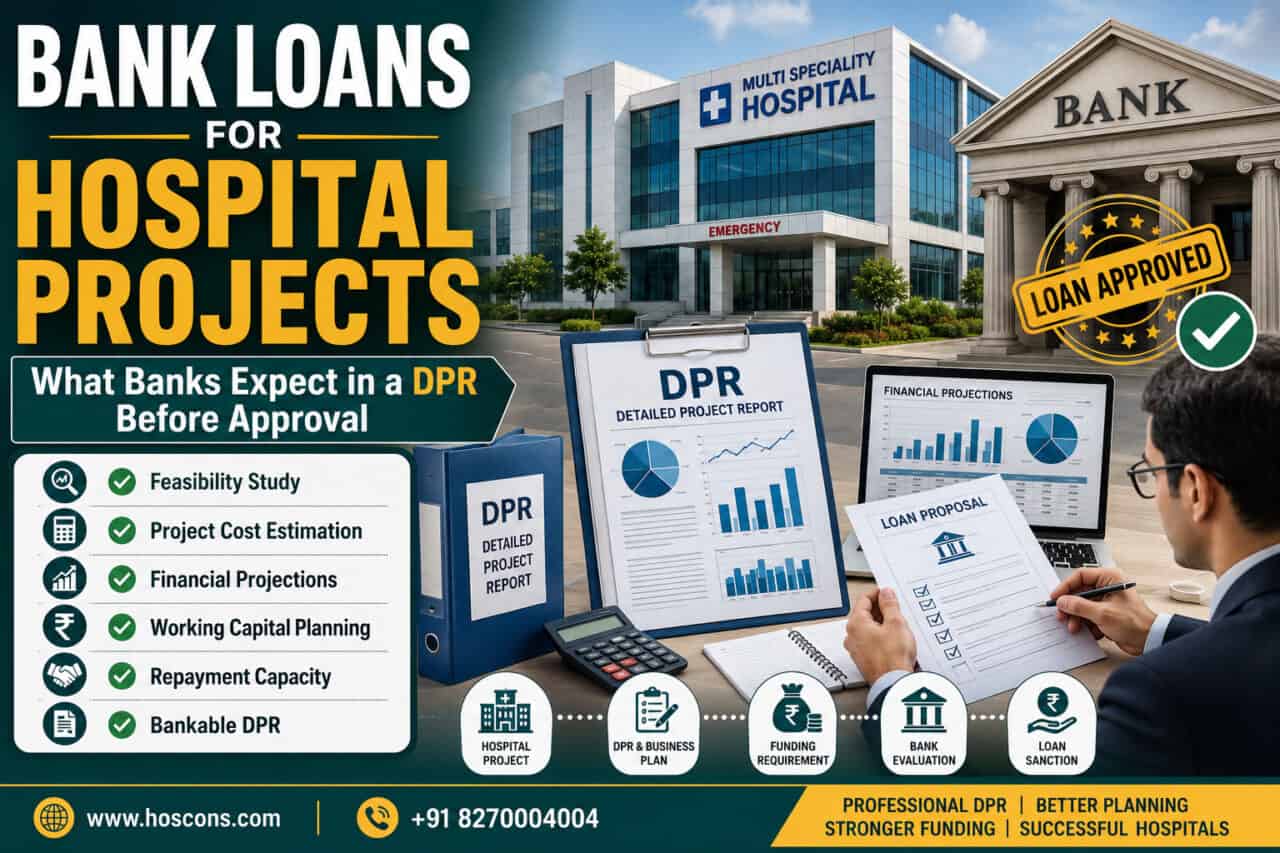
Bank Loans for Hospital Projects: What Banks Expect in a DPR
Securing bank loans for hospital projects is one of the biggest challenges faced by doctors, healthcare entrepreneurs, trusts, and investors planning a new hospital. While banks actively finance healthcare infrastructure projects, loan approval depends heavily on the quality of the Detailed Project Report (DPR), project feasibility, promoter profile, and financial viability.
Many hospital promoters assume that owning land and having a hospital concept is sufficient to secure funding. In reality, banks undertake detailed due diligence before approving hospital loans and expect a professionally prepared DPR that demonstrates the project’s viability and repayment capability.
Why Banks Finance Hospital Projects
Healthcare is considered a priority sector in many regions because of its social impact and long-term growth potential. Hospitals generate employment, improve healthcare access, and support community development.
However, hospitals are also capital-intensive projects that require substantial investment in land, construction, medical equipment, manpower, and working capital. Therefore, banks carefully evaluate risks before approving funding.
What Is a Hospital DPR?
A Detailed Project Report (DPR) is a comprehensive document that evaluates every aspect of a proposed hospital project.
The DPR helps banks understand:
- The project’s feasibility
- Total project cost
- Promoter capability
- Market demand
- Revenue potential
- Profitability projections
- Loan repayment capacity
- Operational risks
For most banks, the DPR serves as the foundation for evaluating bank loans for hospital projects.
What Banks Expect in a Hospital DPR
A bankable hospital DPR should address multiple areas of the project in a structured and professional manner.
1. Promoter Background and Experience
Banks want to understand who is leading the project.
- Educational qualifications
- Medical background
- Business experience
- Healthcare experience
- Existing hospitals or clinics
- Financial strength
Strong promoter credentials significantly improve lender confidence.
2. Market Feasibility Study
Banks expect evidence that the proposed hospital can attract sufficient patients and generate sustainable revenue.
The DPR should include:
- Catchment area analysis
- Population demographics
- Disease burden analysis
- Healthcare demand assessment
- Competitor mapping
- Referral patterns
- Growth opportunities
3. Hospital Concept and Service Mix
Banks want clarity regarding:
- Hospital type
- Bed strength
- Specialties offered
- Critical care services
- Diagnostic facilities
- Operation theatres
- Emergency services
The service mix should align with local healthcare demand and market opportunities.
4. Project Cost Estimation
Banks carefully review project cost estimates because underestimating costs can create future funding gaps.
A hospital DPR should clearly present:
- Land cost
- Civil construction cost
- MEP and infrastructure cost
- Medical equipment budget
- Furniture and fixtures
- IT and HIS investment
- Licensing expenses
- Pre-opening expenses
- Contingency provisions
5. Medical Equipment Planning
Medical equipment represents a significant portion of hospital investment.
Banks often review:
- Equipment list
- Department-wise allocation
- Budget justification
- Vendor quotations
- Procurement strategy
Proper equipment planning demonstrates financial discipline and operational readiness.
6. Revenue Projections
Banks expect realistic financial projections rather than overly optimistic assumptions.
Revenue projections should include:
- OPD volumes
- IP occupancy
- Diagnostics revenue
- Surgical revenue
- Pharmacy revenue
- Insurance and corporate business
Assumptions must be supported by market data and feasibility findings.
7. Operating Cost Projections
The DPR should estimate:
- Manpower expenses
- Consumables
- Utilities
- Maintenance
- Marketing costs
- Administrative expenses
- Insurance costs
Banks compare projected revenue against operating expenses to assess sustainability.
8. Working Capital Requirement
Many new hospitals require working capital support during the initial months of operation.
The DPR should estimate:
- Monthly operational expenses
- Cash flow requirements
- Break-even period
- Working capital gap
9. Loan Repayment Capacity
Ultimately, banks need confidence that the hospital can repay the loan.
The DPR should clearly demonstrate:
- Projected profitability
- Cash flow adequacy
- Debt servicing capability
- DSCR (Debt Service Coverage Ratio)
- Break-even analysis
A strong repayment profile significantly improves funding prospects.
Common Reasons Banks Reject Hospital Loan Applications
- Poor market feasibility assessment
- Unrealistic financial projections
- Inadequate promoter contribution
- Incomplete DPR documentation
- Weak repayment projections
- Overestimated occupancy assumptions
- Insufficient working capital planning
- Lack of healthcare expertise
How HOSCONS Helps Secure Bank Loans for Hospital Projects
HOSCONS assists hospital promoters in preparing professional, bankable DPRs that meet lender expectations and support funding discussions.
Our services include:
- Hospital feasibility studies
- Detailed Project Reports (DPR)
- Project cost estimation
- Revenue and profitability projections
- Working capital assessment
- Medical equipment planning
- Business planning
- Hospital project advisory
- Funding support documentation
- Turnkey project consulting
Need a Bankable Hospital DPR?
Whether you are planning a new hospital, expansion project, specialty center, or healthcare facility, HOSCONS can help prepare a professional DPR that improves funding readiness and supports informed investment decisions.
👉 Contact HOSCONS for Hospital DPR Preparation
📍 Serving Hospitals across India & International Markets
📞 +91 8270004004
🌐 www.hoscons.com
📩 grace@hoscons.com
Related Services:
- Hospital Feasibility Study Consultants
- Hospital DPR Consultants
- Turnkey Hospital Project Consultants
- Hospital Project Management Consultants
According to the World Bank, healthcare infrastructure investments require strong planning, financial sustainability, and long-term operational viability to ensure successful outcomes.