
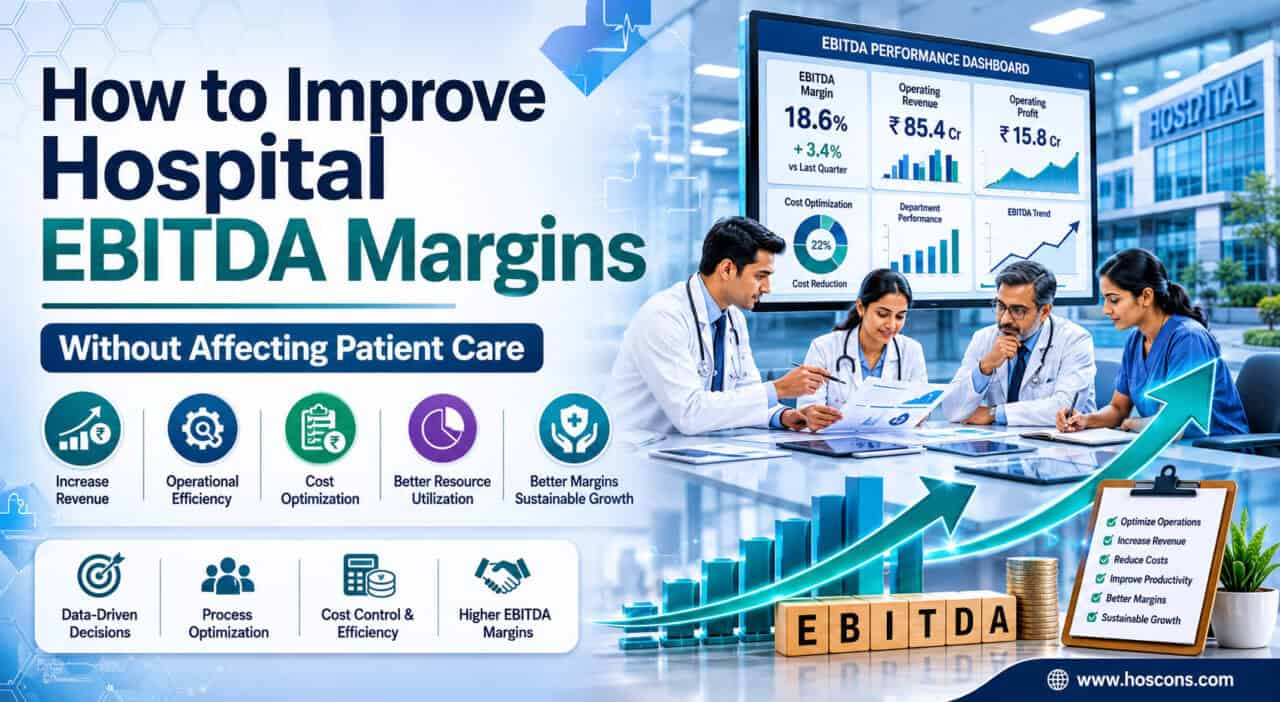
How to Improve Hospital EBITDA Margins Without Affecting Patient Care
Improving hospital EBITDA margins has become a major priority for healthcare organizations facing rising operational costs, insurance pressures, manpower expenses, and tightening profitability. In today’s competitive healthcare environment, hospitals must improve operational efficiency, optimize revenue realization, and strengthen financial performance without compromising patient care quality.
Many hospitals assume that increasing occupancy alone will automatically improve profitability. However, sustainable hospital growth depends on stronger EBITDA margins driven by smarter systems, better utilization, and operational discipline.
What Is EBITDA in Hospitals?
EBITDA stands for Earnings Before Interest, Taxes, Depreciation, and Amortization. In hospital management, EBITDA is one of the most important indicators of operational profitability and financial health.
It reflects how efficiently a hospital generates operating profits from its healthcare services before accounting and financing adjustments.
Healthy hospital EBITDA margins generally indicate:
- Strong operational efficiency
- Better revenue realization
- Controlled operational costs
- Higher department productivity
- Improved specialty utilization
- Sustainable long-term growth
Why Many Hospitals Struggle With EBITDA Margins
Even hospitals with good occupancy and patient inflow may struggle financially because profitability is often affected by hidden operational inefficiencies.
Common factors affecting hospital EBITDA margins include:
- Revenue leakage in billing and insurance claims
- Low ARPOB realization
- Weak specialty monetization
- Underutilized diagnostics and OT capacity
- High manpower expenses
- Poor procurement control
- Extended ALOS without clinical justification
- Low surgical conversion rates
- Department-level inefficiencies
- Weak operational monitoring systems
Practical Strategies to Improve Hospital EBITDA Margins
1. Improve ARPOB and Specialty Revenue
One of the fastest ways to improve hospital EBITDA margins is by increasing Average Revenue Per Occupied Bed (ARPOB).
Hospitals can improve ARPOB through:
- Better specialty mix optimization
- Higher surgical conversion rates
- Advanced procedure development
- Diagnostics utilization enhancement
- Cross-specialty referrals
- Improved insurance tariff management
- Clinical package restructuring
2. Reduce Revenue Leakage
Revenue leakage is one of the biggest hidden threats to hospital profitability.
Leakages commonly occur through:
- Uncaptured consumables
- Billing errors
- Package deviations
- Insurance deduction losses
- Pharmacy reconciliation gaps
- Unbilled diagnostics and procedures
- Weak revenue cycle monitoring
Regular revenue leakage audits can significantly improve realization without increasing patient volumes.
3. Optimize Manpower Productivity
Manpower costs form a major portion of hospital operational expenditure.
Instead of focusing purely on staff reduction, hospitals should improve productivity through:
- Department-wise manpower benchmarking
- Role-based accountability systems
- Optimized shift planning
- Cross-functional staff utilization
- Performance monitoring systems
- Skill-based deployment models
- Workflow restructuring
4. Improve OT and Diagnostics Utilization
Operation theatres and diagnostics departments are among the most important hospital revenue centers.
Hospitals can improve utilization through:
- Better OT scheduling systems
- Reduced turnaround times
- Specialty-wise OT allocation
- Improved consultant engagement
- Enhanced diagnostics referrals
- Streamlined patient coordination
5. Control Procurement and Inventory Costs
Poor procurement systems can silently reduce hospital profitability through wastage, blocked inventory, and inefficient purchasing.
Hospitals should focus on:
- Vendor consolidation
- Inventory standardization
- Expiry monitoring systems
- Consumption-based procurement
- Centralized purchasing systems
- Negotiated vendor contracts
- Fast-moving and slow-moving stock analysis
6. Reduce ALOS Through Better Coordination
Extended Average Length of Stay (ALOS) increases operational costs and reduces bed turnover efficiency.
Hospitals can optimize ALOS through:
- Early discharge planning
- Clinical pathway standardization
- Improved diagnostics coordination
- Faster insurance approvals
- Department coordination improvement
- Digital workflow monitoring
Why EBITDA Improvement Requires a Systems Approach
Many hospitals focus only on isolated financial measures. However, EBITDA improvement requires coordinated optimization across operational, financial, clinical, and administrative functions.
Successful hospitals continuously monitor:
- ARPOB
- ARPP
- Occupancy
- ALOS
- OT utilization
- Diagnostics contribution
- Department profitability
- Manpower productivity
- Revenue leakage
- Cash flow cycles
How HOSCONS Helps Hospitals Improve EBITDA Margins
HOSCONS works with hospitals across India to improve hospital EBITDA margins through structured operational and financial optimization consulting.
Our hospital performance consulting services include:
- Hospital operational efficiency reviews
- Revenue leakage audits
- ARPOB and ARPP optimization
- Department profitability analysis
- Hospital turnaround consulting
- Revenue cycle management optimization
- Manpower productivity improvement
- Specialty profitability enhancement
- Executive dashboard development
- Operational restructuring strategies
Improve Hospital EBITDA Margins With HOSCONS
Whether your hospital is facing profitability challenges, weak operational efficiency, rising costs, or revenue leakage issues, HOSCONS can help identify practical strategies to improve EBITDA margins sustainably.
👉 Contact HOSCONS for Hospital EBITDA Improvement Consulting
📍 Serving Hospitals across India & International Markets
📞 +91 8270004004
🌐 www.hoscons.com
📩 grace@hoscons.com
Related Hospital Consulting Services:
- Hospital Operations Management Consulting
- Hospital Revenue Leakage Audit
- Hospital Turnaround Consulting
- Hospital Process Re-Engineering
- Hospital Consulting Division
According to the
World Health Organization (WHO), healthcare operational efficiency and system optimization play a critical role in long-term healthcare sustainability and quality improvement.