
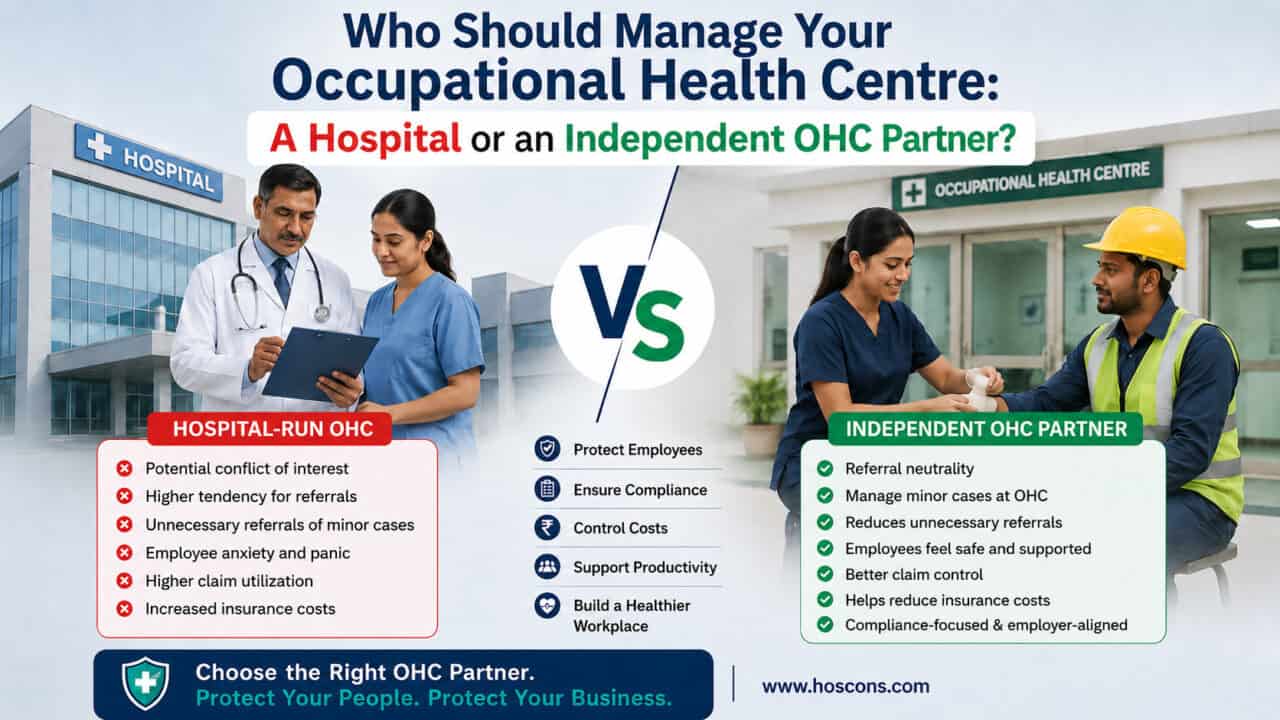
Who Should Manage Your Occupational Health Centre: A Hospital or an Independent OHC Partner?
For many factories and industrial organisations, selecting an Occupational Health Centre partner is treated as a routine vendor decision. The common assumption is simple: if a hospital is available nearby, why not allow the hospital to manage the OHC?
At first glance, this may appear convenient. Hospitals have doctors, specialists, diagnostic facilities and treatment infrastructure. However, an Occupational Health Centre inside a factory has a very different purpose from a hospital.
A hospital is designed for treatment.
An OHC is designed for workplace health protection.
That difference is important.
An Occupational Health Centre should support employee health, emergency response, statutory compliance, medical surveillance, referral guidance and employer risk control. It should not become a channel where every minor case is escalated into a hospital visit.
Should your Occupational Health Centre be managed by a hospital, or by an independent OHC partner whose primary responsibility is to protect the employee and the employer without referral bias?
What Should an Occupational Health Centre Actually Do?
An Occupational Health Centre is not just a medical room inside a factory. It is the organisation’s first line of defence for employee health, emergency response, statutory records and workplace risk control.
A well-managed OHC should be able to handle minor injuries, first aid cases, routine workplace health complaints, medical documentation, fitness monitoring, emergency escalation, ambulance coordination, health checkup follow-up and monthly reporting.
But most importantly, an OHC should know the difference between what can be safely managed inside the factory and what genuinely requires hospital referral.
This is where the choice of OHC management partner becomes important.
A hospital is designed for treatment, investigations, admissions and specialist care. An OHC is designed for workplace health protection, compliance, first response and employer risk control.
Hospitals are essential when advanced care is needed. But day-to-day OHC management should remain neutral, workplace-focused and employer-aligned.
An OHC should not convert every small case into a hospital visit. It should manage what can be safely managed, document what must be documented, and refer only when referral is clinically justified.
The Concern with Hospital-Run OHC Models
When an OHC is managed directly by a hospital, there can be a perceived or structural conflict of interest.
The same organisation that manages the factory medical room may also benefit from consultations, investigations, admissions, procedures or further treatment referrals.
This does not mean every hospital-run OHC is wrong. Many hospitals provide excellent clinical care. But industries must carefully evaluate whether the OHC is functioning as a true workplace health centre or gradually becoming a referral channel.
The key question is:
Is the OHC reducing unnecessary escalation, or increasing hospital dependency?
Why Referral Neutrality Matters
Referral is an important part of occupational health. No OHC should attempt to manage cases beyond its clinical capability.
However, referrals must be clinically justified, properly documented and directed to the right hospital, right specialist and right level of care.
Referral neutrality is important because employees and employers should receive unbiased guidance. The OHC team should not feel pressured, directly or indirectly, to route employees to a particular hospital unless it is genuinely appropriate.
A neutral OHC partner can help the company choose the most suitable hospital based on the case, location, specialty, emergency need, insurance network, employee preference and cost considerations.
A hospital may be the right place for treatment. But the OHC should ideally be managed in a way that keeps referral decisions objective, documented and employer-aligned.
Why Unnecessary Referrals Can Create Panic and Increase Costs
One of the important roles of an Occupational Health Centre is to manage minor workplace health issues appropriately within the OHC itself, wherever clinically safe and permitted.
Minor cuts, small abrasions, simple first aid cases, mild symptoms, routine dressings and basic workplace health complaints can often be assessed, documented and managed at the OHC level by a competent medical team.
However, when even small and manageable cases are frequently referred outside the factory, it can create avoidable panic among employees, supervisors and management teams.
A high number of referrals may give the impression that the workplace has more serious health incidents than it actually does. This can affect internal reporting, employee confidence and management perception of safety performance.
Frequent referrals can also increase hospital visits, investigations, consultations and claim utilisation. Over time, this may affect the employer’s medical expenditure, insurance usage pattern and future insurance premium discussions.
The objective is not to avoid referrals. The objective is to ensure that referrals are clinically justified, properly documented and made only when required.
An OHC should not become a referral counter. It should function as a workplace health, first-response, documentation and risk-control system.
How Hospital-Linked Referrals Can Affect Employer Health Costs
Industries often focus on the direct cost of OHC management, such as doctor charges, nurse salary, ambulance support or medical consumables. But the larger cost may come from indirect medical expenditure.
If minor cases are frequently referred, the organisation may experience:
- Increased outpatient consultations
- Higher investigation usage
- More specialist referrals
- Increased insurance claim utilisation
- Employee anxiety and repeated hospital visits
- Higher administrative follow-up by HR and EHS teams
- Possible pressure during insurance renewal discussions
When claim patterns rise, insurance providers may view the organisation as a higher utilisation account. This can contribute to increased premium pressure over time.
A well-managed OHC should help reduce unnecessary escalation while ensuring timely referral for genuine cases.
Why Industries May Prefer an Independent OHC Partner
An independent OHC partner is not attached to one hospital’s patient acquisition model. Its role is to support the employer and employees with workplace-focused medical governance.
A good independent OHC partner can provide:
- Neutral medical guidance
- Employer-aligned occupational health management
- Better referral control
- Proper documentation and MIS
- Support in identifying the right hospital or specialist
- OHC audit and compliance review
- Multi-location OHC coordination
- Cost-conscious employee health support
- Stronger coordination between HR, EHS, Admin and healthcare providers
This model gives industries greater flexibility and better control over employee health management.
Why HOSCONS Is Different
HOSCONS brings a unique advantage because it is built by healthcare and hospital management professionals who understand both sides of the system — hospitals as well as workplace health requirements.
HOSCONS is not just a manpower vendor supplying doctors and nurses. It brings structured healthcare management knowledge into Occupational Health Centre operations.
HOSCONS supports organisations through structured Occupational Medical Centre Services, including OHC setup, staffing, records, compliance support and workplace medical governance.
For employee health surveillance and medical fitness requirements, HOSCONS also provides onsite medical checkups for factories, industries and corporate organisations.
For emergency readiness, HOSCONS supports organisations through onsite ambulance services and escalation support.
For medical room readiness, medicine stock, consumables and emergency items, organisations can also review our OHC medical supplies and equipment services.
HOSCONS can support industries with:
- Occupational Medical Centre setup and management
- Doctor, nurse and paramedic deployment
- OHC audit and compliance gap assessment
- Annual and periodic medical checkups
- Medical records and MIS reporting
- Medicine, consumable and equipment planning
- Ambulance coordination and emergency readiness
- Referral guidance and hospital coordination
- Multi-location OHC management support
- Employee health support beyond the factory campus
Support Beyond the Factory Campus
A strong OHC partner should not stop its role at the factory gate.
Employees may require support in identifying the right hospital, meeting the right doctor, understanding the next step, coordinating admission, managing follow-up or navigating treatment options.
HOSCONS can support organisations by helping employees and employers coordinate with appropriate hospitals and doctors based on the nature of the case.
This is different from a hospital-run OHC model where employees may be directed mainly toward one hospital system.
An independent OHC partner gives the organisation wider choice, neutral guidance and better control.
What Industries Should Check Before Choosing an OHC Partner
Before appointing an OHC provider, industries should ask:
- Is the provider independent or linked to a hospital?
- Does the provider benefit from referrals?
- Are minor cases being managed appropriately within the OHC?
- Is there a clear referral protocol?
- Are referral cases documented properly?
- Are monthly OHC reports shared with management?
- Are emergency medicines and equipment reviewed regularly?
- Are annual medical checkups followed up properly?
- Does the provider support multiple hospital coordination?
- Is the OHC helping reduce risk or simply increasing hospital dependency?
Hospital or Independent OHC Partner: Which Is Better?
Hospitals are essential for treatment, emergency care, specialist opinion and advanced medical support.
But the day-to-day management of an Occupational Health Centre is often better handled by an independent OHC partner who is focused on workplace health, compliance, employee support and employer risk control.
A hospital should be the treatment partner when required.
An independent OHC company should be the workplace health partner managing the OHC objectively.
This separation helps maintain neutrality, reduce unnecessary referrals, improve compliance and support better cost control.
Final Thought
An Occupational Health Centre should protect employees, support the employer and strengthen workplace health systems.
It should not become a referral channel.
The best OHC model is one where the provider is independent, professionally managed, compliance-focused and capable of guiding employees to the right care at the right time.
For industries, the right question is not only:
Who can provide a doctor?
The real question is:
Who can manage our OHC in a way that protects employees, controls risk, supports compliance and avoids unnecessary medical escalation?
Explore HOSCONS Occupational Health Services
HOSCONS supports factories, industries and corporate organisations with structured occupational health services covering OHC management, medical checkups, ambulance support, medical supplies and compliance-focused workplace healthcare solutions.
Contact HOSCONS for Independent OHC Review
If your organisation wants to review its current OHC model, reduce unnecessary referrals, improve compliance, strengthen emergency readiness or set up a professionally managed Occupational Health Centre, HOSCONS can support you.
HOSCONS Occupational Health & OHC Services
Serving factories, industries, corporates and hospitals across India.
WhatsApp: +91 80150 52202 I Website: www.hoscons.com I Email: grace@hoscons.com
Request an Independent OHC Review
Share your details and our team will connect with you for OHC audit, OHC setup, doctor/nurse deployment, onsite medical checkups, ambulance support, medical supplies or occupational health management services.
Frequently Asked Questions
1. What is an independent OHC partner?
An independent OHC partner is an occupational health service provider that manages workplace medical services without being tied to one hospital’s referral or treatment model.
2. Can hospitals manage Occupational Health Centres?
Hospitals can manage Occupational Health Centres, but industries should evaluate whether the model maintains referral neutrality, cost control, compliance focus and workplace health priorities.
3. Why is referral neutrality important in OHC management?
Referral neutrality ensures that employees are referred to hospitals or specialists only when clinically required and not because of provider-linked treatment incentives.
4. Can unnecessary referrals increase employer health costs?
Yes. Frequent referrals for minor cases can increase consultations, investigations, insurance claim utilisation and may contribute to higher medical expenditure and premium pressure over time.
5. How can HOSCONS help industries manage OHCs?
HOSCONS can support industries with OHC setup, doctor and nurse deployment, OHC audit, medical checkups, ambulance coordination, medical supplies, compliance documentation and neutral referral guidance.