
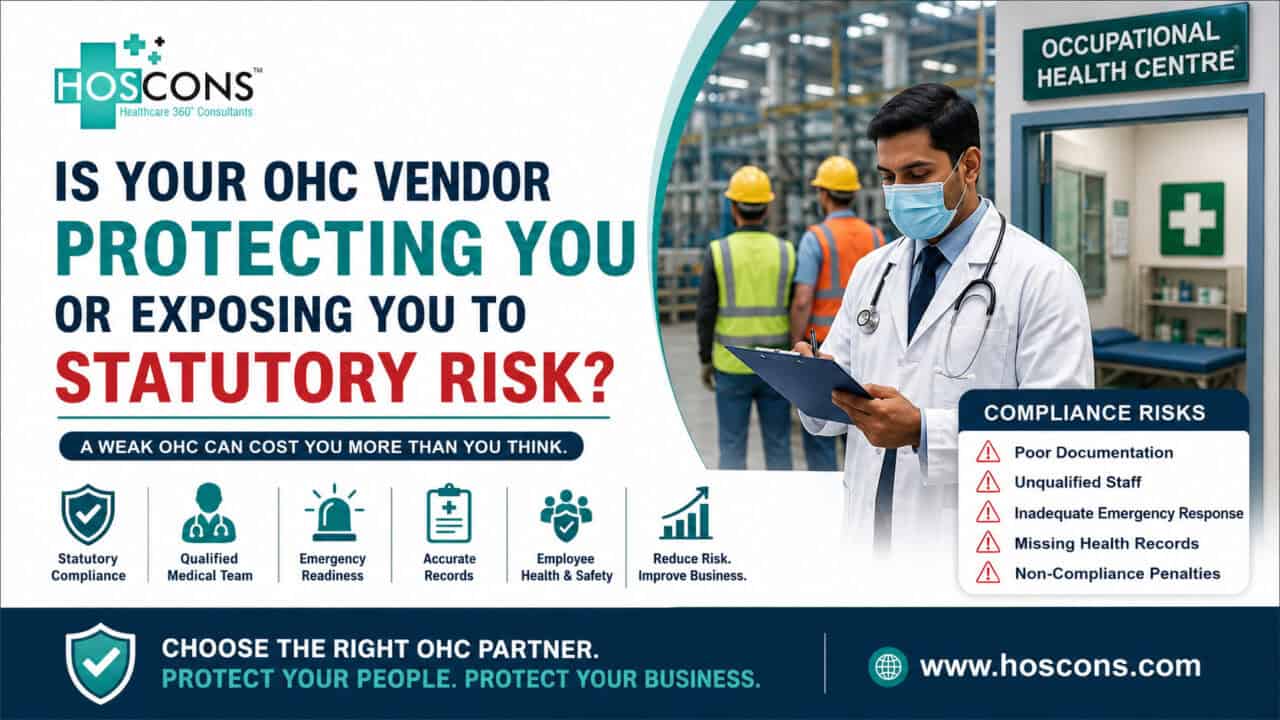
Is Your OHC Vendor Protecting You or Exposing You to Statutory Risk?
OHC vendor statutory risk is a serious concern for factories and industrial organisations that outsource Occupational Health Centre management without properly checking compliance, medical records, emergency readiness and statutory documentation.
For many factories and industrial organisations, the Occupational Health Centre is treated as a routine facility — a doctor, nurse, first aid box, ambulance tie-up, basic records and periodic medical checkups.
But in reality, your OHC is much more than that.
It is a statutory, safety, medical and employer-risk protection system.
The key question every employer must ask
Is your OHC vendor actually protecting your organisation — or only supplying manpower and invoices?
Why OHC Compliance Matters for Employers
Occupational Health Centres are not just medical rooms inside factories. They are part of the employer’s workplace health and safety responsibility.
A factory may appoint an OHC vendor for doctor deployment, nurse staffing, medicines, medical records, ambulance support or health checkups. However, the legal and compliance responsibility does not fully disappear just because the service is outsourced.
Important Risk Point
If the vendor fails to maintain proper records, deploys unsuitable staff, ignores medical surveillance requirements or mishandles emergencies, the factory management can still face questions from authorities, auditors, employees, unions, insurers or client compliance teams.
Employers should also stay updated with applicable workplace safety and factory compliance requirements through official sources such as DGFASLI.
That is why choosing the right OHC partner is not just a procurement decision. It is a statutory risk decision.
Common Ways an OHC Vendor Can Expose Your Factory to Risk
1. Non-Compliant Medical Staff
Many factories require qualified medical professionals based on the nature of industry, employee strength, risk category and statutory requirements.
If your vendor is sending any available doctor without occupational health understanding or factory exposure, your OHC may look functional on paper but remain weak during inspection or emergency.
2. Poor OHC Records
Records are the backbone of OHC compliance. Weak vendors may maintain only basic registers or incomplete records, often updated only before audits or inspections.
If records are incomplete, inconsistent or poorly maintained, the OHC becomes a liability instead of a protection system.
3. No Medical Follow-Up
Many vendors conduct annual health checkups as one-day camps and submit reports. But real occupational health management does not end with test reports.
The employer needs actionable interpretation, fitness status, referral tracking and follow-up of abnormal findings.
4. Weak Emergency Readiness
Industrial injuries, chemical exposure, burns, trauma, cardiac symptoms, breathing difficulty and workplace accidents require immediate structured response.
If staff, equipment, medicines, ambulance readiness and escalation protocols are weak, the organisation can face serious consequences during a crisis.
5. Medicine Mismanagement
Expired medicines, poor stock records, uncontrolled dispensing, missing consumables and lack of emergency medicine review can affect both patient safety and audit readiness.
6. No OHC Audit
Many companies continue with the same OHC vendor for years without checking whether the OHC is compliant, efficient, clinically safe and useful to the organisation.
Annual Medical Checkups Should Not End with Reports
The employer needs clear answers after every annual or periodic medical examination:
- Who is fit?
- Who is temporarily unfit?
- Who needs specialist referral?
- Who requires repeat evaluation?
- Are high-risk workers being monitored?
- Are abnormal reports being followed up?
Without this follow-up, annual medical checkups become a formality rather than a workplace health protection system.
Warning Signs That Your OHC Vendor May Be a Risk
Your OHC needs immediate review if you notice these issues:
- Doctors or nurses are frequently absent or replaced
- Records are incomplete or manually adjusted later
- Medical checkups are done without interpretation
- Emergency medicines are not regularly checked
- Ambulance response is unclear or unreliable
- OHC reports are not submitted monthly
- Abnormal health findings are not reviewed
- There is no proper escalation protocol
- Vendor staff do not understand factory compliance
- The vendor is only focused on manpower supply
What a Responsible OHC Vendor Should Provide
A strong OHC partner should provide more than manpower. The vendor should support your factory with structured occupational health management, compliance documentation and emergency readiness.
OHC Setup & Planning
Medical room planning, workflow, manpower, equipment and operational readiness.
FMO / AFIH Doctor Support
Appropriate doctor deployment based on factory and occupational health needs.
Records & Documentation
Registers, medical records, fitness documentation, referral tracking and MIS.
Emergency Preparedness
Emergency medicines, ambulance coordination, escalation protocols and first response readiness.
Annual Medical Examinations
Pre-employment, annual and periodic medical checkups with follow-up support.
OHC Audit & Review
Periodic review of documentation, staffing, medicines, equipment, reporting and corrective actions.
This is the difference between a basic vendor and a true occupational health partner.
Why Low-Cost OHC Vendors Can Become Expensive
Many companies select OHC vendors based only on monthly cost. But the cheapest vendor may become the costliest mistake if they fail in compliance, emergency response, documentation or employee health management.
- Inspection-related issues
- Poor audit scores
- Employee dissatisfaction
- Delayed emergency response
- Medical negligence allegations
- Weak injury documentation
- Uncontrolled medicine usage
- Lack of health surveillance
In occupational health, cost saving without compliance control is not real savings. It is hidden risk.
Why Regular OHC Vendor Risk Review Is Important
Regular review of OHC vendor statutory risk helps factories identify gaps in staffing, documentation, emergency preparedness, medical surveillance and compliance reporting before they become serious liabilities.
An OHC that looks operational on paper may still have hidden weaknesses. These gaps usually become visible only during audits, inspections, medical emergencies, client compliance reviews or employee health incidents.
A structured review helps management understand whether the OHC is truly protecting the organisation or quietly increasing exposure.
How HOSCONS Helps Factories Reduce OHC Risk
HOSCONS supports factories, industries and corporate organisations with structured Occupational Medical Centre Services focused on compliance, medical governance and operational reliability.
Our OHC support can include doctor deployment, nurse staffing, OHC setup, onsite medical checkups for employees, ambulance coordination, medicine management, statutory records, MIS reporting, health surveillance support and OHC audit.
For emergency readiness, HOSCONS also supports organisations through onsite ambulance services for factories and OHC medical room preparedness.
For medical room readiness, consumables and emergency stock support, organisations can also review our OHC medical supplies and equipment services.
HOSCONS OHC Support Can Help With:
- New OHC setup
- Existing OHC vendor review
- OHC audit and compliance gap assessment
- Doctor, nurse and paramedic deployment
- Annual medical examination planning
- Medicine, ambulance and emergency readiness review
- Monthly MIS and management reporting
Final Thought
Your OHC vendor should not be just a manpower supplier.
Your OHC vendor should be a compliance partner, emergency response partner, employee health partner and statutory risk protection partner.
If your current OHC is not giving you confidence during audits, inspections, emergencies or management reviews, it may be time to reassess the system.
A properly managed OHC protects your employees. A poorly managed OHC exposes your organisation.
Explore HOSCONS Occupational Health Services
HOSCONS supports factories, industries and corporate organisations with structured occupational health services covering OHC management, medical checkups, ambulance support, medical supplies and compliance-focused workplace healthcare solutions.
Contact HOSCONS for OHC Compliance Review
If your organisation wants to review its current OHC vendor, improve statutory compliance, strengthen emergency readiness or set up a professionally managed Occupational Health Centre, HOSCONS can support you with a structured review and implementation approach.
HOSCONS Occupational Health & OHC Services
Serving factories, industries, corporates and hospitals across India.
Phone: +91 80150 52202 I WhatsApp: +91 80150 52202 I Website: www.hoscons.com I Email: grace@hoscons.com
Request an OHC Compliance Review
If you are unsure whether your current Occupational Health Centre is protecting your organisation or exposing it to statutory risk, HOSCONS can help you review your OHC system.
Share your details below and our team will connect with you for OHC audit, OHC setup, doctor/nurse deployment, onsite medical checkups, ambulance support, medical supplies or occupational health management services.
Frequently Asked Questions
1. What is OHC vendor statutory risk?
OHC vendor statutory risk refers to the compliance, documentation, emergency response and employer liability risks that can arise when an Occupational Health Centre vendor does not manage the OHC properly.
2. Why is OHC compliance important for factories?
OHC compliance is important because the Occupational Health Centre plays a key role in employee medical care, emergency response, health surveillance, statutory documentation and workplace safety support.
3. Can a factory outsource OHC services to a vendor?
Yes, factories can outsource OHC services such as doctor deployment, nurse staffing, medical room management, ambulance coordination and annual medical checkups. However, the employer must ensure that the vendor is competent, compliant and properly monitored.
4. What records should an OHC maintain?
An OHC should maintain proper records of employee visits, first aid cases, injuries, referrals, medicine usage, annual medical examinations, emergency response, ambulance movement, fitness status and other applicable statutory documentation.
5. What are the risks of choosing a poor OHC vendor?
A poor OHC vendor can expose the organisation to compliance gaps, weak emergency response, poor documentation, audit failures, employee dissatisfaction and possible legal or reputational risks.
6. How can HOSCONS help with OHC management?
HOSCONS can support factories with OHC setup, OHC audit, Factory Medical Officer support, nurse deployment, annual medical checkups, medicine management, ambulance coordination, MIS reporting and occupational health compliance support.