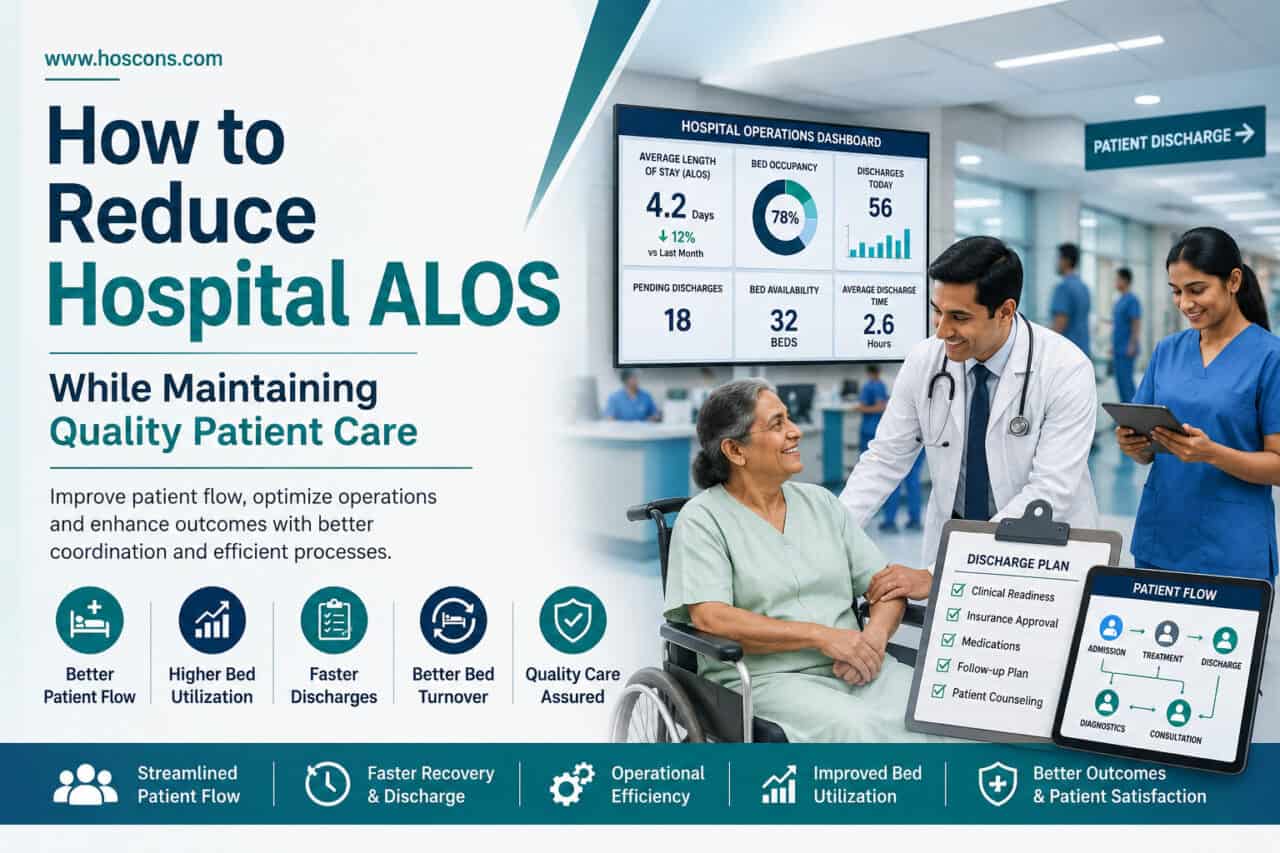
How to Reduce Hospital ALOS While Maintaining Quality Patient Care
Hospital ALOS management has become one of the biggest operational priorities for modern hospitals. Reducing unnecessary inpatient stay duration helps improve bed turnover, patient flow, operational efficiency, and profitability without compromising treatment quality or patient safety.
Hospital ALOS directly impacts bed turnover, operational efficiency, patient flow, discharge management, and overall hospital profitability.
Many hospitals struggle with delayed discharges, inefficient patient movement, diagnostics delays, insurance processing bottlenecks, and coordination gaps between departments. These operational inefficiencies increase Average Length of Stay (ALOS), reduce bed availability, and affect overall hospital performance.
Today, hospitals are increasingly focusing on structured hospital operations management strategies to reduce hospital ALOS while maintaining high-quality patient care outcomes.
Key Insight
Reducing hospital ALOS is not about rushing patient discharge. It is about improving patient flow, operational coordination, discharge planning, diagnostics turnaround, and treatment efficiency.
What is Hospital ALOS?
Hospital ALOS (Average Length of Stay) refers to the average number of days patients remain admitted in a hospital for treatment and recovery.
Hospital ALOS is one of the most important operational performance indicators because it directly affects:
- Bed turnover efficiency
- Occupancy optimization
- Patient throughput
- Revenue generation
- Emergency admission handling
- Operational costs
- Patient satisfaction
While certain specialties naturally require longer inpatient stays, unnecessarily prolonged hospitalization often indicates operational inefficiencies rather than clinical necessity.
Why High Hospital ALOS Becomes a Problem
High hospital ALOS can create serious operational challenges:
- Reduced bed availability
- Admission bottlenecks
- Emergency congestion
- Delayed patient movement
- Increased manpower burden
- Higher operational costs
- Reduced patient throughput
- Lower occupancy efficiency
- Insurance processing delays
In many hospitals, bed occupancy may appear healthy, but high ALOS reduces the number of patients that can actually be treated efficiently.
Common Reasons for Increased Hospital ALOS
Several operational and administrative factors contribute to unnecessarily high hospital ALOS:
- Delayed discharge approvals
- Slow diagnostics turnaround
- Insurance authorization delays
- Poor interdepartmental coordination
- OT scheduling inefficiencies
- ICU transfer delays
- Delayed consultant reviews
- Billing and pharmacy bottlenecks
- Lack of discharge planning systems
- Inefficient patient flow management
Many hospitals focus only on occupancy rates without analyzing patient movement efficiency inside the hospital.
How Hospitals Can Reduce Hospital ALOS Efficiently
Reducing hospital ALOS requires a structured operational approach across departments.
1. Improve Discharge Planning
Discharge planning should begin early during admission rather than at the final stage of treatment.
- Expected discharge date tracking
- Daily discharge reviews
- Faster discharge summaries
- Early billing coordination
- Advance pharmacy clearance
2. Optimize Patient Flow
Hospitals must streamline patient movement between emergency, ICU, wards, diagnostics, OT, and discharge areas.
- Faster patient transfers
- Reduced waiting time
- Improved bed allocation
- Efficient admission planning
3. Reduce Diagnostics Delays
Delayed investigations and reporting significantly increase hospital ALOS.
- Improve lab turnaround time
- Prioritize inpatient diagnostics
- Optimize radiology scheduling
- Strengthen coordination between clinicians and diagnostics teams
4. Improve Insurance Coordination
Insurance approval delays often prolong discharge unnecessarily.
- Early insurance intimation
- Dedicated insurance desk
- Faster documentation processing
- Pre-discharge insurance clearance
5. Strengthen Department Coordination
ALOS reduction depends heavily on communication between departments.
- Daily operational huddles
- Discharge coordination teams
- Bed management systems
- Escalation protocols for delays
How High Hospital ALOS Affects Profitability
When hospital ALOS becomes unnecessarily high, hospitals experience slower bed turnover, delayed admissions, operational congestion, increased manpower burden, and reduced revenue efficiency.
High hospital ALOS can also affect emergency admission capacity, ICU utilization, insurance processing cycles, and patient satisfaction scores.
- Lower bed availability
- Reduced patient throughput
- Higher operational costs
- Delayed discharge cycles
- Lower occupancy efficiency
- Reduced departmental productivity
Hospital ALOS vs Occupancy: Understanding the Difference
| Metric | Measures | Operational Impact |
|---|---|---|
| Occupancy | Bed utilization percentage | Indicates bed usage level |
| Hospital ALOS | Average patient stay duration | Indicates patient movement efficiency |
A hospital may show high occupancy but still perform poorly if hospital ALOS remains unnecessarily high.
Operational Efficiency Matters More Than Just Bed Occupancy
Modern hospitals are now focusing on operational efficiency metrics such as:
- Hospital ALOS
- Bed turnover ratio
- Emergency admission conversion
- OT utilization
- ICU efficiency
- Discharge turnaround time
- Diagnostics utilization
- Patient throughput
Improving these operational indicators helps hospitals increase profitability while maintaining high-quality patient care standards.
Improve Hospital Operational Efficiency With HOSCONS
HOSCONS helps hospitals improve hospital ALOS, patient flow, discharge efficiency, occupancy utilization, and operational performance through structured healthcare operational consulting strategies.
From workflow optimization and operational restructuring to patient throughput enhancement and hospital turnaround support, our team works closely with hospitals to improve both efficiency and patient care outcomes.
👉 Contact HOSCONS for Hospital Operational Performance Consulting
📍 Serving Hospitals across India & International Markets
📞 +91 8270004004
🌐 www.hoscons.com
📧 grace@hoscons.com
Related Hospital Consulting Services:
Hospital Operations Management Consulting
Hospital Turnaround Consulting
Hospital Gap Analysis & Process Optimization
Hospital Revenue Leakage Audit
Hospital Revenue Cycle Management Consulting
Hospital Consulting Division
Frequently Asked Questions
What is Hospital ALOS?
Hospital ALOS stands for Average Length of Stay. It measures the average number of days patients remain admitted in a hospital during treatment.
Why is reducing Hospital ALOS important?
Reducing hospital ALOS improves bed availability, patient throughput, operational efficiency, occupancy utilization, and hospital profitability while reducing unnecessary inpatient delays.
Can hospitals reduce Hospital ALOS without affecting patient care?
Yes. Hospitals can reduce hospital ALOS safely through better discharge planning, diagnostics coordination, patient flow management, insurance processing efficiency, and operational workflow optimization.
What causes unnecessarily high Hospital ALOS?
Common causes include delayed discharge approvals, slow diagnostics turnaround, insurance authorization delays, poor interdepartmental coordination, and inefficient patient flow systems.
How does patient flow affect Hospital ALOS?
Efficient patient flow improves bed turnover, diagnostics coordination, discharge efficiency, ICU transfers, and emergency admission handling — all of which help reduce hospital ALOS.
How can HOSCONS help improve Hospital ALOS?
HOSCONS helps hospitals improve hospital ALOS through workflow optimization, operational performance consulting, discharge management improvement, patient flow enhancement, and hospital process re-engineering strategies.