
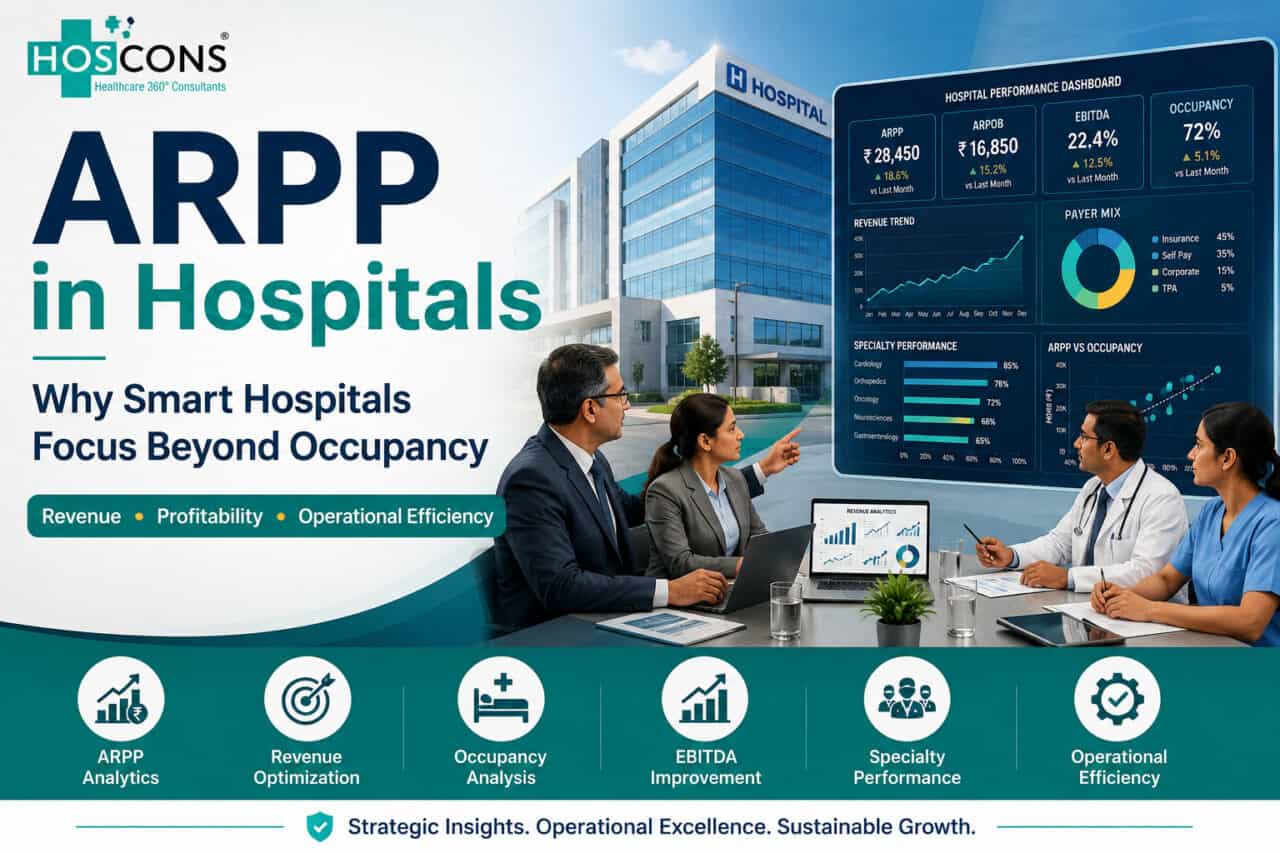
Why Smart Hospitals Focus on ARPP, Not Just Occupancy
ARPP in hospitals is becoming one of the most important indicators of financial performance and operational efficiency in modern healthcare management. While many hospitals continue to focus heavily on occupancy percentage, occupancy alone does not always reflect whether the hospital is truly profitable or financially efficient.
A hospital may operate at very high occupancy and still struggle with margins, cash flow, operational stress, and long-term sustainability if revenue realization per patient remains weak.
This is why modern hospitals are increasingly shifting focus toward ARPP (Average Revenue Per Patient) as a more meaningful performance metric.
What Is ARPP in Hospitals?
ARPP stands for Average Revenue Per Patient. It measures the average revenue generated from each patient admission or encounter during a specific period.
ARPP helps hospitals understand:
- Revenue efficiency
- Service monetization
- Clinical utilization effectiveness
- Operational profitability
- Financial sustainability
- Revenue realization quality
Unlike occupancy alone, ARPP reflects the actual economic value being generated from patient care.
Why Occupancy Alone Can Be Misleading
Many hospitals celebrate high occupancy percentages without evaluating whether the occupied beds are generating adequate revenue and profitability.
High occupancy without proper revenue optimization can actually create:
- Operational stress
- Higher manpower burden
- Lower margins
- ICU and OT bottlenecks
- Cash flow issues
- Resource exhaustion
- Reduced service quality
In many hospitals, occupancy increases without corresponding growth in:
- Surgical conversion
- Diagnostics utilization
- Critical care monetization
- Specialty revenue
- Revenue cycle efficiency
- Billing realization
Why Smart Hospitals Prioritize ARPP
Hospitals that focus on ARPP usually pay greater attention to revenue quality rather than patient volume alone.
They focus on:
- Specialty mix optimization
- Surgical throughput
- Diagnostics utilization
- Critical care efficiency
- Clinical monetization
- Revenue leakage control
- Payer mix optimization
- Operational discipline
This approach helps hospitals improve profitability without necessarily increasing bed strength or infrastructure.
Key Factors That Influence Hospital ARPP
1. Specialty Mix
High-value specialties generally improve ARPP because they generate stronger revenue through procedures, diagnostics, critical care utilization, implants, pharmacy, and ancillary services.
Examples include:
- Cardiology
- Orthopedics
- Neurosciences
- Oncology
- Gastroenterology
- Critical care
Hospitals heavily dependent on low-value medical admissions may struggle with weak ARPP despite good occupancy.
2. Surgical Conversion
Surgical services significantly influence ARPP because they generate revenue across multiple hospital departments including:
- Operation theatres
- Anesthesia
- ICU
- Diagnostics
- Pharmacy
- Consumables
- Room charges
Improving OP-to-surgery conversion rates can significantly improve revenue per patient.
3. Diagnostics and Ancillary Revenue
Diagnostics, imaging, laboratory services, rehabilitation, pharmacy, and ancillary services contribute significantly to ARPP improvement.
Hospitals should monitor:
- Lab revenue per patient
- Radiology utilization
- Pharmacy contribution
- Internal referral patterns
- Outsourced diagnostic leakage
- Procedure-linked diagnostics
Underutilized diagnostics often result in major missed revenue opportunities.
4. Revenue Leakage Control
Many hospitals lose substantial revenue through missed billing, documentation gaps, insurance deductions, and package leakage.
Revenue leakage commonly occurs in:
- Pharmacy billing
- Consumables billing
- Procedure charges
- Doctor visit charges
- Diagnostic billing
- Insurance claims
- Package exclusions
5. Payer Mix Optimization
Hospitals with healthier payer mix often achieve better ARPP and stronger cash realization.
Hospitals should evaluate contribution from:
- Cash patients
- Insurance patients
- Corporate tie-ups
- Government schemes
- TPA patients
- Institutional contracts
Poorly negotiated packages and excessive dependence on low-paying schemes can suppress ARPP.
6. Revenue Cycle Management
A strong revenue cycle management system improves:
- Billing accuracy
- Claim submission
- Collection efficiency
- Denial management
- Cash flow
- Revenue realization
Hospitals with weak RCM systems often experience poor ARPP despite strong patient volumes.
How Hospitals Can Improve ARPP
Hospitals can improve ARPP through structured operational and clinical optimization strategies.
Key approaches include:
- Strengthening high-value specialties
- Improving surgical conversion
- Increasing diagnostics utilization
- Reducing revenue leakage
- Improving package structure
- Strengthening payer negotiations
- Improving documentation quality
- Enhancing billing controls
- Improving ICU and OT utilization
- Optimizing revenue cycle management
ARPP vs Occupancy: Why Both Must Be Balanced
Occupancy remains important because unused infrastructure affects cost efficiency. However, occupancy alone cannot drive sustainable profitability.
Hospitals must balance:
- Occupancy percentage
- ARPP
- ALOS
- EBITDA margins
- Specialty contribution
- Payer mix
- Revenue leakage indicators
- Cost per patient
The objective should not be maximum occupancy alone — but optimized occupancy with stronger revenue quality and operational efficiency.
Common Mistakes Hospitals Make
Many hospitals attempt to improve profitability using the wrong strategies.
Common mistakes include:
- Focusing only on occupancy growth
- Increasing tariffs without improving value
- Ignoring diagnostics utilization
- Weak insurance controls
- No department-wise profitability tracking
- Poor package management
- Ignoring revenue leakage
- Lack of revenue intelligence dashboards
How HOSCONS Helps Hospitals Improve Revenue Performance
HOSCONS supports hospitals with structured operational and financial performance improvement strategies focused on ARPP enhancement, profitability optimization, and revenue sustainability.
Our support may include:
- Hospital ARPP analysis
- Revenue leakage audits
- Specialty mix optimization
- Diagnostics utilization review
- Revenue cycle management improvement
- Department-wise profitability assessment
- Operational restructuring
- EBITDA improvement planning
- Hospital turnaround consulting
Improve Hospital Profitability Beyond Occupancy
HOSCONS helps hospitals strengthen ARPP, reduce revenue leakage, optimize specialty utilization, and improve operational profitability through structured healthcare consulting strategies.
👉 Contact HOSCONS for Hospital Revenue Optimization Consulting
📍 Serving Hospitals across India and International Markets
📞 +91 8270004004
🌐 www.hoscons.com
📧 grace@hoscons.com
Related Hospital Consulting Services:
- Hospital Revenue Leakage Audit
- Hospital Operations Management
- Hospital Turnaround Consulting
- Hospital Gap Analysis
- Hospital Consulting Division
Frequently Asked Questions
What is ARPP in hospitals?
ARPP stands for Average Revenue Per Patient. It measures the average revenue generated from each patient admission or encounter.
Why is ARPP important in hospitals?
ARPP helps hospitals understand revenue efficiency, profitability, clinical monetization, and financial sustainability beyond occupancy levels.
Can hospitals improve profitability without increasing occupancy?
Yes. Hospitals can improve profitability through better specialty mix, diagnostics utilization, surgical conversion, revenue cycle management, and revenue leakage control.
How does diagnostics utilization affect ARPP?
Diagnostics contribute significantly to revenue realization per patient. Underutilized imaging and lab services often reduce ARPP potential.
Why can a hospital with high occupancy still struggle financially?
High occupancy alone does not guarantee profitability. Poor ARPP, weak payer mix, low-value admissions, and revenue leakage can reduce financial performance despite strong patient volumes.
How can HOSCONS help improve hospital ARPP?
HOSCONS helps hospitals improve ARPP through revenue optimization, operational restructuring, specialty strategy improvement, revenue leakage audits, and profitability-focused consulting.