
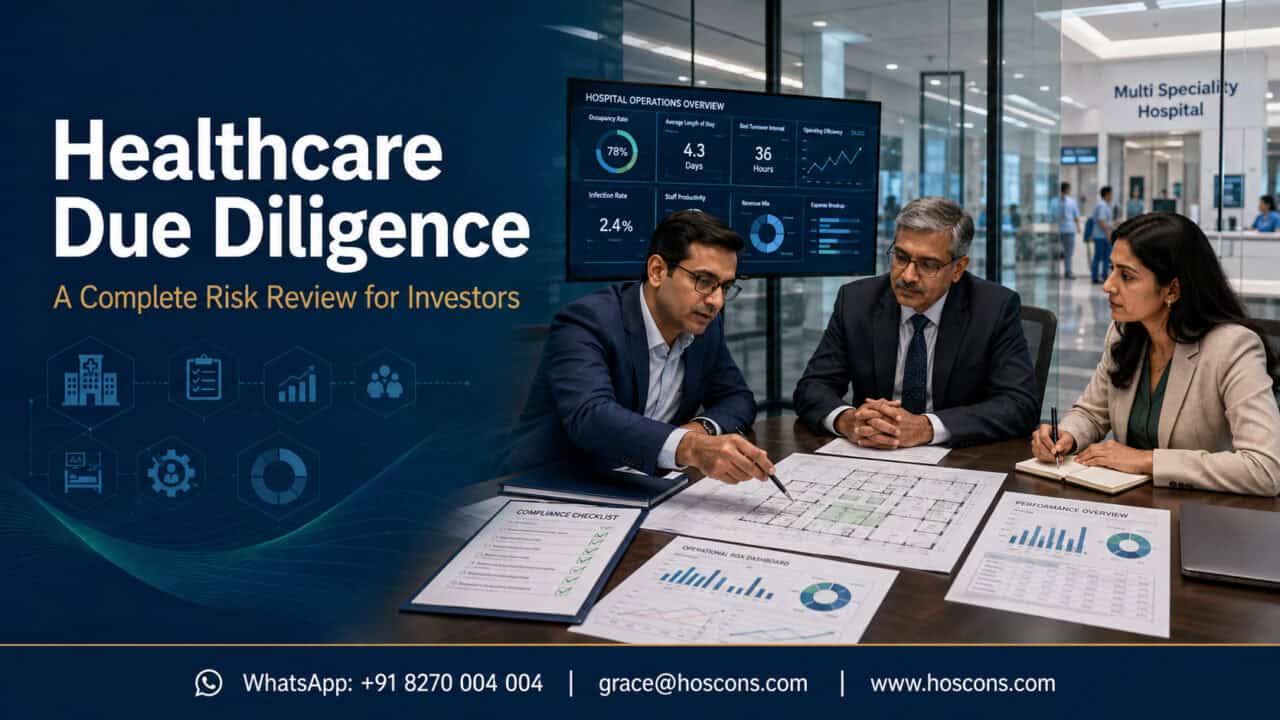
Healthcare due diligence helps private equity firms, family offices, strategic healthcare groups and institutional investors independently evaluate hospitals before an investment, acquisition or strategic partnership.
A hospital may report attractive revenue, occupancy and profitability while carrying significant underlying risks. These may include dependence on a few doctors, weak clinical governance, questionable revenue quality, regulatory gaps, inefficient manpower or unrealistic expansion assumptions.
A hospital may report attractive revenue, occupancy and profitability while carrying significant underlying risks. These may include dependence on a few doctors, weak clinical governance, questionable revenue quality, regulatory gaps, inefficient manpower or unrealistic expansion assumptions.
Financial statements explain what a hospital has reported. Healthcare due diligence examines how those results were produced, whether they are sustainable and what may change after investment.
According to the India Brand Equity Foundation, India’s healthcare sector continues to attract substantial investment and merger-and-acquisition activity. As investment in hospitals increases, identifying the operational realities behind reported performance becomes increasingly important.
A financially attractive hospital is not necessarily an operationally sustainable hospital.
Why Financial and Legal Due Diligence May Not Be Enough
Financial due diligence can validate revenue, expenses, debt, taxation and reported profitability. Legal due diligence can examine ownership, contracts, litigation, land documents and statutory records.
Both are essential. However, they may not fully answer hospital-specific questions such as:
- Is the reported revenue clinically and operationally sustainable?
- How much revenue depends on the promoter or a few doctors?
- Are occupancy figures supported by patient-level records?
- Can the existing clinical team support the proposed expansion?
- Are licences aligned with the services actually being provided?
- Can the hospital scale without compromising quality or profitability?
Healthcare due diligence complements financial, legal and tax reviews by examining how the hospital actually functions and what risks may affect its future value.
The Complete Hospital Risk Review
| Area Reviewed | What Investors Need to Establish |
|---|---|
| Market | Whether demand and competitive positioning support future growth |
| Revenue | Whether reported income is sustainable, collectible and diversified |
| Doctors | Whether performance depends excessively on a few individuals |
| Operations | Whether infrastructure, beds and equipment are efficiently utilised |
| Manpower | Whether staffing is safe, productive and adequate for expansion |
| Clinical governance | Whether quality and patient-safety systems operate effectively |
| Compliance | Whether approvals cover the services currently being delivered |
1. Market Position and Revenue Sustainability
Historical growth alone does not establish future potential. Investors need to determine whether the hospital’s performance is supported by genuine and sustainable demand within its catchment area.
The assessment should examine:
- Catchment population and patient origin
- Competition and speciality gaps
- Hospital positioning and reputation
- Pricing relative to competing hospitals
- Referral sources and their sustainability
- Potential for additional specialties, beds or locations
A smaller regional hospital may possess strong investment potential because of its clinical reputation or presence in an underserved market. Conversely, a hospital operating in a growing city may lack differentiation or a defensible market position.
2. Quality and Sustainability of Revenue
Hospital revenue must be analysed beyond the audited total. The review should examine revenue by department, speciality, doctor, procedure and payer category.
Important investor questions
- Is revenue growth driven by patient volume or only by price increases?
- Are admissions supported by occupancy and billing records?
- Which specialties generate revenue but contribute little profit?
- Are discounts, refunds and package adjustments controlled?
- Are insurance and corporate receivables collected on time?
- Is any revenue dependent on temporary or non-recurring arrangements?
A hospital with high reported revenue may still have weak cash conversion, an unfavourable payer mix, uncontrolled discounts or revenue leakage.
3. Doctor and Promoter Dependency
One of the most significant risks in hospital investment is excessive dependence on a limited number of individuals.
If the promoter-doctor or a few senior consultants generate a major share of admissions and procedures, their departure could materially affect the hospital’s value.
Dependency review
- Revenue attributable to key doctors
- Consultant contracts and retention arrangements
- Referral relationships
- Availability of second-line clinical leadership
- Institutional branding versus individual doctor branding
- Succession and continuity risks
4. Operational Performance and Capacity Utilisation
Bed strength alone does not represent operating capacity or investment potential. Investors need to understand how effectively the hospital uses its infrastructure, equipment and manpower.
| Performance Indicator | Risk It May Reveal |
|---|---|
| Bed occupancy | Demand weakness or unused capacity |
| Average length of stay | Clinical inefficiency or delayed discharge |
| OT utilisation | Poor surgical volumes or scheduling |
| OP-to-IP conversion | Clinical mix or conversion weakness |
| Equipment utilisation | Unproductive capital investment |
Underutilisation may result from weak demand, inadequate doctor availability, operational bottlenecks, unsuitable speciality planning or ineffective market development.
5. Manpower Cost and Management Capability
Hospitals are manpower-intensive organisations. Staff cost cannot be assessed only as a percentage of revenue. Investors must also evaluate the adequacy, productivity and deployment of personnel.
- Department-wise manpower deployment
- Nursing ratios and skill mix
- Overtime, attrition and vacancy patterns
- Management structure and accountability
- Dependence on informal decision-making
- Availability of departmental leadership
- Readiness of the team to support expansion
6. Clinical Governance and Patient Safety
Clinical quality directly affects hospital reputation, liability, accreditation, empanelment and long-term enterprise value.
The review should examine:
- Infection prevention and control
- Medication safety
- Mortality and morbidity reviews
- Clinical documentation and medical records
- Credentialing and privileging of doctors
- Incident reporting and corrective actions
- Patient complaints and medico-legal exposure
- Quality indicators and internal audits
The National Accreditation Board for Hospitals and Healthcare Providers establishes quality and patient-safety benchmarks for hospitals in India. Accreditation is valuable, but investors should still verify whether documented practices are consistently implemented.
7. Regulatory and Infrastructure Readiness
Hospital licensing is complex and varies by state, facility type and services offered. A hospital may possess general registration while having gaps relating to specific departments or equipment.
- Clinical-establishment registration or applicable state licence
- Fire and building-safety approvals
- Pollution-control and biomedical-waste authorisations
- Pharmacy, blood-centre and diagnostic licences
- AERB compliance for applicable radiology equipment
- PCPNDT registration where applicable
- Land-use, occupancy and building documentation
- Licence validity and renewal status
The Ministry of Health and Family Welfare’s Clinical Establishments framework provides for registration, regulation and minimum standards. Applicable state-specific requirements must be verified separately.
Can the Proposed Growth Plan Be Delivered?
Investors are frequently presented with projections involving higher occupancy, new specialties, bed expansion, additional equipment or a multi-location rollout.
Healthcare due diligence should test whether these assumptions are supported by:
- Patient demand within the catchment
- Availability of doctors and trained healthcare workers
- Existing building and infrastructure capacity
- Complete and realistic capital-expenditure estimates
- Achievable implementation and ramp-up timelines
- Management capability to execute the expansion
- Realistic operating costs and profitability assumptions
Hospital Investment Red Flags
- Revenue that cannot be reconciled with billing and hospital systems
- High dependence on one doctor, speciality or payer
- Occupancy figures inconsistent with patient records
- Licences that do not cover services currently provided
- Rapid growth without corresponding manpower or infrastructure
- High receivables accompanied by reported profitability
- Uncontrolled discounts, refunds or complimentary services
- Low equipment utilisation or frequent downtime
- Unresolved patient complaints or medico-legal exposure
- Expansion projections unsupported by a market study
- Weak management and excessive promoter dependency
- Significant expenditure required immediately after acquisition
A red flag does not automatically mean that the proposed transaction should be abandoned. It may affect valuation, transaction conditions, representations, warranties, indemnities or the post-investment improvement plan.
What Investors Should Receive
A healthcare due diligence report should not merely reproduce information supplied by the hospital. It should support an investment decision.
- Executive assessment of the opportunity
- Market and competitive-position review
- Operational and departmental performance analysis
- Revenue quality and sustainability assessment
- Doctor, promoter and referral-dependency analysis
- Clinical-governance and patient-safety observations
- Licensing and compliance-gap assessment
- Infrastructure, equipment and manpower review
- Validation of expansion assumptions
- Risk classification by severity and urgency
- Priority pre- and post-investment actions
How HOSCONS Supports Healthcare Investors
HOSCONS provides independent healthcare-sector assessment for investors evaluating hospitals, healthcare projects and acquisition opportunities in India.
- Commercial and market due diligence
- Hospital operational due diligence
- Clinical-process and governance assessment
- Department-wise performance review
- Hospital compliance-gap assessment
- Infrastructure, equipment and manpower review
- Expansion-plan and assumption validation
- Pre-investment risk and opportunity reporting
- Post-investment operational-improvement planning
- Hospital performance monitoring and management support
Our role complements the work of financial, legal, tax and technical advisers. HOSCONS focuses on understanding how the hospital operates, whether reported performance is sustainable and what may be required to protect and improve value after investment.
Evaluating a Hospital Investment or Acquisition?
HOSCONS can independently assess the hospital’s market potential, operations, clinical systems, compliance readiness and expansion assumptions before the transaction is completed.
WhatsApp:
+91 8270 004 004
|
Email:
grace@hoscons.com
|
www.hoscons.com
Frequently Asked Questions
What is healthcare due diligence?
Healthcare due diligence is an independent assessment of the commercial, operational, clinical, regulatory and infrastructure factors affecting a healthcare investment. It supplements financial, legal and tax due diligence.
When should hospital due diligence be conducted?
It should ordinarily be conducted before acquiring, investing in or entering a strategic partnership with a hospital. A preliminary review may be followed by detailed due diligence once access to management, records and the facility becomes available.
Can due diligence affect hospital valuation?
Yes. Findings related to revenue sustainability, doctor dependency, compliance, future capital expenditure and operational weakness may affect valuation assumptions and transaction terms.
Does it replace financial or legal due diligence?
No. Healthcare due diligence complements financial, legal, tax and technical reviews by examining healthcare-specific operational and clinical realities.
Does HOSCONS help investors identify hospital opportunities?
Subject to the engagement scope and availability of suitable opportunities, HOSCONS may support investors with opportunity assessment, hospital due diligence and post-investment performance improvement. HOSCONS does not provide regulated investment, securities, legal or tax advice.
Related Reading
Hospital owners preparing for investment may also read: Private Equity Funding for Hospitals: What Owners Must Know.