
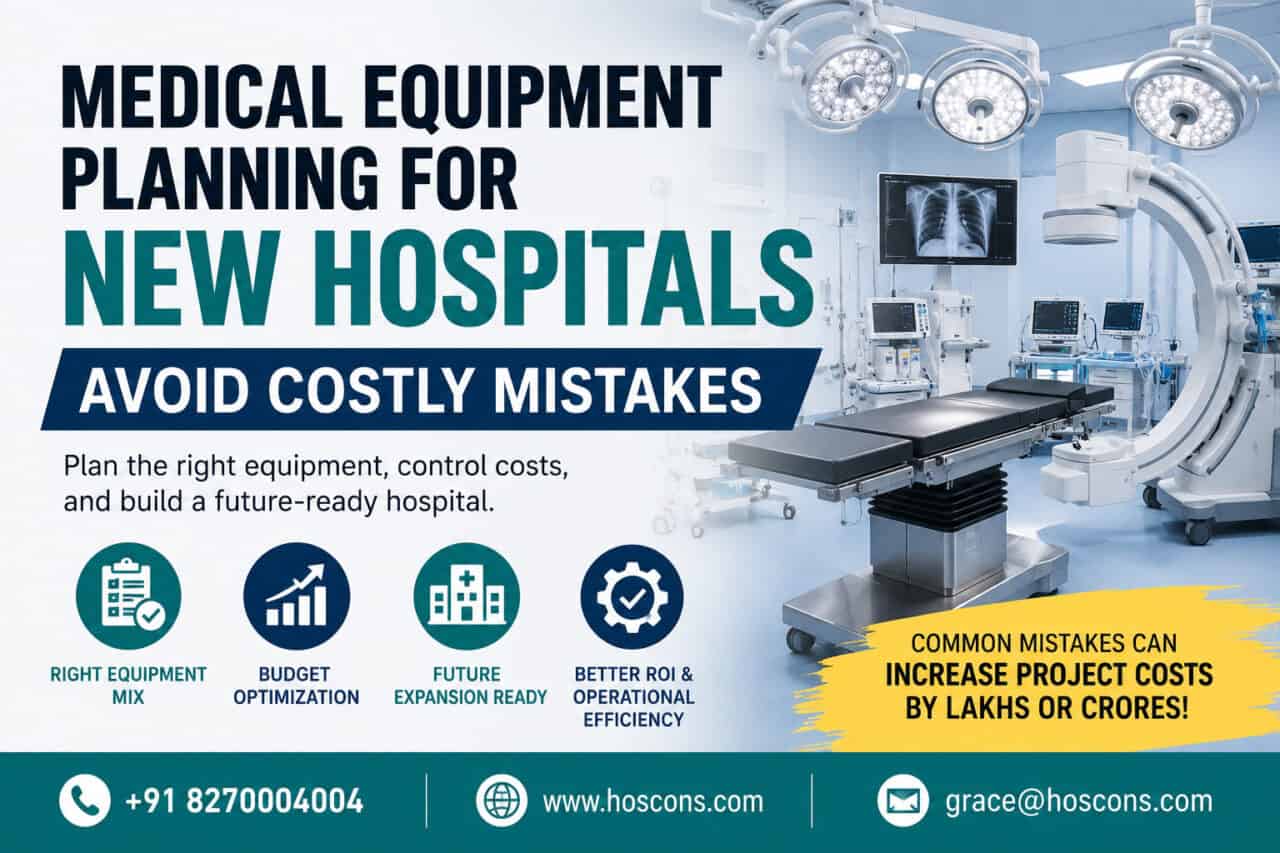
Medical Equipment Planning for New Hospitals: Avoid Costly Mistakes
Medical equipment planning for new hospitals is one of the most important factors that determines project cost, operational efficiency, patient safety, licensing readiness, and long-term return on investment. In many hospital projects, promoters focus first on land, building, interiors, and construction, but delay equipment planning until the later stages.
This delay can create serious problems. Poor medical equipment planning for new hospitals can lead to budget overruns, wrong room sizes, inadequate electrical load planning, poor HVAC provisions, medical gas pipeline issues, workflow problems, and underutilized equipment.
Why Medical Equipment Planning for New Hospitals Is Critical
Medical equipment is usually one of the largest investments in a hospital project after land and construction. Depending on the size and specialty mix of the hospital, medical equipment may account for a significant portion of the total project budget.
Proper medical equipment planning for new hospitals helps promoters:
- Control project cost
- Avoid unnecessary purchases
- Plan department layouts correctly
- Ensure electrical, HVAC, and medical gas readiness
- Improve patient flow and staff workflow
- Support NABH and statutory readiness
- Reduce commissioning delays
- Improve equipment utilization and ROI
Mistake 1: Starting Equipment Planning Too Late
One of the biggest mistakes in new hospital projects is starting equipment planning only after the building design is completed.
By that stage, many important infrastructure decisions may already be fixed, including:
- Room sizes
- Door widths
- Ceiling heights
- Electrical load provisions
- HVAC capacity
- Medical gas points
- Equipment movement pathways
- Floor loading requirements
When equipment requirements are not planned early, hospitals may need expensive redesigns and modifications later.
Mistake 2: Buying Equipment Before Finalizing the Service Mix
A hospital should not buy equipment before finalizing its specialty mix and clinical service plan.
For example, a hospital planning general medicine, surgery, obstetrics, paediatrics, orthopaedics, emergency care, and diagnostics will require a different equipment plan compared to a cardiac, oncology, fertility, or eye hospital.
Before procurement, promoters must clearly define:
- Hospital type
- Bed strength
- Specialties planned
- ICU and emergency requirements
- Operation theatre requirements
- Diagnostic services
- Phased expansion strategy
Mistake 3: Vendor-Driven Equipment Planning
Many promoters depend heavily on equipment vendors to decide what should be purchased. While vendors provide useful technical inputs, vendor-driven planning can result in overbuying, duplication, or purchase of equipment that may not match actual hospital requirements.
Independent medical equipment planning helps hospitals:
- Prepare need-based equipment lists
- Compare specifications objectively
- Control procurement budgets
- Avoid unnecessary upgrades
- Negotiate better with vendors
- Plan equipment in phases
The hospital’s clinical and operational strategy should decide equipment needs — not vendor sales pressure.
Mistake 4: Overinvesting in Premium Equipment Too Early
High-end equipment can improve clinical capability, but it must be justified by patient demand, specialist availability, and revenue potential.
New hospitals sometimes overinvest in advanced equipment such as:
- High-end CT or MRI systems
- Robotic surgery platforms
- Cath lab systems
- Advanced ICU equipment
- Premium OT technology
- Specialty diagnostic systems
If patient volume is not adequate, such equipment may remain underutilized and increase financial burden.
Mistake 5: Ignoring AMC, CMC, Consumables and Lifecycle Costs
Purchase price is only one part of equipment cost. The actual cost of ownership includes maintenance, consumables, calibration, downtime, and replacement planning.
Promoters must evaluate:
- Annual Maintenance Contract (AMC)
- Comprehensive Maintenance Contract (CMC)
- Consumable cost
- Spare part availability
- Service response time
- Calibration requirements
- Software upgrades
- Equipment lifespan
A cheaper machine can become more expensive in the long run if maintenance and consumable costs are high.
Mistake 6: Poor OT and ICU Equipment Planning
Operation theatres and intensive care units require detailed equipment and infrastructure coordination.
Poor planning can lead to:
- Inadequate power sockets
- Wrong equipment placement
- Insufficient space around patient beds
- Improper medical gas provisions
- Inadequate storage
- Poor nurse visibility
- Workflow bottlenecks
- Difficulty during commissioning
OT and ICU equipment planning must be coordinated with architects, MEP consultants, biomedical engineers, clinicians, and hospital operations experts.
Mistake 7: Not Planning Equipment Room Requirements Properly
Large equipment such as CT, MRI, cath lab, CSSD equipment, modular OT systems, laboratory automation, and radiology units require special room planning.
These departments may require:
- Special flooring
- Shielding provisions
- Controlled temperature
- Dedicated electrical load
- UPS backup
- Equipment access routes
- Service access space
- Safety clearances
If these are not planned early, installation delays and additional civil modifications may increase project cost.
Mistake 8: Ignoring NABH and Regulatory Requirements
Medical equipment planning for new hospitals should also consider accreditation and statutory requirements.
Important requirements may include:
- Biomedical equipment safety
- Calibration records
- Radiation safety compliance
- Electrical safety
- Medical gas safety
- Emergency equipment availability
- Infection control requirements
- Preventive maintenance systems
Planning with NABH-readiness in mind helps hospitals avoid future compliance gaps.
Typical Medical Equipment Budget Allocation
The exact budget depends on hospital size, specialty mix, service level, and phase of development. However, a typical hospital equipment budget may be distributed across major departments as follows:
| Department | Indicative Budget Share |
|---|---|
| Diagnostics & Imaging | 30% – 40% |
| Operation Theatre & ICU | 25% – 35% |
| Laboratory | 10% – 15% |
| Wards & Patient Care Areas | 10% – 15% |
| Emergency, CSSD & Support Areas | Balance |
How Proper Equipment Planning Reduces Hospital Project Cost
Proper medical equipment planning for new hospitals helps promoters avoid unnecessary expenditure and improve long-term operational performance.
It helps in:
- Preparing department-wise equipment lists
- Prioritizing Phase 1 purchases
- Avoiding duplicate equipment
- Optimizing vendor selection
- Planning infrastructure correctly
- Reducing installation delays
- Improving equipment utilization
- Supporting better project budgeting
How HOSCONS Helps With Medical Equipment Planning for New Hospitals
HOSCONS supports doctors, healthcare entrepreneurs, trusts, and investors with structured medical equipment planning for new hospitals as part of hospital feasibility, DPR, design coordination, turnkey project support, and commissioning.
Our services include:
- Department-wise medical equipment planning
- Equipment list preparation
- Technical specification support
- Budget estimation
- Vendor comparison guidance
- Procurement planning
- Equipment room planning coordination
- NABH-readiness support
- Hospital DPR preparation
- Turnkey hospital project consulting
Planning Medical Equipment for a New Hospital?
Avoid costly procurement mistakes. HOSCONS helps hospital promoters plan the right equipment mix, optimize budgets, coordinate infrastructure requirements, and improve project readiness.
👉 Contact HOSCONS for Medical Equipment Planning Support
📍 Serving Hospitals across India & International Markets
📞 +91 8270004004
🌐 www.hoscons.com
📩 grace@hoscons.com
Related Services:
- Hospital Feasibility Study Consultants
- Hospital DPR Consultants
- Turnkey Hospital Project Consultants
- Hospital Project Management Consultants
- Hospital Consulting Division
According to the World Health Organization, healthcare technology and infrastructure planning play an important role in improving access, safety, and quality of healthcare delivery.
Frequently Asked Questions
When should medical equipment planning for new hospitals begin?
Medical equipment planning for new hospitals should begin during the feasibility, DPR, and facility design stage before architectural drawings and MEP provisions are finalized.
Why is medical equipment planning important in hospital projects?
It helps control project cost, avoid unnecessary purchases, plan infrastructure correctly, improve workflow, and support licensing and accreditation readiness.
Can poor medical equipment planning increase hospital project cost?
Yes. Poor planning can lead to redesign costs, wrong infrastructure provisions, duplicate purchases, underutilized equipment, and commissioning delays.
Should hospitals buy all equipment in Phase 1?
Not always. Many hospitals benefit from phased procurement based on service mix, demand projections, patient volume, and financial feasibility.
How can HOSCONS help in hospital equipment planning?
HOSCONS helps prepare department-wise equipment lists, budgets, technical specifications, vendor comparison support, infrastructure coordination, and DPR-linked equipment planning.