
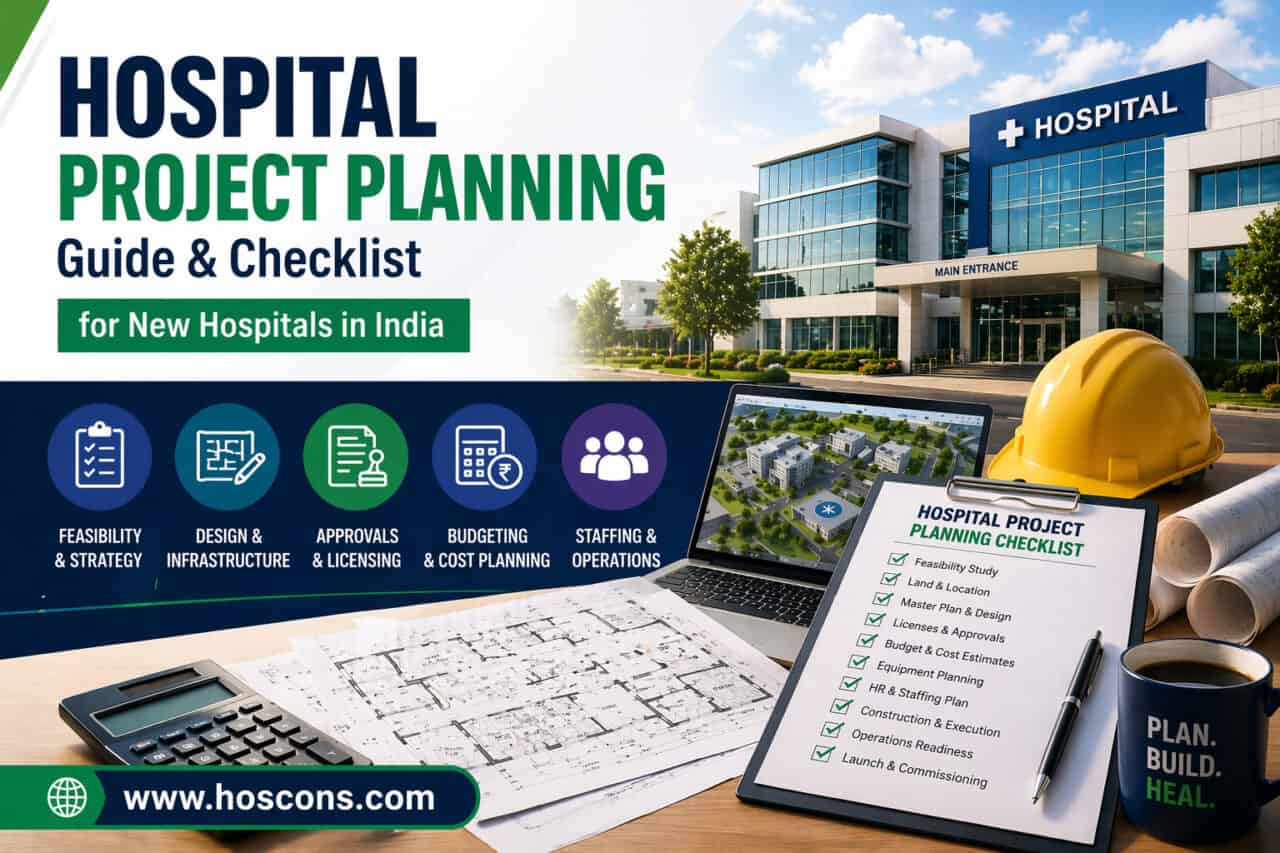
Hospital Project Planning: Step-by-Step Guide & Checklist
Hospital project planning is one of the most critical stages in starting a new hospital or expanding an existing healthcare facility. It requires careful coordination of infrastructure, clinical services, technology, staffing, regulatory compliance, and financial planning to ensure the hospital operates safely and efficiently from day one.
Without structured planning, hospital projects often face delays, cost overruns, and operational inefficiencies. A clear planning roadmap helps hospital promoters manage each stage systematically and reduce project risks.
This guide is useful whether you are planning:
- A new hospital
- A specialty hospital
- A diagnostic center
- A hospital expansion
- A multi-specialty healthcare facility
Why Proper Hospital Project Planning Is Critical
Hospital projects involve multiple stakeholders and complex coordination. Unlike other construction projects, hospitals must meet strict regulatory, clinical, and safety standards.
Poor planning can lead to:
- Construction delays
- Budget overruns
- Operational inefficiencies
- Licensing delays
- Patient safety risks
- Financial losses
Hospital Project Planning Checklist
Use this checklist to track your hospital project planning progress:
- Define hospital vision and scope
- Conduct feasibility study
- Select location and land
- Plan hospital infrastructure and layout
- Plan medical equipment and technology
- Obtain licenses and approvals
- Recruit and train staff
- Establish operational systems
- Commission and launch hospital
Step-by-Step Hospital Project Planning Process
1. Define the Hospital Vision and Scope
The first step is to clearly define what kind of hospital you want to establish and the market it will serve.
- Type of hospital (general, specialty, multi-specialty)
- Number of beds
- Target patient population
- Services to be offered
- Location and catchment area
- Investment capacity
2. Conduct a Feasibility Study
A feasibility study evaluates whether the proposed hospital project is financially and operationally viable before major investments are made.
- Demand for healthcare services
- Expected patient volume
- Revenue potential
- Capital investment requirements
- Break-even timeline
- Risk factors
3. Select the Right Location and Land
Location is one of the most important factors influencing hospital success.
- Accessibility for patients and ambulances
- Population density and demand
- Road connectivity
- Availability of utilities
- Future expansion potential
- Competition in the area
4. Plan Hospital Infrastructure and Layout
Hospital infrastructure planning must prioritize patient safety, workflow efficiency, clinical functionality, and future scalability.
- Department layout planning
- Patient flow design
- Emergency access planning
- Infection control planning
- Utility planning
- Future expansion planning
5. Plan Medical Equipment and Technology
Medical equipment planning should align with the hospital’s specialties, bed strength, and projected patient volumes.
- Diagnostic equipment
- ICU equipment
- Operation theatre equipment
- Laboratory equipment
- Radiology equipment
- Hospital information systems
6. Obtain Licenses and Regulatory Approvals
Hospital licensing and statutory compliance are essential before operations can begin.
- Clinical Establishment Registration
- Fire Safety Clearance
- Pollution Control Board Approval
- Biomedical Waste Management Authorization
- Building Plan Approval
- Pharmacy License
7. Recruit and Train Hospital Staff
Staff readiness is critical for safe and efficient hospital operations from day one.
- Doctors
- Nurses
- Technicians
- Administrative staff
- Support staff
8. Plan Hospital Operations and Financial Systems
Operational systems determine how smoothly the hospital performs after launch.
- Billing and revenue cycle management
- Inventory management
- Quality and patient safety protocols
- Clinical workflows
- Financial management systems
9. Commission and Launch the Hospital
Commissioning is the final stage before opening the hospital to patients.
- Equipment testing
- Staff training
- Process validation
- Safety checks
- Trial runs
Hospital Project Planning for New Hospitals in India – Common Challenges
Hospital projects often face avoidable setbacks because of fragmented execution and incomplete planning.
- Poor coordination between vendors
- Construction delays
- Budget overruns
- Licensing delays
- Equipment installation delays
- Staff shortages
How Long Does Hospital Project Planning Take?
Hospital project planning typically takes between 3 and 6 months depending on project size, location, regulatory approvals, and infrastructure complexity.
- Small hospital (20–50 beds): 3–4 months
- Medium hospital (50–100 beds): 4–5 months
- Large hospital (100+ beds): 5–6 months
Planning a Hospital Project Can Be Complex — Consider the Turnkey Model
Planning a hospital requires coordination between multiple stakeholders, including architects, contractors, equipment vendors, and regulatory authorities. Managing these elements separately can lead to delays, cost overruns, and operational inefficiencies.
Many hospital promoters today prefer a turnkey hospital project model, where a single experienced partner manages the entire project from concept to commissioning.
A turnkey approach offers:
- Single point of accountability
- Faster project execution
- Better coordination
- Reduced project risk
- Smoother hospital launch
Explore Our Turnkey Hospital Project Consultants Page
👉 Contact HOSCONS for a Detailed Market Survey & Feasibility Study
📍 Serving 150+ Hospitals across India
📞 +91 8270004004
🌐 www.hoscons.com
📧 grace@hoscons.com
Related Hospital Consulting Services:
- Hospital Feasibility Studies
- Hospital Consulting Division
- Turnkey Hospital Project Consulting
- Hospital Gap Analysis
- Hospital Revenue Leakage Audit
- About HOSCONS
- NABH Accreditation Support
External Resources:
Frequently Asked Questions
What is hospital project planning?
Hospital project planning is the process of defining infrastructure, services, equipment, staffing, compliance, and operational systems required to establish a hospital successfully.
How long does hospital project planning take?
Hospital project planning typically takes between 3 and 6 months depending on project size, complexity, location, and approval requirements.
What is the most important step in hospital planning?
Conducting a feasibility study is one of the most important steps because it helps determine demand, viability, investment needs, and long-term sustainability.
Can a hospital project be delivered through a turnkey model?
Yes. In a turnkey model, a single partner manages planning, infrastructure coordination, equipment integration, and commissioning to deliver a treatment-ready facility.