
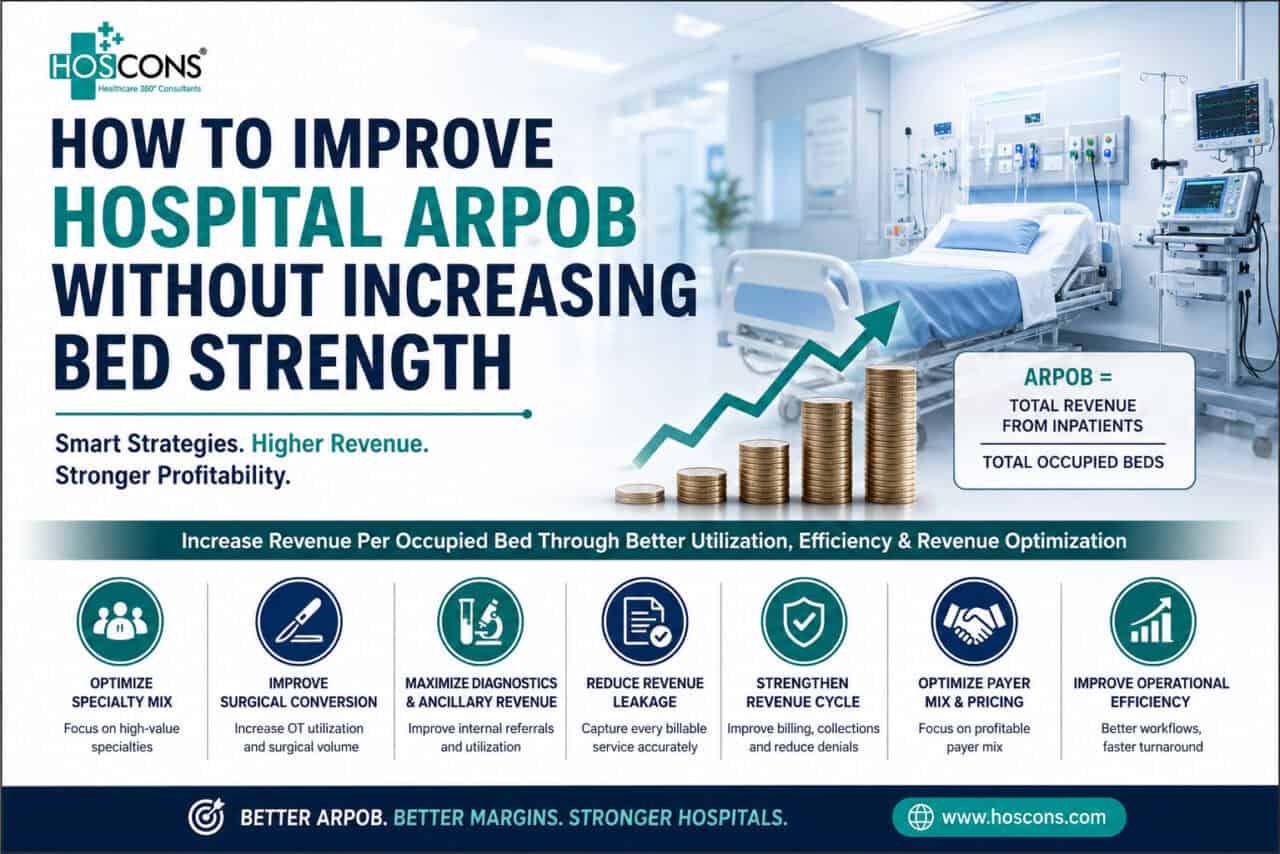
How to Improve Hospital ARPOB Without Increasing Bed Strength
Hospital ARPOB improvement is one of the most effective ways to increase hospital revenue and profitability without investing in additional beds, new buildings, or major infrastructure expansion.
Many hospitals focus heavily on increasing occupancy, but occupancy alone does not guarantee profitability. A hospital may have good patient footfall and high bed occupancy, yet still struggle financially if the revenue generated per occupied bed is low.
Improving ARPOB requires a structured focus on specialty mix, procedure volume, diagnostics utilization, payer mix, billing accuracy, revenue leakage control, and operational efficiency.
What Is ARPOB in Hospitals?
ARPOB stands for Average Revenue Per Occupied Bed. It is an important hospital performance metric that measures how much revenue a hospital generates from each occupied bed during a given period.
ARPOB helps hospital owners and management teams understand whether existing beds are being used efficiently from a revenue and profitability perspective.
A higher ARPOB usually indicates better case mix, stronger clinical utilization, improved service depth, and better revenue capture.
Why ARPOB Matters for Hospital Profitability
Hospital profitability depends not only on how many beds are occupied, but also on what type of patients, procedures, diagnostics, and services are being delivered through those beds.
A hospital with high occupancy but low ARPOB may still face financial stress due to:
- Low-value admissions
- Poor specialty mix
- Underutilized diagnostics
- Low surgical volume
- Revenue leakage
- Delayed billing
- High operating costs
- Weak payer mix
Why Many Hospitals Have Low ARPOB Despite Good Occupancy
Many hospitals assume that high occupancy automatically means strong financial performance. However, this is not always true.
A hospital may have good patient flow but poor revenue performance if the occupied beds are not linked to the right specialties, procedures, diagnostics, and billing discipline.
Common reasons for low ARPOB include:
- Overdependence on low-value medical admissions
- Low surgical conversion from OPD
- Poor utilization of ICU, OT, diagnostics, and imaging
- Weak package design and pricing structure
- Inadequate billing capture
- Delayed discharge billing
- High discounts and uncontrolled concessions
- Poor insurance and corporate billing management
- Low contribution from specialty services
How to Improve Hospital ARPOB Without Adding Beds
Improving ARPOB requires a systematic review of how existing beds, clinical services, diagnostics, procedures, and revenue systems are being utilized.
Below are key strategies hospitals can use to improve ARPOB without increasing bed strength.
1. Optimize Specialty Mix
The specialty mix of a hospital has a direct impact on ARPOB. Hospitals that depend mainly on low-revenue specialties may struggle to improve revenue per occupied bed.
Hospitals should evaluate:
- Which specialties generate higher revenue per admission
- Which departments have better procedure potential
- Which services improve diagnostic and ancillary revenue
- Which specialties improve ICU, OT, and imaging utilization
- Which departments have better profitability and growth potential
A balanced specialty mix helps hospitals improve revenue density without increasing bed count.
2. Improve Surgical Conversion
Surgical services usually contribute significantly to ARPOB because they involve OT usage, anesthesia, implants, consumables, diagnostics, pharmacy, ICU care, and post-operative stay.
Hospitals can improve surgical conversion by:
- Tracking OPD-to-surgery conversion
- Improving consultant engagement
- Reducing OT scheduling gaps
- Strengthening pre-surgical counselling
- Improving package clarity
- Reducing surgical cancellation rates
- Improving insurance pre-authorization processes
3. Increase Diagnostics and Imaging Utilization
Diagnostics, imaging, lab services, endoscopy, cath lab, and other ancillary services play a major role in improving hospital ARPOB.
Many hospitals lose revenue because diagnostics are underutilized or referred outside due to poor coordination, delayed reporting, or lack of internal referral discipline.
Hospitals should monitor:
- Lab revenue per inpatient
- Radiology utilization per admission
- CT, MRI, ultrasound and X-ray utilization
- Internal referral patterns
- Outsourced diagnostic leakage
- Turnaround time for reports
4. Reduce Revenue Leakage
Revenue leakage is one of the most common reasons for low ARPOB. Hospitals may deliver services but fail to capture, bill, or collect revenue correctly.
Revenue leakage may occur in:
- Pharmacy billing
- Consumables billing
- Procedure billing
- Doctor visit charges
- Nursing charges
- Equipment usage charges
- Diagnostic billing
- Package exclusions
- Insurance deductions
5. Strengthen Revenue Cycle Management
A strong revenue cycle management system helps hospitals improve billing accuracy, reduce denials, speed up collections, and improve cash flow.
Hospitals should review:
- Admission documentation
- Pre-authorization process
- Daily billing updates
- Discharge billing turnaround time
- Insurance claim submission
- Denial management
- Outstanding receivables
- Package billing compliance
Improving RCM directly supports better revenue realization and stronger financial performance.
6. Improve ICU and Critical Care Utilization
ICU and critical care units can significantly influence ARPOB when properly planned and utilized. However, poor ICU utilization, inappropriate admissions, or inefficient step-down planning can reduce revenue efficiency.
Hospitals should evaluate:
- ICU occupancy and case mix
- ICU revenue per patient
- Step-down unit utilization
- Critical care package structure
- Ventilator and monitoring utilization
- ICU length of stay patterns
7. Review Pricing and Package Strategy
Hospitals should periodically review pricing, packages, discounts, and payer contracts. Outdated pricing can silently reduce ARPOB even when patient volumes are stable.
Key areas to review include:
- Surgical package pricing
- Room category pricing
- ICU and HDU pricing
- Diagnostic rates
- Procedure charges
- Insurance package rates
- Corporate tariff agreements
- Discount approval systems
8. Improve Payer Mix
The payer mix has a direct impact on hospital ARPOB and cash flow. A hospital heavily dependent on low-paying schemes or poorly negotiated contracts may struggle despite high occupancy.
Hospitals should track revenue contribution from:
- Cash patients
- Insurance patients
- Corporate clients
- Government schemes
- TPA patients
- Institutional tie-ups
A healthier payer mix improves revenue quality, collection efficiency, and profitability.
9. Reduce Average Length of Stay Where Appropriate
ARPOB should not be improved by unnecessarily extending patient stay. Instead, hospitals should improve clinical efficiency and discharge planning.
Reducing avoidable delays can help improve bed turnover and revenue productivity.
Hospitals should review delays caused by:
- Late consultant rounds
- Delayed investigations
- Insurance approval delays
- Pharmacy delays
- Discharge summary delays
- Billing clearance delays
10. Use Data-Driven Department Reviews
Hospitals should conduct monthly department-wise performance reviews to understand which services are growing, declining, or underperforming.
Important metrics include:
- ARPOB by department
- Revenue per doctor
- Procedure volume
- Diagnostic utilization
- OT utilization
- ICU utilization
- Revenue leakage indicators
- Denials and deductions
- Patient conversion rates
ARPOB vs Occupancy: Why Hospitals Must Track Both
Occupancy shows how many beds are being used. ARPOB shows how efficiently those beds are generating revenue.
A hospital with high occupancy but low ARPOB may still struggle financially, while a hospital with moderate occupancy and strong ARPOB may perform better if it has the right specialty mix and revenue systems.
Hospitals should avoid focusing only on occupancy. Instead, management teams should evaluate:
- Occupancy percentage
- ARPOB
- ALOS
- EBITDA margin
- Specialty-wise revenue
- Payer mix
- Cost per occupied bed
- Revenue leakage
Common Mistakes Hospitals Make While Trying to Improve ARPOB
Many hospitals attempt to increase ARPOB without understanding the root causes of low revenue density.
Common mistakes include:
- Increasing prices without improving service value
- Ignoring revenue leakage
- Not reviewing specialty-wise performance
- Poor consultant engagement
- Weak insurance billing control
- No department-wise revenue dashboard
- Not tracking diagnostics and procedure utilization
- Allowing uncontrolled discounts
How HOSCONS Helps Hospitals Improve ARPOB
HOSCONS supports hospitals with structured revenue optimization and operational performance improvement strategies designed to improve ARPOB, profitability, and long-term sustainability.
Our approach may include:
- ARPOB and revenue performance analysis
- Specialty-wise revenue review
- Department-wise profitability assessment
- Revenue leakage audit
- Billing and RCM process review
- Diagnostics and procedure utilization analysis
- Insurance and payer mix review
- Operational workflow improvement
- EBITDA improvement planning
Improve Hospital Revenue Without Expanding Bed Strength
HOSCONS helps hospitals identify revenue gaps, improve ARPOB, reduce leakage, optimize specialty mix, and strengthen operational performance.
👉 Contact HOSCONS for Hospital ARPOB Improvement Consulting
📍 Serving Hospitals across India and International Markets
📞 +91 8270004004
🌐 www.hoscons.com
📧 grace@hoscons.com
Related Hospital Consulting Services:
- Hospital Revenue Leakage Audit
- Hospital Revenue Cycle Management
- Hospital Operations Management
- Hospital Gap Analysis
- Hospital Turnaround Consulting
- Hospital Consulting Division
Frequently Asked Questions
What is ARPOB in hospitals?
ARPOB stands for Average Revenue Per Occupied Bed. It measures how much revenue a hospital generates from each occupied bed during a specific period.
How can hospitals improve ARPOB without increasing beds?
Hospitals can improve ARPOB by optimizing specialty mix, increasing surgical conversion, improving diagnostics utilization, reducing revenue leakage, strengthening billing systems, and improving payer mix.
Is ARPOB improvement the same as increasing patient charges?
No. Sustainable ARPOB improvement is not about random price increases. It is about improving service utilization, reducing leakage, strengthening revenue systems, and increasing value per occupied bed.
Why can a hospital have high occupancy but low profitability?
A hospital may have high occupancy but low profitability if it has low-value admissions, poor specialty mix, weak billing capture, high discounts, low diagnostic utilization, or high operating costs.
How does revenue leakage affect ARPOB?
Revenue leakage reduces ARPOB because services delivered by the hospital are not fully billed, captured, or collected. Leakage may occur in pharmacy, consumables, procedures, diagnostics, insurance claims, and packages.
How can HOSCONS help improve hospital ARPOB?
HOSCONS helps hospitals analyze ARPOB, identify revenue gaps, reduce leakage, optimize specialty mix, improve revenue cycle management, strengthen operational workflows, and improve hospital profitability.